Battle of Petsamo
Captain Antti Pennanen commanded fewer than 900 men. Across the frozen border, the Soviet 14th Army had assembled 52,500. The arithmetic was absurd: roughly sixty Soviet soldiers for every Finn. Yet when fighting erupted in the Petsamo region of far northern Finland in late November 1939, the opening weeks of the Winter War, it was Pennanen's outnumbered detachment that dictated the terms. The Battle of Petsamo became one of the most lopsided defensive stands of the entire conflict, a case study in how terrain, weather, and determined leadership can multiply a small force's effectiveness beyond anything the numbers would suggest.
A Detachment Named for Its Captain
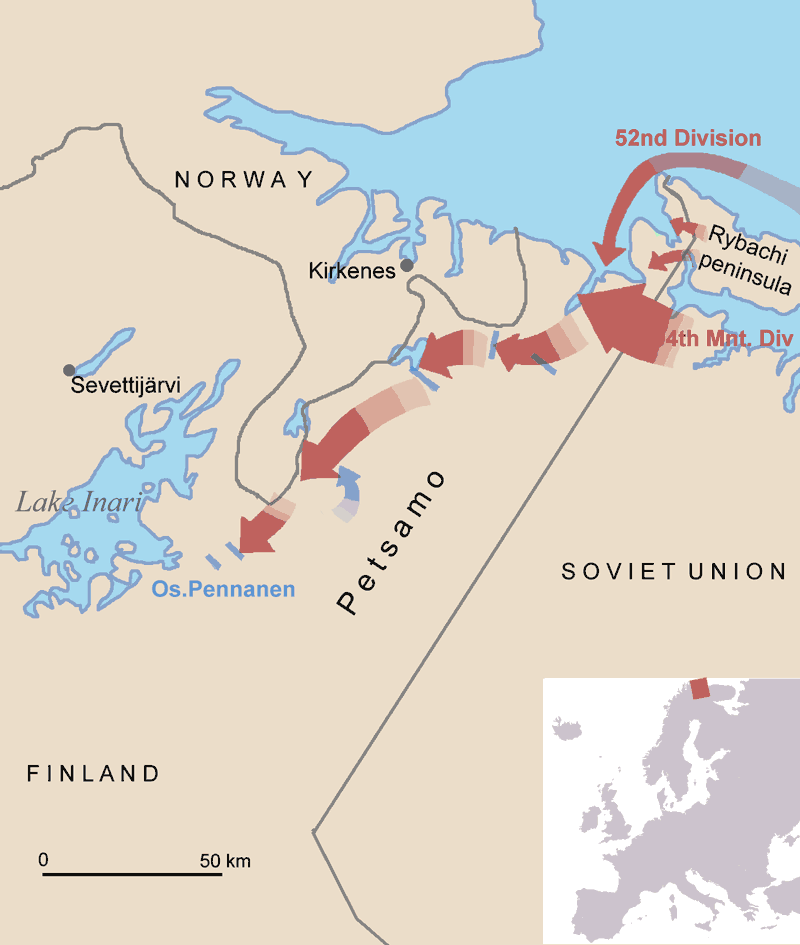
The Finnish forces defending Petsamo were an improvised formation typical of the Winter War's desperate early days. The core was the 10th Separate Company stationed at Parkkina and the 5th Separate Battery at Liinahamari, the latter equipped with four 76-millimeter field cannons dating from 1887, weapons already half a century old. These units belonged to no specific division; they were separate companies and batteries that could be placed wherever the crisis demanded. Reinforcements trickled in: the 11th Separate Company, a hastily organized 3rd Company that had not even been part of the original mobilization plans, and the small Reconnaissance Detachment 11. Together they formed Detachment Pennanen, named after their commander in the Finnish tradition of ad hoc battle groups. They were part of the Lapland Group, headquartered far to the south in Rovaniemi, operating at the end of a supply chain stretched across hundreds of kilometers of Arctic wilderness.
An Army Against a Company
The Soviet 14th Army, based on the Kola Peninsula, brought overwhelming force. Three full divisions -- the 104th, the 52nd, and the 14th -- gave it an operational strength of approximately 52,500 men. The Soviets moved quickly to seize the port at Liinahamari, securing it from any potential third-party intervention, and occupied the Finnish portion of the Rybachi Peninsula. The 242nd Infantry Regiment of the 104th Division reached Parkkina by December 1, pushing the Finnish defenders southward along the Arctic Highway. The nickel mines at Salmijarvi fell next. The Soviets seemed to be rolling through Petsamo province with the momentum of a force that had every material advantage.
The Stand at Nautsi
Then the advance stalled. Near Nautsi, in hilly terrain that broke up the broad Soviet formations and channeled them into killzones, the Finnish detachment -- by now reinforced to roughly battalion strength -- turned and fought. On December 21, Pennanen's soldiers drove the numerically superior Soviet force back several miles to Hoyhenjarvi. The terrain was the great equalizer: roadless, snow-choked hills where the Soviets' advantages in armor and artillery counted for little. The Arctic darkness, with the sun barely cresting the horizon, further disrupted Soviet coordination. Finnish soldiers, many of them local men who knew the land intimately, moved through conditions that paralyzed their opponents. The hilly country around Nautsi became the high-water mark of the Soviet advance, a line the Finns held through a combination of stubborn defense and counterattacks that exploited every fold in the ground.
The Price of Petsamo
Detachment Pennanen's stand at Nautsi contained the Soviet threat in the far north for the duration of the Winter War, but the larger story of Petsamo was one of incremental loss. Finland held the line tactically, yet the broader war ground on, and the Moscow Peace Treaty of March 1940 ended the Winter War on Soviet terms. Petsamo province remained Finnish after that first war, but its fate was already sealed. When Finland and the Soviet Union fought again in the Continuation War of 1941 to 1944, the stakes in the Arctic rose. The Soviet Union ultimately annexed the entire province of Petsamo, absorbing it into the Russian SFSR. The nickel mines that had drawn German interest, the port at Liinahamari, the hills where Pennanen's men had held -- all passed permanently out of Finnish hands. Today the area is the Pechengsky District of Russia's Murmansk Oblast, and the battlefield where 900 Finns defied 52,000 lies on the other side of a national border that the defenders never imagined would move.
From the Air
Located at 69.25°N, 30.57°E in what is now the Pechengsky District of Murmansk Oblast, Russia, near the Norwegian and Finnish borders. The former port of Liinahamari is visible on the Barents Sea coast to the north. The terrain is hilly tundra with scattered lakes. Kirkenes Airport Hoybuktmoen (ENKR) in Norway is approximately 60 km to the northwest. Murmansk Airport (ULMM) is approximately 180 km to the southeast. Best viewed at 5,000-8,000 ft AGL. The Arctic Highway corridor runs through the area.