Battle of Picacho Pass
Lieutenant James Barrett was under strict orders not to engage. Wait for the main column, his commanders had instructed. But on that April afternoon in 1862, with Confederate pickets within reach and glory beckoning, the young cavalry officer from California led his dozen men single file into a mesquite thicket near Picacho Peak. Minutes later, a bullet struck his neck as he sat remounting his horse, and the westernmost fatal battle of the American Civil War claimed its first victim. His disobedience would cost three Union lives and extinguish any hope of a surprise attack on Tucson.
The Confederacy's Pacific Dream
The war that tore apart the nation reached even into the Sonoran Desert. When 120 Confederate cavalrymen rode into Tucson from Texas on February 28, 1862, they proclaimed it the capital of the western district of Confederate Arizona Territory. Their ambitions stretched all the way to the Pacific Ocean, where they hoped a flood of sympathizers in southern California would rally to their cause. It never happened. Instead, 2,000 Union volunteers from California formed the California Column under Colonel James Henry Carleton, marching east through the punishing desert heat toward Fort Yuma and then into Arizona. The Confederate dream of a Pacific outlet was about to collide with reality near a distinctive desert peak.
Ninety Minutes in the Mesquite
The skirmish unfolded near Picacho Pass Station, a stop along the now-abandoned Butterfield Overland Stagecoach route. Thirteen men, including scout John W. Jones, swept the area looking for the small Confederate force commanded by Sergeant Henry Holmes. Barrett spotted them and made his fatal decision. Rather than dismount and approach tactically, he led his cavalry in a single file column into dense brush. The first Confederate volley emptied four saddles. In the chaos that followed, three rebels surrendered while the rest retreated deeper into the thicket. Barrett secured a prisoner, climbed back onto his horse, and died moments later. For ninety brutal minutes, confused fighting raged among the mesquite and arroyos before the exhausted, leaderless Californians withdrew.
The Retreat and Aftermath
The surviving Arizona Rangers mounted up and raced toward Tucson carrying warning of the advancing Union army. The Union troops fell back to the Pima Indian Villages, where they hastily constructed Fort Barrett, named for their fallen commander. But Confederate Captain Sherod Hunter knew reinforcements would never arrive. When the California Column advanced again, he and his men quietly withdrew, and Tucson fell without another shot fired. The bodies of enlisted men George Johnson and William S. Leonard eventually reached the National Cemetery at San Francisco's Presidio. Barrett's grave, reportedly near the railroad tracks, was lost to time and remains unmarked to this day.
The High-Water Mark of the Confederate West
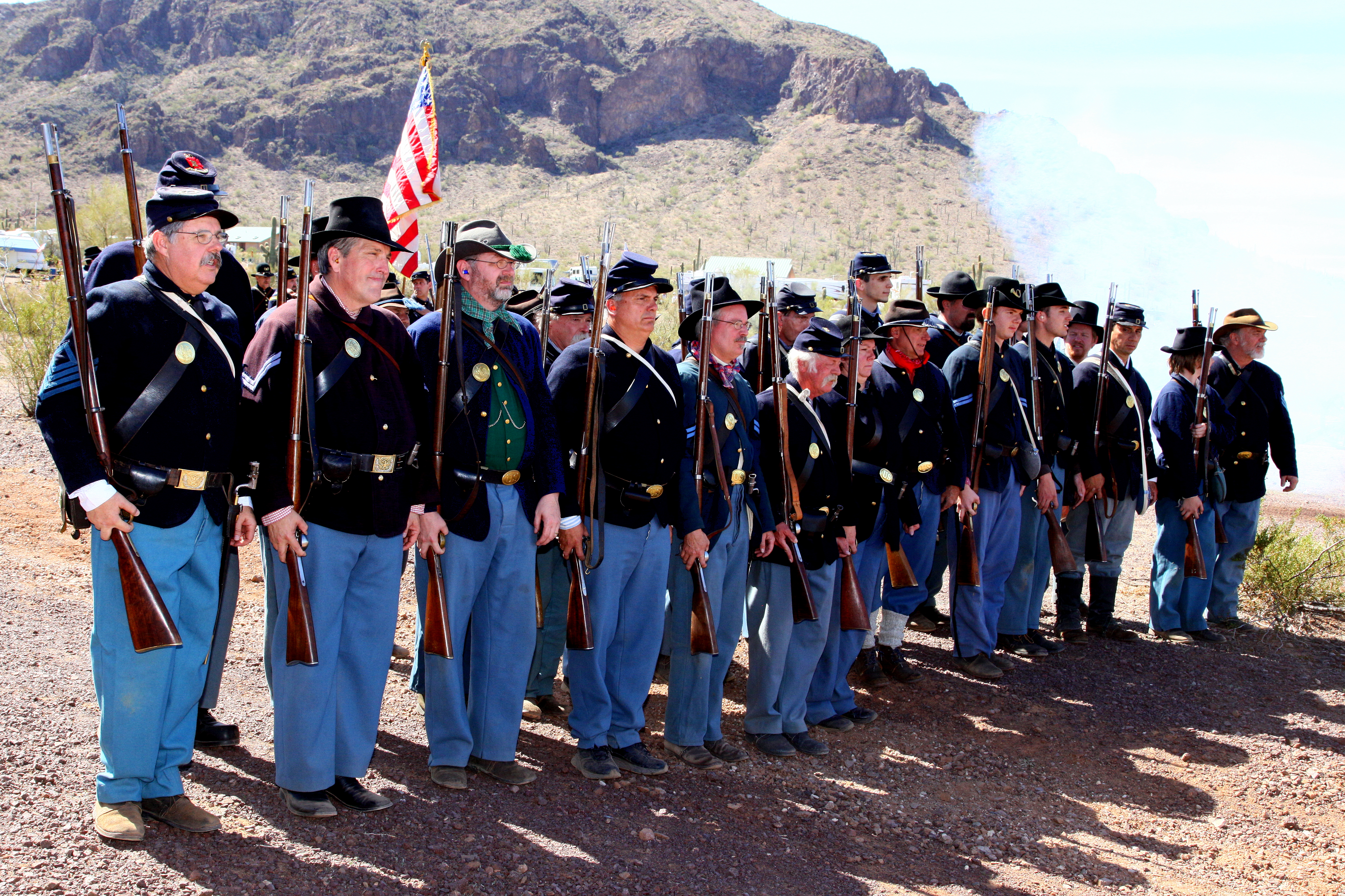
While just a minor engagement in the vast scope of the Civil War, Picacho Pass represents something larger: the furthest effective reach of Confederate power in the West. Around the same time, a larger Confederate force attempting to advance north from Santa Fe was stopped at the Battle of Glorieta Pass in New Mexico. By July 1862, all Confederate forces had retreated to Texas. The following year, the Union organized its own Arizona Territory, and the provisional capital at Prescott extended Federal control southward. Today, Picacho Peak State Park hosts annual Civil War reenactments each March, where the number of participants now far exceeds the handful of men who actually fought in that desperate thicket.
From the Air
Located at 32.63N, 111.42W, approximately 40 miles northwest of Tucson. Picacho Peak rises distinctively from the desert floor and is visible from considerable distance. The battlefield site and remains of Butterfield Station are listed on the National Register of Historic Places. Nearest airports include Tucson International (KTUS) approximately 45 miles southeast, and Phoenix Sky Harbor (KPHX) approximately 65 miles northwest. Best viewed at 3,000-5,000 feet AGL for perspective on the terrain where cavalry maneuvered through mesquite and arroyos.