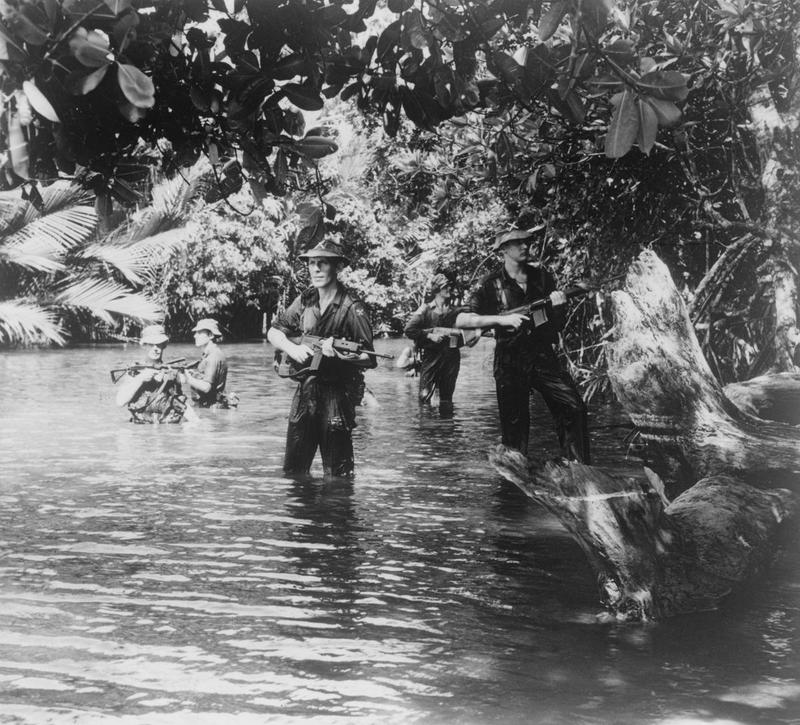
Battle of Plaman Mapu
Thirty-six men held a hilltop against four hundred. When the firing stopped on the morning of 27 April 1965, the tiny British garrison at Plaman Mapu had repulsed three Indonesian assaults in two hours, and Sergeant-Major John Williams had earned a Distinguished Conduct Medal despite a head wound that blinded him in one eye, a fact he did not discover until after the battle. The engagement at this obscure village near the Sarawak-Kalimantan border was one of the largest of the Indonesia-Malaysia Confrontation, and it proved to be the last major Indonesian offensive of the conflict.
An Undeclared War in the Jungle
The Confrontation grew from a collision of decolonization and Cold War ambition. When Britain proposed merging Malaya, Singapore, Sarawak, North Borneo, and Brunei into a new Malaysian Federation in the early 1960s, Indonesian President Sukarno saw a threat to his vision of regional dominance. Sukarno, increasingly aligned with Communist China and the Soviet Union, launched a campaign of cross-border raids and subversion intended to strangle the new nation at birth. The first blood came with the Indonesian-staged Brunei Revolt in December 1962, swiftly crushed by British forces flown in from Singapore. From April 1963, Indonesian regular forces began making incursions into Sarawak, and when the Malaysian Federation was formally created on 16 September 1963, a Jakarta mob stormed the British embassy in response. Sukarno authorized stronger raids, expanding the fighting along hundreds of miles of Borneo jungle frontier.
Operation Claret and the Border Bases
The British faced an uncomfortable strategic paradox. A purely defensive posture had been proven ruinous during the twelve-year Malayan Emergency, but a full offensive into Indonesian territory risked escalation into open war. The solution, championed by Major General Walter Walker, was Operation Claret: elite light infantry would patrol deep into Indonesian Kalimantan, attacking camps and ambushing patrols while maintaining the fiction that British forces never crossed the border. One-third of each unit stayed behind to defend a chain of small bases along the frontier. Plaman Mapu was one of these outposts, a tiny village less than two kilometers from the border where B Company of the 2nd Battalion, the Parachute Regiment, maintained a position equipped with two 3-inch mortars, a trench network, and a command bunker. By the spring of 1965, Sukarno was desperate for a decisive victory, and he ordered stronger attacks against the British border positions.
Before Dawn on the Hilltop
Warning signs were everywhere. Patrols had found evidence of Indonesian troop movements in the days before the attack, but the intelligence was misread; newly cleared positions were mistaken for ambush sites rather than assembly areas. The base continued to send most of its men out on patrol, leaving only 36 defenders in the early hours of 27 April. They were a mix of experienced paratroopers and a recently arrived platoon of replacements with little jungle warfare training. Lieutenant Colonel Ted Eberhardie, the base commander, had managed to send a few of the new men, including Sergeant-Major Williams, to a training course in Singapore. It was a fortunate decision. Between 150 and 400 Indonesian troops, supported by artillery and rockets, struck the base in the darkness. They swarmed into one section of the trench network and destroyed one of the two mortars in the opening moments.
Williams Holds the Line
Artillery fire hammered the camp, wounding defenders and scattering the garrison into confusion. Williams sprinted to the command bunker and ordered the artillery officer to call fire onto the overrun positions, then organized a counterattack himself. Gathering a section of men from a slit trench, he led them toward the captured outer perimeter. A shell landed among the group and wounded half of them. Williams and the survivors closed with at least thirty Indonesian soldiers in hand-to-hand fighting and drove them from the trench. Seeing a second wave massing for another assault on the command bunker, Williams dropped into a vacated machine gun nest and opened fire. He was hit in the head, the wound costing him the sight in one eye, though the adrenaline of combat kept him from realizing it. Supporting rifle fire from nearby trenches, the single surviving mortar, and 105mm howitzers from an adjacent camp poured into the attackers. Twenty minutes after the second assault, the Indonesians launched a third charge up the slope. British artillery and grenades broke it. When the rocket fire finally stopped, the remaining defenders rose from their positions and cleared the perimeter. Gurkha reinforcements and medical teams arrived by helicopter shortly after, but the Indonesians had already withdrawn.
The Beginning of the End
The butcher's bill was remarkably low for so intense a fight: two British dead, eight wounded. Indonesian casualties were at least 30, though the true number remains unknown. The battle was a propaganda disaster for Sukarno. His forces had outnumbered the defenders by at least five to one, attacked with artillery support, and still been repulsed. Major General George Lea responded by intensifying Claret operations to establish a no-man's land inside the Kalimantan frontier. By September, discontent within Indonesia's military leadership boiled over into the 30 September Movement, an attempted coup that the army blamed on the Communist Party. The resulting anti-communist purge claimed hundreds of thousands of lives and stripped Sukarno of his political base. Secret peace talks between Malaysia and Indonesia began in late 1965, and a treaty ending the Confrontation was signed in August 1966. Sukarno was forced from power in March 1967. The jungle around Plaman Mapu has long since reclaimed the trenches where Williams held the line, but the battle marked the moment Indonesia's will to fight finally broke.
From the Air
The battle site is at approximately 0.92N, 110.49E on the Sarawak-Kalimantan border in western Borneo. The terrain is dense tropical jungle with hilly ridgelines. Nearest airport is Kuching International Airport (WBGG), roughly 60 nautical miles to the west-southwest. The border area is largely unmarked jungle canopy from the air. Best viewed at 3,000-5,000 feet altitude. Typical tropical weather with morning haze and afternoon thunderstorms; dry season (May-September) offers better visibility.