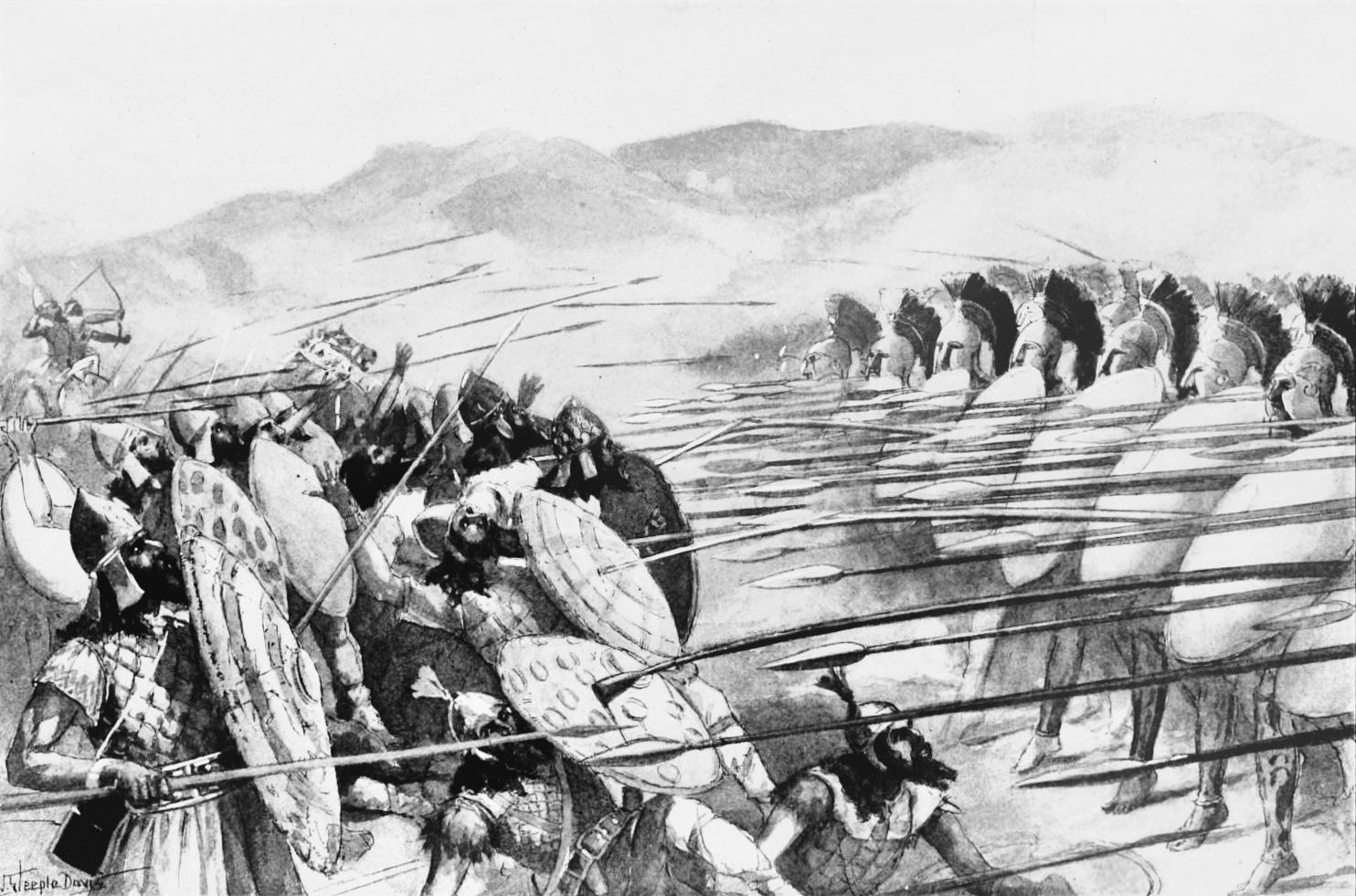
Battle of Plataea
Aeimnestus picked up a stone. He was a Spartan hoplite in the line that day at Plataea, and he had spent perhaps an hour locked in the close press where Greek shields met Persian wicker and Persian arrows had been falling for longer. Mardonius, the Persian commander, had ridden out to inspire his troops on a white horse with a unit of a thousand chosen men. According to Plutarch, Aeimnestus threw, the stone struck Mardonius in the head, and he fell. The general's bodyguard fought on for a while around the body. Then they broke. The largest Persian invasion of Greece, the one that had burned Athens twice and brought a million-man army across the Hellespont on bridges of boats, came apart on a Boeotian plain because of one thrown rock.
What Was Left After Salamis
Xerxes had gone home. After the disaster of his fleet at Salamis the previous autumn, the Great King had retreated to Asia with the bulk of his forces, leaving his general Mardonius behind with a chosen army to finish the conquest. Mardonius spent the winter in Thessaly. In the spring he marched south, burned Athens for a second time - the citizens had once again evacuated to Salamis - and then withdrew into Boeotia, where the open country favored his cavalry. There he built a fortified camp on the north bank of the Asopos river, near Plataea. Sparta, after some politically embarrassing delay, had finally sent its full strength north. Five thousand Spartiates - the entire mobilized citizen body - were marching with Pausanias, the regent for the boy-king Pleistarchus. Athenians, Corinthians, Megarians, Tegeans, and contingents from dozens of other Greek cities joined them. By the time the army was assembled at Plataea, it numbered something like 40,000 hoplites - the largest Greek force ever fielded.
Eleven Days of Waiting
Neither side wanted to attack first. The Greeks held high ground on the slopes of Mount Cithaeron, where Persian cavalry could not get at them; the Persians held the river plain, where their horse archers had every advantage. For eleven days the armies sat and stared at each other. Mardonius's cavalry harassed the Greek lines, attacking supply convoys, and finally - after a Theban traitor named Timagenes pointed out a vulnerable spot - blocked the Gargaphian spring that was the Greek camp's only water supply. The Greek position became untenable. Pausanias decided to retreat at night to a defensible position called the 'island,' between two streams, closer to Plataea. The retreat went badly. The center wing went too far and ended up at a temple. The Spartan rearguard, under a stubborn officer named Amompharetus who refused to leave on the grounds that retreat was cowardly, was still in place at dawn. By the time Pausanias and his Spartans could resume their movement, Mardonius - thinking the entire Greek army was running - had launched his attack.
The Press of Shields
The Persian infantry advanced behind a wall of wicker shields, with archers firing over the top. The Spartans and Tegeans on the Greek right took it for some time before Pausanias gave the order to charge. The Tegeans went first; the Spartans followed. The fighting that followed was the kind of brutal close work that hoplite warfare demanded - spears against shield walls, then short swords when the spears broke, then men trying to push each other backwards with their bodies. The Persians, brave and well-led, were not equipped for it. Their lighter armor and shorter weapons could not match the Greek panoply at arm's length. Herodotus, who is honest about courage on both sides, says the Persians grabbed at the Greek spears with their hands trying to break them off. They could not. Then Aeimnestus threw his stone, Mardonius died, and the morale of the Persian army collapsed. The bodyguard fought on around the body for a time, then broke.
The Camp and the Aftermath
The Persians retreated to their fortified camp. Most never made it. Those who did were trapped against the walls when the Tegeans, then the Athenians, then the Spartans broke through. Herodotus says only three thousand survived the slaughter at the camp. Andreas Konecny argues those three thousand were probably prisoners. The killing in the camp was awful and modern readers should not look away from it: men trapped against ramparts, unable to retreat, dying because they had been ordered into a war they had not chosen. Forty thousand or more men died that day, on both sides. The Greek dead were buried in tumuli at Plataea: separate graves for the Spartiates, the perioikoi, the helots, the Athenians, the Tegeans, and others, with annual sacrifices kept up for centuries. The same day, according to legend, the Greek fleet won at Mycale across the Aegean and ended the war at sea. Within a few years, Persia would never again seriously try to conquer Greek-speaking lands in Europe.
What Plataea Made Possible
Plutarch tells a story about Pausanias after the battle, walking through Mardonius's tent and being amazed by the luxury - the gold, the couches, the Persian cooks - and ordering the Spartan and Persian cooks to prepare meals side by side, then summoning the other Greek commanders to laugh at the absurdity of an empire that lived like this trying to conquer people who lived in austerity. The story is partly a Greek joke about themselves, partly an introduction to Pausanias's own later corruption: a decade later he would be accused of plotting with Persia and starved to death in a Spartan temple. Plataea was the high point. The spoils funded the Athenian Treasury at Delphi and the Serpent Column - which still stands, in Istanbul of all places, where a later emperor had it moved. The plain itself is now farmland in modern Boeotia, with the small town of Plataies nearby. The Stoa of Zeus Eleutherios in the Athenian agora, dedicated to Zeus the Liberator in honor of the victory, was where Socrates would later walk and talk. The freedom that allowed him to do so had been bought, eighty years earlier, on this plain.
From the Air
Battlefield at 38.22N, 23.27E, on the plain just north of modern Plataies (Plataea), at the foot of Mount Cithaeron in southern Boeotia, about 65 km northwest of Athens. Athens International Airport (LGAV) lies southeast; Tanagra (LGTG) is the closest military field. From cruise, the plain is bounded on the south by the Cithaeron range (the Greek camp's high ground) and on the north by the Asopos river (the Persian camp's location). Best viewing 6,000-12,000 ft on a clear day; the Bay of Corinth is visible to the south, the channel toward Thebes to the north.