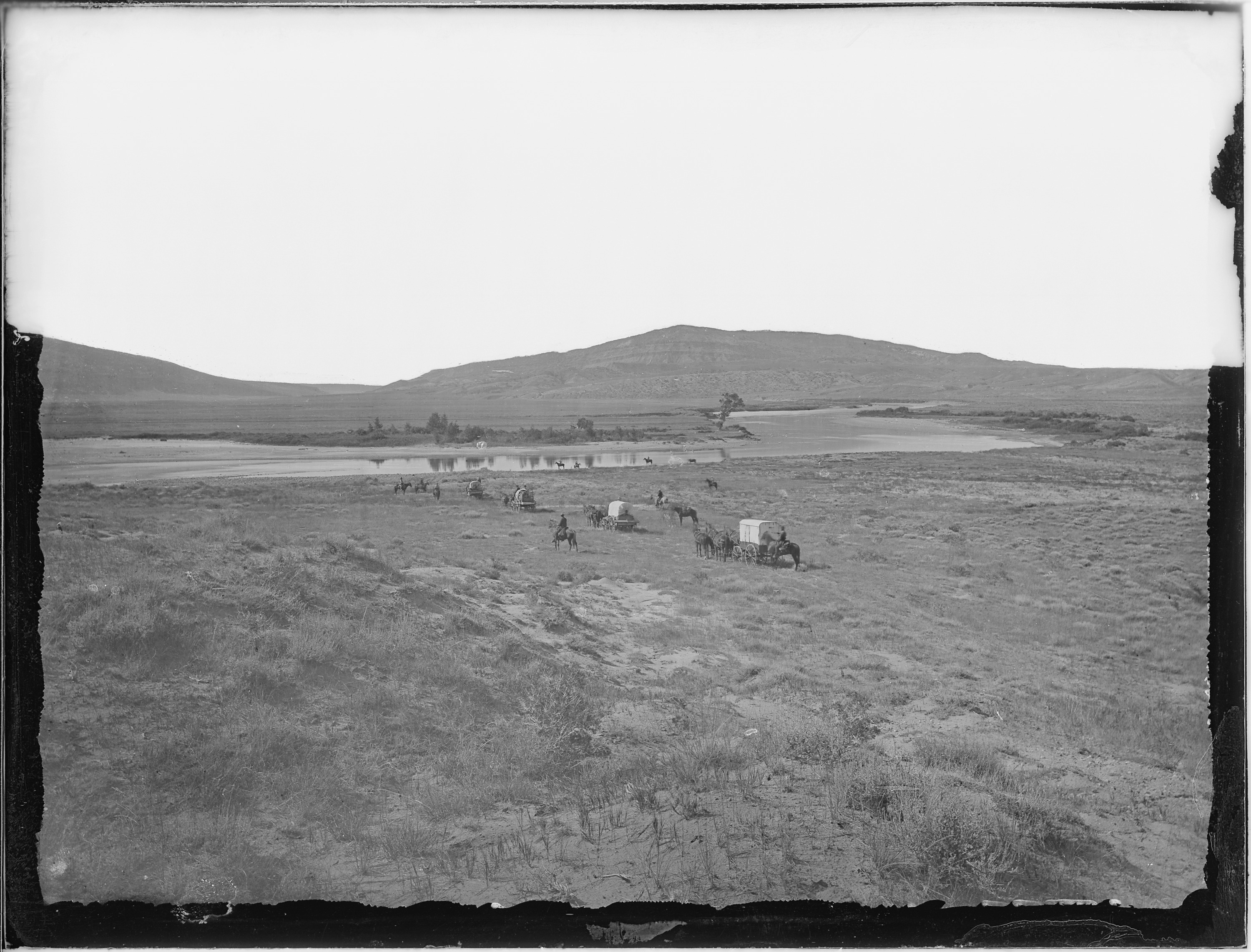
Battle of Platte Bridge
Crazy Horse was among the decoys. On July 25, 1865, the young Oglala warrior and nine others rode toward the Platte Bridge stockade, trying to lure soldiers across the North Platte River into an ambush where 3,000 warriors waited in the hills. But excited young fighters crested the ridgeline too soon, spoiling the trap. Disgusted, Crazy Horse and a Cheyenne named High Back Wolf galloped straight through two groups of soldiers anyway, doing little damage but sending them scrambling for cover. High Back Wolf was killed. The next morning, the trap would finally spring, and a 20-year-old lieutenant named Casper Collins would ride to his death trying to save a wounded soldier. The city that grew here would carry his name, with a spelling error that stuck.
The Largest Army
George Bent, the mixed-blood Cheyenne warrior who recorded so much frontier history, estimated the force gathered at Platte Bridge at 3,000 men. It was, he wrote, the largest Indigenous army he had ever seen. Historian Stephen E. Ambrose called it the closest the Lakota and Cheyenne ever came to a 'concerted, unified offensive movement.' The war leaders read like a roster of Great Plains legends: Red Cloud, Old Man Afraid Of His Horses and his son Young Man Afraid Of His Horses, Roman Nose, Dull Knife, and Crazy Horse. The march south from Crazy Woman Creek on the Powder River was 'perfectly organized,' with warrior societies like the Crazy Dogs and Dog Soldiers keeping undisciplined young men in check. Yet for all its size, this army carried the fatal weakness of all Indigenous forces: individual warriors followed only whom they wished and fought only when they wished.
Colonel Moonlight's Disasters
The U.S. Army defending the region was in disarray. Colonel Thomas Moonlight at Fort Laramie had spent May hunting Lakota 'in the opposite direction from where their trail led,' according to his own soldiers. On May 26, he hanged two Oglala leaders, Two Face and Black Foot, who had actually ransomed a kidnapped white woman from the Cheyenne and brought her to the fort as a peace gesture. Their bodies hung from the gallows for months. Moonlight then tried to forcibly relocate 1,500 peaceful Lakota to Fort Kearny. Crazy Horse slipped into the camp at night and convinced them to flee. The young officer escorting them, Captain William Fouts, was killed trying to stop them. Moonlight pursued with 234 cavalry, rode his horses into exhaustion, and on June 17 the Lakota stole most of his remaining mounts. He walked sixty miles back to Fort Laramie. By July 7, Moonlight was out of the army.
The Bridge
The Platte Bridge was a vital crossing on the North Platte River for emigrants traveling the Oregon and Bozeman Trails. Built in 1859, it stretched nearly 1,000 feet long and 17 feet wide. On the south bank sat the military stockade with 100 soldiers, a few Shoshone scouts, and an Overland Telegraph office. The soldiers were low on ammunition. On the morning of July 26, Lieutenant Casper Collins led 25 men of the 11th Kansas across the bridge to investigate warriors taunting the garrison. Behind him, 30 infantry crossed on foot as support. Then 400 Cheyenne emerged from arroyos between Collins and the bridge. Possibly a thousand more Lakota, Cheyenne, and Arapaho had concealed themselves in the surrounding hills. Collins charged the first group, found himself hopelessly outnumbered, and ordered a retreat. Twenty-one of his men fought through, all wounded. Collins was not among them.
Sergeant Custard's Choice
Five miles west, Sergeant Amos Custard led a supply train of five wagons toward the station. An Ohio cavalry patrol warned him that warriors were everywhere and offered shelter behind their wagon breastworks. Custard refused, saying 'We have been South, where fighting is done, and we know how to do it.' Civil War veterans dismissing frontier warfare as inferior would learn otherwise. Custard heard the station's cannon and sent four men to investigate; they were chased by a hundred Cheyenne led by Left Hand, brother of Roman Nose. Left Hand was killed in the pursuit. Custard's wagons were forced into a hollow where his men held out for four hours with Spencer rifles until warriors closed on foot and overwhelmed them. All 21 remaining soldiers died. The day's total: 29 American soldiers killed, at least eight warriors dead.
Disbanding
The day after the battle, the great army dissolved. Most warriors returned to the Powder River country for the summer buffalo hunt. Indigenous forces lacked the logistics to sustain a prolonged campaign, and this was their fundamental limitation: they could raise armies but not keep them. The achievements of 3,000 warriors against 120 soldiers were, as one historian noted, 'rather meager.' The planned simultaneous attack on Fort Rice in North Dakota never materialized. The Army renamed Platte Bridge Station as Fort Caspar to honor Collins, deliberately misspelling his first name to distinguish it from Fort Collins, Colorado, named for his father. The warriors who fought at Platte Bridge were home and rested when General Patrick Connor's Powder River Expedition arrived in August with 2,000 soldiers. They successfully fended him off. The larger war was only beginning.
From the Air
Located at 42.84°N, 106.37°W near present-day Casper, Wyoming, at the crossing of the North Platte River. The terrain features river bluffs and surrounding high plains. Fort Caspar has been reconstructed as a museum. Best viewed at 2,000-3,000 feet AGL to see the river crossing and surrounding terrain where warriors concealed themselves. Nearest airport: Casper-Natrona County International (KCPR) approximately 3 miles northwest. The Red Buttes, site of Sergeant Custard's last stand, are visible to the west.