Battle of Poison Spring
Colonel James M. Williams had a simple mission: collect 5,000 bushels of corn and bring it back to Camden. His men were starving. Union forces under Major General Frederick Steele had occupied the small Arkansas town as part of the Camden Expedition, but by mid-April 1864, rations had been cut to one-quarter of normal. Soldiers boiled bark and roasted weeds. When word reached Steele that corn lay stored on farms along the road to Washington, he sent Williams out with 198 wagons and a mixed force of infantry, cavalry, and artillery. The 1st Kansas Colored Infantry Regiment -- African American soldiers, most of them formerly enslaved in Arkansas and Missouri -- formed the backbone of the escort. Confederate Lieutenant General E. Kirby Smith had already issued an order regarding such men: give 'no quarter to armed negroes and their officers.' What happened on the morning of April 18 near a place called Poison Spring would become, in the words of historian Gregory J. W. Urwin, 'the worst war crime ever committed on Arkansas soil.'
Hunger and Desperation on the Camden Road
By April 1864, the Confederacy was losing the war, but in southwestern Arkansas, the situation was peculiarly reversed. Steele's Union force held Camden, yet they were the ones slowly starving. Guerrillas had poisoned wells with dead animals. Banks's Red River campaign had collapsed after defeats at Mansfield and Pleasant Hill, leaving Steele isolated and without support. Confederate cavalry under Sterling Price circled Camden like wolves, picking off patrols and foraging parties. Williams set out on April 17 with 438 soldiers from the 1st Kansas Colored, 195 cavalrymen from three Kansas regiments, and two James rifles from the 2nd Indiana Light Artillery. When his column reached White Oak Creek, they found the Confederates had already destroyed half the corn. What remained was scattered across small farms, forcing the soldiers to fan out across the countryside. By the time they loaded 141 wagons and turned back toward Camden on the morning of April 18, Confederate scouts had been watching them for a full day.
The Trap at the Spring
Confederate Brigadier General John S. Marmaduke had set his trap carefully. His men formed a roadblock along the route back to Camden, while Major General Samuel B. Maxey's division -- Texans under Colonel Charles DeMorse and Choctaw soldiers under Colonel Tandy Walker -- prepared to strike from the south. Williams's column, reinforced that morning by 386 men from the 18th Iowa Infantry, numbered roughly 1,169 soldiers, but many were straggling from exhaustion. The Confederates fielded 3,621 men and twelve cannons. Williams spotted the roadblock and formed his wagons into a compact line north of the road, deploying the 1st Kansas Colored to face both east and south. For half an hour, Confederate artillery pounded the Union position. Then Maxey's men charged. The first assault was repulsed at close range. The second was beaten back as well. But Williams's men were running out of ammunition, and the sounds of battle, audible in Camden, brought no reinforcements. Steele, for reasons never explained, did not send help.
An Orgy of Barbarism
The third Confederate assault broke the Union line. Crawford's brigade outflanked the 1st Kansas Colored while Cabell's men drove into their center. As Black soldiers fell back through the wagon train, Confederate troops began murdering wounded men on the ground. The sight of their comrades being killed as they lay helpless caused portions of the regiment to flee. Williams abandoned the wagons and tried to save his remaining troops. The 18th Iowa conducted a fighting withdrawal, making stands at successive ridgelines, but the 1st Kansas Colored had been shattered. The regiment lost 182 men -- 117 killed and 65 wounded -- a ratio of dead to wounded almost unheard of in Civil War combat. The disparity was no accident. Historian Urwin described what followed as an 'orgy of barbarism.' Wounded Black soldiers were shot on the ground. Men trying to surrender were killed. Cabell's troops drove wagons over the heads of fallen African American soldiers as a game. Walker's Choctaw troops scalped several bodies. Union burial parties who visited days later found three officers scalped, stripped naked, and laid face-down inside an arranged circle of dead Black soldiers.
Vengeance at Jenkins' Ferry
The Confederates captured 170 wagons, 1,200 mules, and four cannons. Steele's position was now untenable. A week later, another foraging column was destroyed at the Battle of Marks' Mills, where more than 100 African American noncombatants were reportedly murdered. Steele abandoned Camden on April 26 and retreated toward Little Rock. On April 30, at Jenkins' Ferry on the Saline River, Confederate forces attacked his rearguard. This time, men of the 2nd Kansas Colored Infantry Regiment were waiting. Their officers had sworn after Poison Spring that 'the regiment would take no prisoners as long as the Rebels continued to murder our men.' They kept that oath, executing captured Confederates and cutting the throats of wounded men on the field. The cycle of atrocity spiraled. Historian Thomas DeBlack called the entire Camden Expedition 'the greatest Federal military disaster of the Civil War in Arkansas.'
Eighty-Four Acres of Hallowed Ground
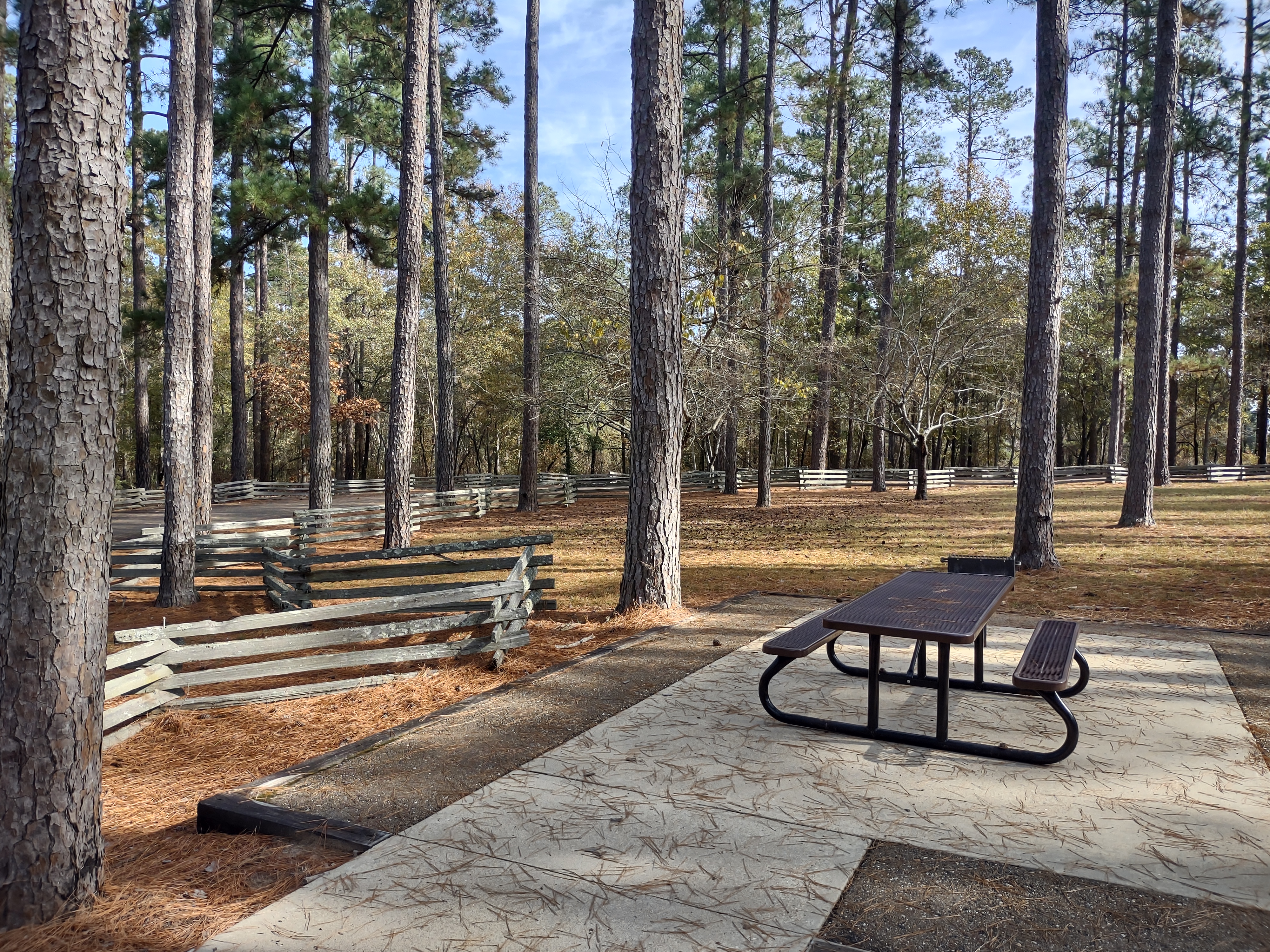
Today, Poison Springs Battleground State Park preserves 84 acres of the site where 301 Union soldiers fell. The park sits along the road from Camden, part of the Camden Expedition Sites National Historic Landmark, listed on the National Register of Historic Places in 1994. For decades, the Arkansas Department of Parks and Tourism, as historian Urwin noted in 2000, 'tended to ignore the dark deeds that stained that particular patch of hallowed ground.' The Confederate newspaper Washington Telegraph had set the template back in 1864, burying news of the massacre under a heading called 'Choctaw Humor.' Its editor, John R. Eakin, later wrote that Confederate soldiers were 'not bound to receive' the surrender of Black troops. The battlefield is quiet now -- split-rail fences, evergreen trees, a park bench where visitors can sit and contemplate what happened when desperate men fought over corn, and one side decided the other was not human enough to deserve mercy.
From the Air
Located at 33.64°N, 93.00°W in Ouachita County, Arkansas, roughly 10 nm west of Camden. The battlefield sits in rolling, wooded terrain along the old Camden-to-Washington road. Look for the cleared park area amid dense forest. Recommended viewing altitude: 2,000-4,000 ft AGL. Nearest airports: KCXW (Camden, 10 nm E), KHOT (Hot Springs Memorial Field, 55 nm NE). The Red River lies approximately 30 nm south. Weather in April can produce low ceilings and spring thunderstorms.