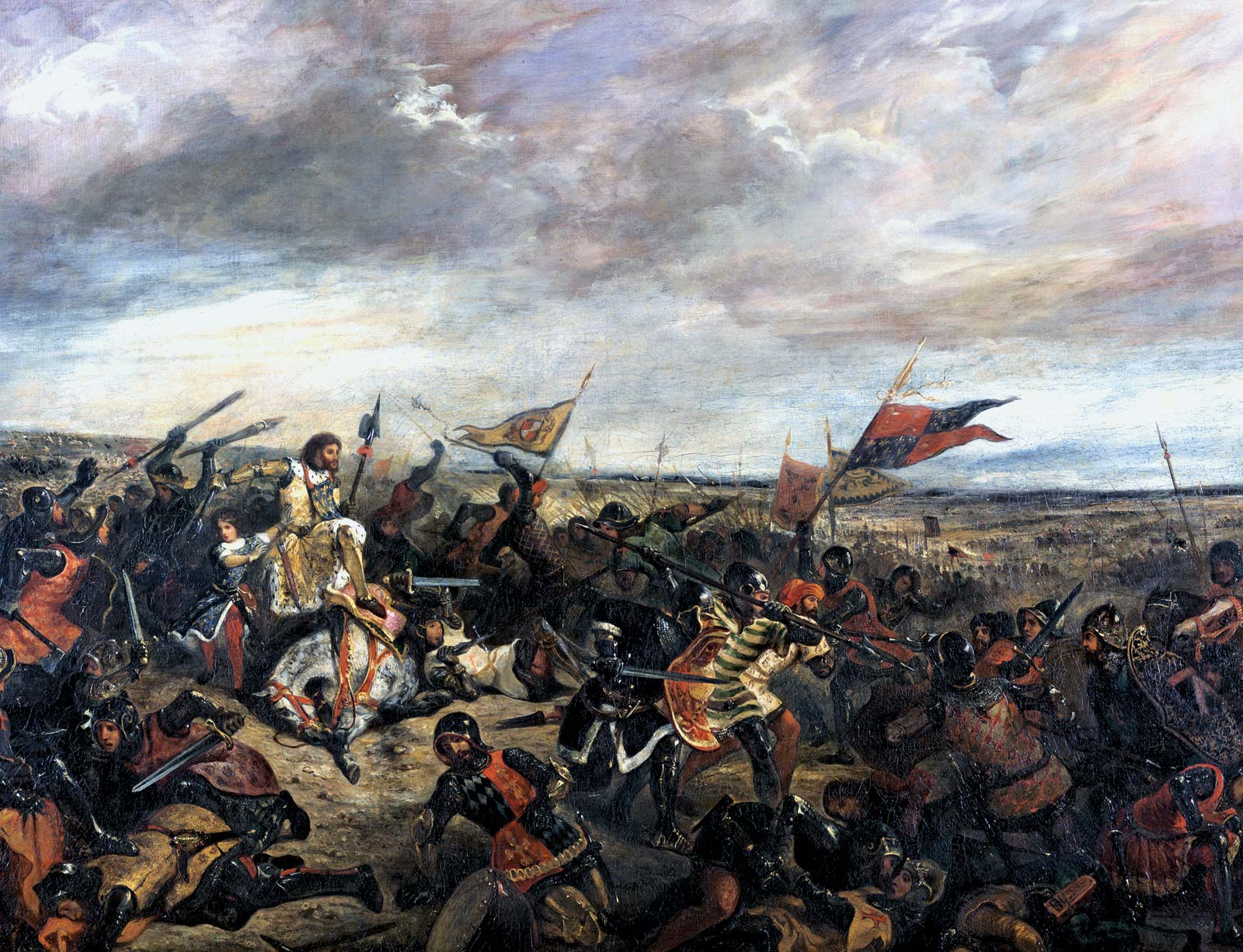
Battle of Poitiers
The French king rode into battle with the sacred Oriflamme unfurled, the ancient banner that signaled no quarter would be given and no prisoners taken. By nightfall on September 19, 1356, King John II was himself a prisoner, captured alongside his fourteen-year-old son Philip and some 2,500 men-at-arms. The Battle of Poitiers was the second of three catastrophic French defeats during the Hundred Years' War, and arguably the most humiliating: a defensive force of roughly 6,000 Anglo-Gascons, short on food and water, broke an army of 14,000 to 16,000 French soldiers who attacked them across open ground south of Poitiers.
The Prince Who Burned His Way North
Edward of Woodstock, the Black Prince, arrived in Bordeaux in September 1355 with 2,200 English soldiers and immediately set about making France suffer. Gascon nobles reinforced him to nearly 6,000 men, and he launched a chevauchee, a devastating mounted raid that marched 675 miles from Bordeaux almost to the Mediterranean coast and back, looting and burning a swath of French territory. The following year he headed north from Bergerac with a combined force of 6,000, again laying waste to the countryside. His strategy was deliberate: use the threat of destruction to force the French army into attacking a position of his choosing. The Anglo-Gascons were confident they could defeat a larger force fighting defensively, and equally confident they could evade one if the odds grew too steep. Every man in the army rode a horse, giving them mobility that matched any French force.
A Cat-and-Mouse Across the Loire
King John had spent weeks besieging the fortress of Breteuil in Normandy while the Black Prince ravaged the southwest. By August 1356 the pressure became unbearable, and John bribed the Breteuil garrison to surrender so he could march south. At Chartres he received reinforcements and, in a bold move, sent home nearly all his infantry, creating an entirely mounted army that could match the Black Prince's speed. The two forces maneuvered for days along the Loire and Vienne rivers, each trying to dictate the terms of engagement. John repeatedly attempted to cut off Edward's line of retreat to Gascony. The Black Prince, for his part, did not want a quick escape; he wanted John to attack him on unfavorable ground. When Cardinal Talleyrand arrived to negotiate, both sides initially dismissed him. On September 18, with the armies so close that withdrawal had become nearly impossible, Edward finally agreed to discuss terms. He offered extensive concessions for free passage home, but John's advisers convinced the king it would be humiliating to let the army that had devastated France simply walk away.
Four Waves, Four Failures
The Anglo-Gascons dug in on a wooded hill five miles south of Poitiers, digging pits and trenches, forming barricades, and positioning archers along hedgerows. The French attacked in four successive waves. Two groups of mounted knights charged first, one on each flank, hoping to scatter the English longbowmen. On the left, the marsh terrain protected the archers, who turned their fire on the French crossbowmen and then shot into the unprotected hindquarters of the French horses. On the right, the cavalry funneled into a single gap in a thick hedge, where English archers calculated to be firing fifty arrows per second cut them down. The second assault, 4,000 dismounted men-at-arms under the Dauphin Charles, fought for two brutal hours before withdrawing in good order. The third wave lost half its men before it even engaged, as the Duke of Orleans marched away with 1,600 troops. Those who remained launched a feeble attack easily repulsed.
A King in Chains
John gathered his remaining forces for a fourth and final assault. The Oriflamme flew overhead. The exhausted Anglo-Gascons, many wounded and nearly out of arrows, braced for what looked like the end. The fighting was fierce, and the French slowly gained the upper hand. Then a small mounted Anglo-Gascon force of just 160 men, sent earlier to threaten the French rear, appeared behind the French lines. The effect was devastating: soldiers who thought they were surrounded broke and ran, and panic swept through the French ranks. John fought on beside his son Philip until he was overwhelmed and captured. The ransom demanded for his return would be staggering: three million gold ecus, a sum that strained the French treasury for years. The Treaty of Bretigny in 1360 ceded vast territories to England, but the peace proved temporary. France resumed the war in 1369 and eventually won it in 1453.
The Field That Changed Europe
Poitiers broke more than an army. With the king captive in London, France descended into chaos. Populist revolts erupted across the kingdom, the Estates General seized power, and the Dauphin struggled to govern a country that had lost faith in its aristocracy. The battle demonstrated that heavy cavalry charges against prepared defensive positions were suicidal, a lesson the French would painfully relearn at Agincourt in 1415. For the English, Poitiers validated a style of warfare built around the longbow and disciplined infantry fighting from chosen ground. The battlefield itself lies in rolling farmland five miles south of modern Poitiers, near the village of Nouaille-Maupertuis. The hedgerows and wooded terrain that shaped the fighting remain, though the men who bled behind them have been gone for nearly seven centuries.
From the Air
The battlefield lies approximately 8 km south of Poitiers at roughly 46.53N, 0.38E, near Nouaille-Maupertuis in the Foret de Nouaille. The terrain is rolling farmland with scattered woodlands. From the air, look for the Clain River valley running south from Poitiers. Nearest airport: Poitiers-Biard (LFBI), approximately 10 km northwest of the battlefield. The area is gentle countryside with good visibility in fair weather. The city of Poitiers on its promontory is a useful navigation reference.