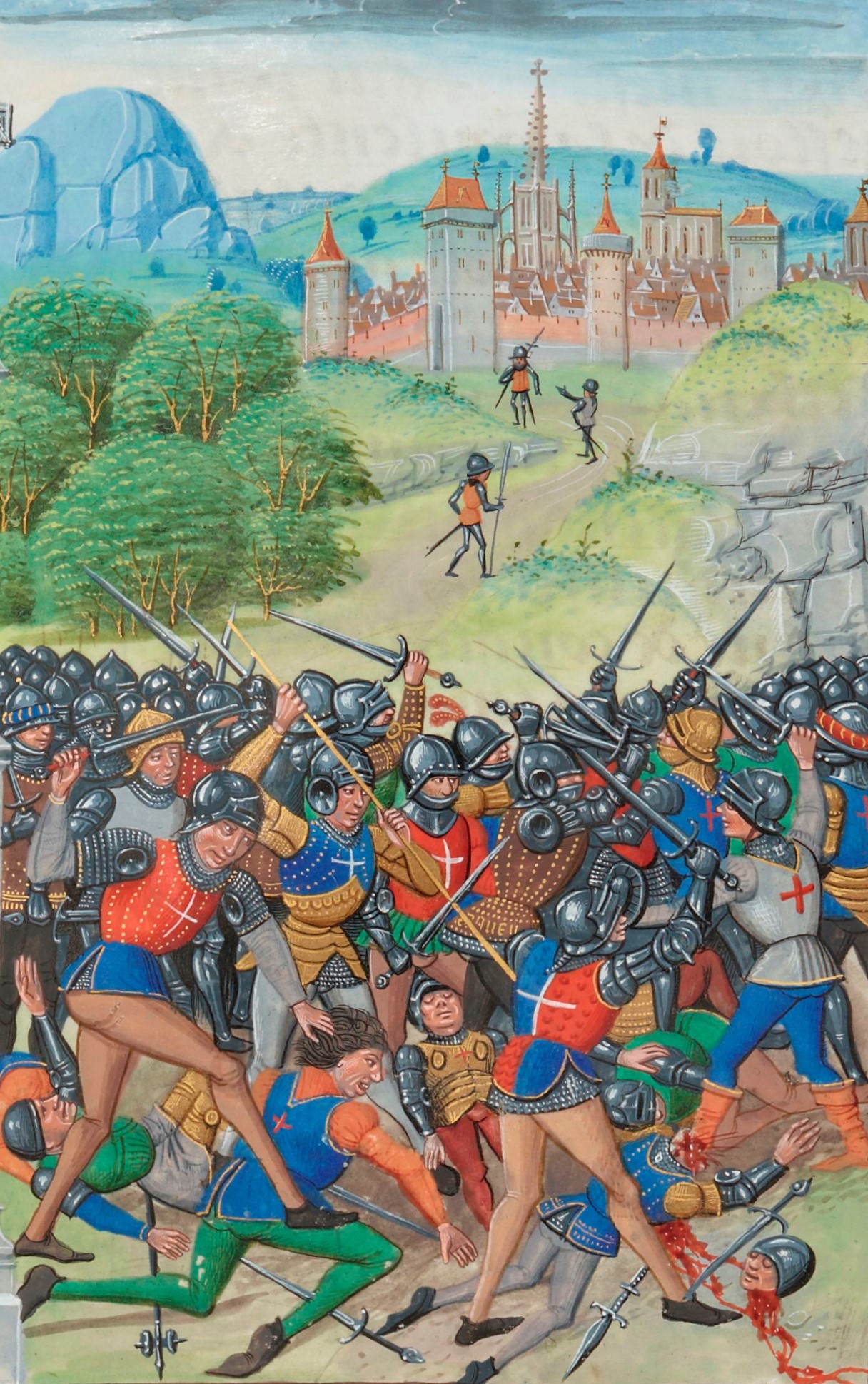
Battle of Pontvallain
For more than thirty years, English armies had seemed unbeatable in open battle. Crecy, Poitiers, Auray -- the names read like a catalog of French humiliation. Then on 4 December 1370, in the quiet Sarthe countryside near the town of Pontvallain, a Breton soldier named Bertrand du Guesclin proved that the pattern could break. The newly appointed Constable of France led roughly 5,200 men on a forced overnight march, caught an English force of similar size completely off guard, and destroyed it. By day's end, England's aura of invincibility in France was finished.
The Chevauchee That Lost Its Way
The battle grew from a familiar English tactic: the chevauchee, a mounted raid designed to burn and plunder its way across enemy territory, demoralizing the population and demonstrating the French king's inability to protect his subjects. In late 1370, Sir Robert Knolles led a large English force from Calais south toward Paris, devastating the countryside. But as winter approached, the English commanders quarreled. Knolles and his captains could not agree on strategy, and the army fractured into four separate columns. It was exactly the kind of mistake du Guesclin had been waiting for. King Charles V had appointed him Constable of France specifically because of his willingness to avoid the pitched battles that had cost France so dearly, preferring instead to pick off isolated English forces. A divided enemy was an invitation.
A Night March Through the Sarthe
Du Guesclin learned that a substantial English column under Thomas Granson and several other captains was moving through the Sarthe region. He gathered his forces and set out on a forced march that continued through the night, covering the distance to Pontvallain with a speed the English did not anticipate. The French arrived to find the English unprepared. Du Guesclin struck hard, and the result was not a battle so much as a rout. The English force was effectively wiped out. In a coordinated action the same day, du Guesclin's subordinate Louis de Sancerre intercepted another English column at the nearby town of Vaas and destroyed it as well. The twin engagements, sometimes counted as separate battles, demonstrated a new French approach to the war: disciplined coordination, strategic patience, and the refusal to let the English dictate the terms of engagement.
Breaking the Myth of English Arms
The engagements at Pontvallain and Vaas were not large by the standards of the Hundred Years' War. Combined, the forces involved numbered perhaps ten thousand men. But their significance was psychological as much as military. Since the war's beginning in 1337, English armies had won a seemingly unbroken string of victories in open combat. French strategy after the catastrophe at Poitiers in 1356 had been to avoid battle entirely, sheltering behind castle walls and refusing to engage. Du Guesclin's triumph at Pontvallain proved that the French could meet the English in the field and win -- not through the massed chivalric charges that had failed so disastrously before, but through speed, surprise, and tactical intelligence. The constable pursued the surviving English forces through the winter and into the following year, recapturing much of the territory that had been lost.
The Breton Who Remade French Warfare
Du Guesclin's approach at Pontvallain reflected a broader transformation in how France waged war. Born into minor Breton nobility, he had learned his trade in the brutal guerrilla conflicts of Brittany's civil war and the campaigns in Spain, where he fought for Henry of Trastamara. He understood that France's greatest military failures had come from reckless aggression -- the headlong cavalry charges at Crecy and Poitiers that English longbowmen had cut to pieces. His genius was restraint: choosing when and where to fight, refusing engagement when the odds were wrong, and striking decisively when they were right. Pontvallain was the proof of concept. The town in the Sarthe where it happened remains a quiet place, but in December 1370 it witnessed the moment when France began to win its own war back.
From the Air
Located at 47.75N, 0.19E in the Sarthe department of northwest France. The town of Pontvallain sits in gently rolling agricultural countryside along the Loir river valley. The nearby town of Vaas, site of the coordinated second engagement, is approximately 20 km to the southwest. Le Mans Arnage Airport (LFRM) is roughly 40 km to the north. The terrain is flat to gently undulating farmland, typical of the western Loire basin.