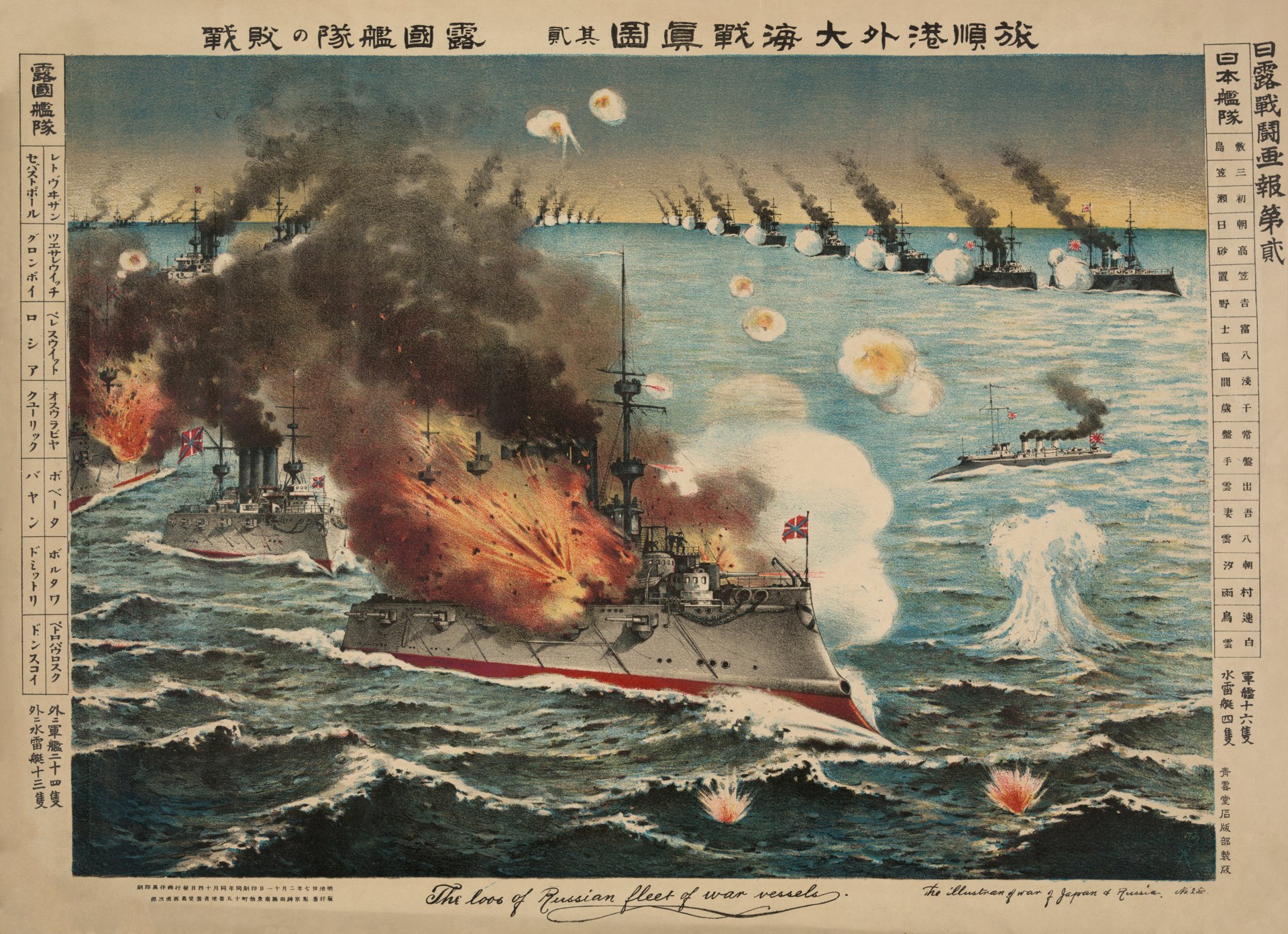
Battle of Port Arthur
Most of the Russian officer corps was at a party. Admiral Starck was hosting the evening's festivities on 8 February 1904 when ten Japanese destroyers slipped through the darkness toward Port Arthur's outer anchorage. Just after midnight, the attack began. The formal declaration of war between Japan and Russia would not come until two days later. By then, three Russian warships were already crippled, and the twentieth century's first great power conflict was underway.
Torpedoes in the Dark
Admiral Togo Heihachiro had planned to deliver a crushing blow with his entire Combined Fleet -- six battleships, armored cruisers, fifteen destroyers, and twenty torpedo boats. But false intelligence from spies around Port Arthur convinced him the Russian shore batteries were on full alert, so he held back his capital ships and sent only the destroyers. Even that limited strike nearly unraveled: two Japanese destroyers collided in the dark and fell behind, scattering the formation. The first four destroyers reached the anchorage undetected at approximately 00:28 on 9 February. Of sixteen torpedoes fired, only three struck their targets. But those three hits were devastating. The battleship Retvizan was holed in the bow, the protected cruiser Pallada caught fire and sank in shallow water, and the powerful Tsesarevich -- the best ship in the Russian fleet -- was disabled. The last Japanese destroyer attacked around 02:00, by which time Russian searchlights and gunfire had made close-range runs impossible.
The Admiral's Mistake
At dawn, Togo sent Vice Admiral Dewa Shigeto with four cruisers on reconnaissance. Through morning mist, Dewa counted twelve Russian battleships and cruisers, several badly listing. The smaller vessels outside the harbor appeared to be in disarray. Convinced the night attack had paralyzed the enemy, Dewa raced back to Togo with a fatally optimistic report: the moment was perfect for the main fleet to attack. What Dewa had missed was that the Russians were getting ready for battle. Their battleships had steam up. When Togo's First Division approached at noon, they found not a crippled fleet but an angry one. Within five minutes, Togo's flagship Mikasa took a ricocheting shell that wounded seven officers and men and wrecked the aft bridge. The Russian cruiser Novik closed to within 3,300 yards and launched torpedoes. By 12:20, Togo ordered his fleet to withdraw -- a risky turning maneuver under the full fire of Russian shore batteries.
A War of Mines and Miscalculation
The weeks that followed were a grinding contest of blockade and counter-blockade. Russia's own minelayer accidentally sank after one of her mines washed against her rudder, killing 120 of 200 crew and taking with her the only chart showing the mine positions. Togo attempted three times to block Port Arthur's entrance with scuttled transports -- all three attempts failed. In early March, the energetic Admiral Stepan Makarov arrived and revitalized the Russian fleet. But on 13 April 1904, Makarov's flagship Petropavlovsk struck Japanese mines and sank in less than two minutes, killing approximately 676 men along with their admiral. Togo ordered his fleet's flags flown at half-mast for a day of mourning. The following month brought the war's worst day for Japan's navy: on 15 May, two battleships sank in a Russian minefield, eliminating one-third of Japan's battleship strength in a single morning.
Echoes of 1904
The Battle of Port Arthur produced no decisive winner. The Russians suffered about 150 casualties to Japan's 90, and no major warship was lost outright on either side. But the strategic implications were immense. Japan had ship repair facilities at Sasebo; the Russian fleet had only limited capability at Port Arthur. Russia's naval presence in the Pacific would never recover its footing. The attack itself -- conducted against an unsuspecting neutral power before any declaration of war -- drew comparisons even at the time to what it might portend. In 1907, the Second Hague Conference adopted provisions requiring formal declarations before commencing hostilities, a direct response to the precedent Port Arthur set. Those provisions did not prevent the pattern from repeating at Pearl Harbor in 1941, when Japan again struck before declaring war. Port Arthur's harbor, quiet now under Chinese administration as Lushunkou, still holds the memory of the night that announced a new kind of warfare to the world.
From the Air
Located at 38.78N, 121.26E at the southern tip of the Liaodong Peninsula. The harbor entrance is clearly visible from altitude -- a narrow channel leading to a sheltered inner basin. Dalian Zhoushuizi International Airport (ZYTL) is approximately 35 km to the northeast. The Yellow Sea extends to the southeast, with the Bohai Sea to the west. At 3,000-5,000 ft, the defensive hills surrounding the harbor are clearly apparent.