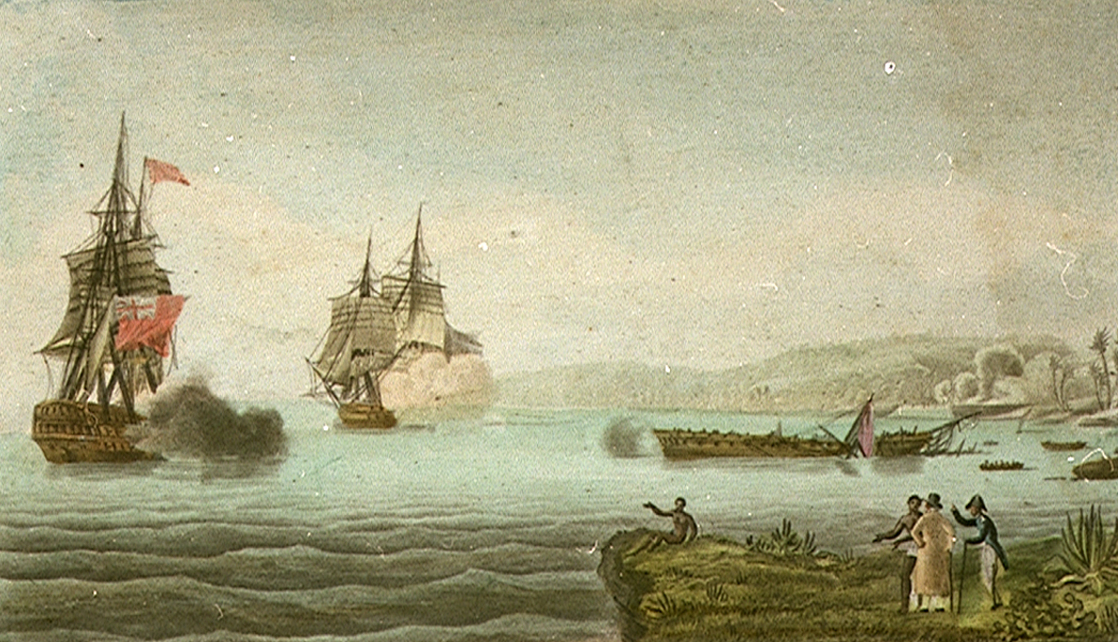
Battle of Port Louis
On the evening of 11 December 1799, Contre-amiral Pierre Cesar Charles de Sercey stood on the beach near Port Louis, Mauritius, and watched the last ship of his command burn. The frigate Preneuse, a 40-gun warship that had been the sole significant French naval presence in the Indian Ocean, was ablaze at the mouth of the Tombeau River, set alight by British boarding parties who had rowed through shore battery fire to reach the wreck. Her captain, Jean-Marthe-Adrien l'Hermite, had been taken prisoner. The flames that consumed the hull also consumed what remained of French naval power east of the Cape. Sercey, a commander with nothing left to command, would soon book passage home to France and retire from the service he had spent three years trying to sustain at the far edge of empire.
Six Frigates Against an Ocean
The story of Preneuse's destruction begins three years earlier, when the French Navy dispatched six frigates to the Indian Ocean under Sercey's command, hoping to challenge British Royal Navy dominance in the East Indies. The squadron was based at Port Louis on Ile de France, the island now known as Mauritius. From this forward position, Sercey attempted to disrupt British trade, linking up with Spanish allies and even carrying 86 military volunteers to the Tipu Sultan of Mysore, an Indian ruler seeking a French alliance against the British. But the campaign was plagued by frustration. Engagements in the Dutch East Indies produced no decisive results, and one by one the frigates were sent home, lost in battle, or wrecked. By the summer of 1799, Preneuse was the only French warship of consequence remaining in the entire Indian Ocean, a solitary raider flying the tricolor in waters dominated by British men-of-war.
The Night Fight at Algoa Bay
Ordered to raid British shipping off Southeast Africa, l'Hermite sailed from Port Louis in August 1799 and on 20 September discovered a small British squadron anchored in Algoa Bay on the South African coast. The force consisted of the storeship HMS Camel and the sloop HMS Rattlesnake, both with their masts removed, supporting an army fighting the Third Xhosa War. L'Hermite approached at dusk flying false Danish colors, but a boat from Camel quickly identified the stranger as hostile. What followed was a confused night battle. Rattlesnake's Lieutenant William Fothergill opened fire first, and both British ships engaged the frigate despite being outgunned. By midnight, Camel was flooding from hull damage and her crew abandoned the guns to work the pumps. L'Hermite shifted fire to Rattlesnake, and the exchange continued until 03:30 when the French captain withdrew, apparently convinced that the schooner Surprise was a well-armed warship. British losses were two killed and twelve wounded. Preneuse suffered roughly 40 casualties and significant damage, setting in motion the pursuit that would end her.
A Chase Through Heavy Seas
Word of Preneuse's condition reached the British commander at the Cape, who sent the 50-gun HMS Jupiter in pursuit. On 9 October, Jupiter found Preneuse and gave chase through a gale. The sea conditions were so severe that Captain William Granger could not safely open his lower gunports, restricting him to his lighter upper-deck 12-pounders against l'Hermite's heavier main battery. The running fight lasted two days and nights, the ships tearing through heavy swells at high speed, exchanging fire at long range. When Granger finally closed the distance, his lighter guns proved no match and Jupiter's rigging was shot away, forcing the British ship to fall back for repairs. L'Hermite escaped, but Preneuse was battered and her options narrowing. Granger returned to Table Bay under criticism from naval historians. William Laird Clowes later wrote that no explanation of Jupiter's failure could be given, while William James considered l'Hermite's escape a triumph that helped restore French honor after the inconclusive fight at Algoa Bay.
Fire on the Tombeau
In early December, l'Hermite brought his damaged frigate home to Port Louis. But the entrance was blockaded by HMS Tremendous, a 74-gun ship of the line under Captain John Osborn, and HMS Adamant, a 50-gun vessel under Captain William Hotham, sent specifically to intercept Preneuse. Spotted on approach, l'Hermite was chased northeast by Adamant, which pressed so close that escape became impossible. He drove Preneuse onto the beach at the mouth of the Tombeau River, within range of a shore battery. The masts were cut away and the battery opened fire on Adamant as Hotham worked his ship carefully through coastal shoals. By 17:30, Adamant was in position and unleashed its broadside on the beached frigate. Within fifteen minutes, l'Hermite struck his colors. That night, Lieutenant Edward Grey led three cutters through battery fire to board the wreck. Most of the crew had already escaped to shore. Grey took l'Hermite prisoner, allowed him to bring his personal belongings, and set the ship ablaze. The boarding party returned to Adamant without losing a single man. The French had lost their last warship in the Indian Ocean.
From the Air
The Battle of Port Louis took place near Port Louis, Mauritius (Ile de France), but the associated action at Algoa Bay occurred near present-day Gqeberha (Port Elizabeth), South Africa. The article's coordinates (34.68S, 27.90E) place it off the South African coast. The mouth of the Tombeau River near Port Louis, Mauritius, is where Preneuse was beached and destroyed. Algoa Bay (33.83S, 25.83E) is where the preliminary night battle took place. For the South African portion, nearest airport is Port Elizabeth (FAPE). The bay where l'Hermite fought Camel and Rattlesnake is the same sweep of water visible from altitude over Gqeberha.