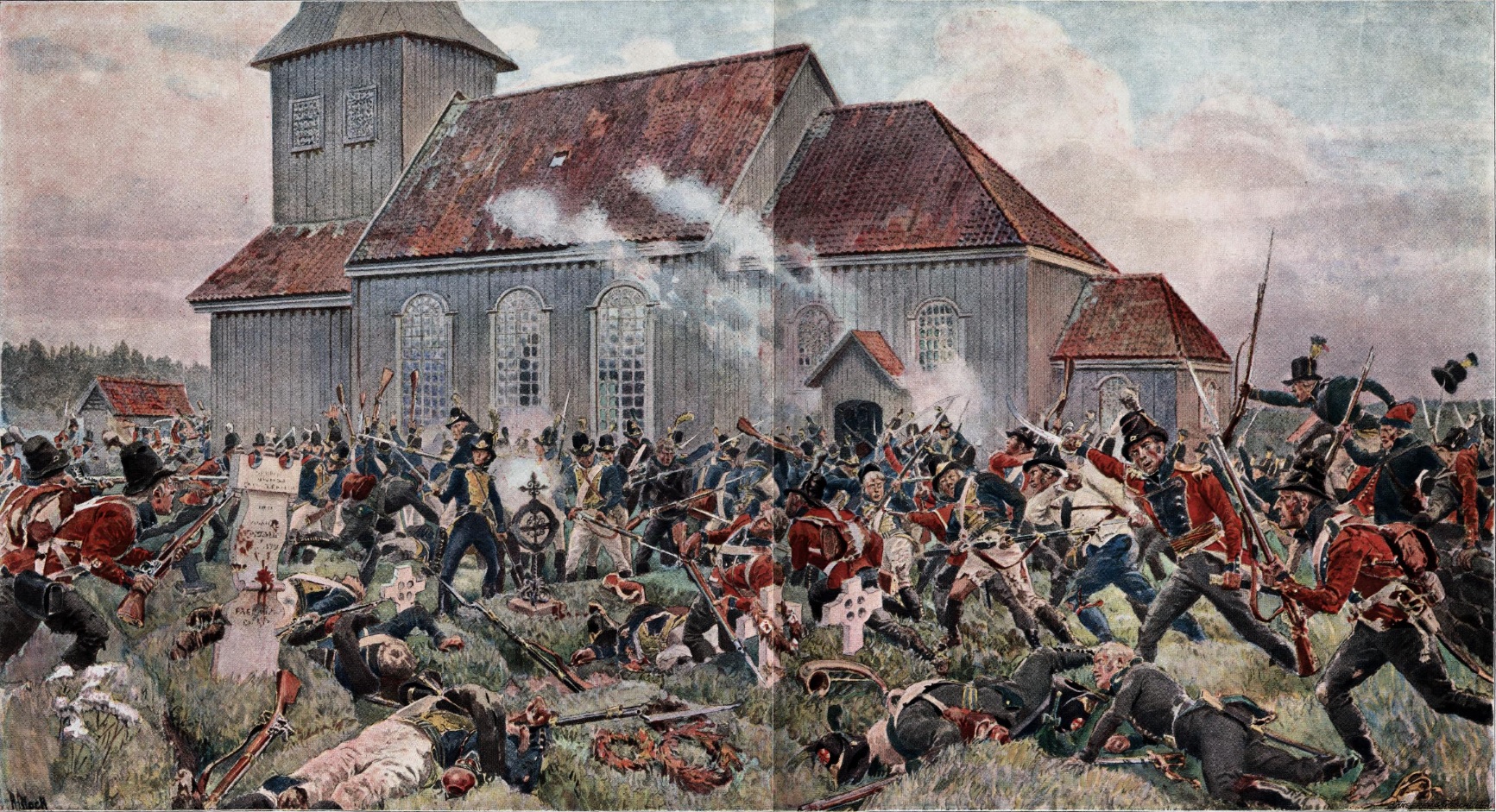
Battle of Prestebakke
The attack came at 03:30, when darkness still clung to the Enningdal valley. Swedish sentries, grown careless after weeks of quiet, never saw the Norwegian columns closing in from multiple directions. By the time the sun rose on June 10, 1808, the Swedish commander Anton von Knorring would be surrendering with his remaining 150 men, having lost 380 soldiers captured and 18 killed. The Battle of Prestebakke would prove a tactical masterstroke for the Norwegians, a humiliation for the Swedes, and ultimately, a footnote that changed nothing. Four days later, the Swedes would retake everything they had lost.
The Commander Who Wasn't There
Georg Adlersparre held overall command of the Swedish forces in the region, but he was absent when the Norwegians struck. After the Swedish retreat from Norway following the Battle of Mobekk, a small detachment had been left at Prestebakke and Berby. It was a thin screen, vulnerable and exposed. Christian August, commanding the Norwegian forces, saw the opportunity and ordered an offensive to push the Swedes back across the border. The task fell to Niels Petersen Juul, commander of Kongsvinger Fortress, who devised a three-pronged assault exploiting Swedish carelessness. But illness struck Juul down, and the execution passed to Arild Huitfeldt. The plan remained intact: 876 men in three columns would surprise and overwhelm a garrison of 420.
Dawn Strike
Huitfeldt's columns moved through the darkness with precision. He personally led 230 men in a frontal attack on Prestebakke. A larger force of 540 men swept wide to strike the Swedish rear. A third column of 106 men launched a diversion against Berby, sailing through the Iddefjord on a small flotilla. The Norwegian attack in the Swedish rear came first, catching outposts completely off guard. Knorring, the acting commander, mustered about 128 men for a counterattack but found both flanks threatened and no reinforcements coming. After an hour of fighting, he began a retreat toward Glenne. Meanwhile, Huitfeldt's frontal attack drove the remaining Swedish outposts back toward the village.
The Fight at the Churchyard
Swedish detachments rallied at the church in Prestebakke, taking cover behind the cemetery wall. It was a desperate last stand. The Norwegians encircled the position, pouring fire into the stone enclosure while seeking gaps in the defense. Eventually they broke through, overwhelming the defenders. The church that had offered sanctuary became a trap. Those Swedes who escaped joined Knorring's fighting retreat, but the net was closing. A Norwegian detachment waited at a stream crossing 1.3 kilometers from the church. Knorring ordered his men into Jäger formation and attempted to break through. Twice they charged. Twice they failed. With larger Norwegian forces closing from behind, Knorring surrendered with his remaining 150 men.
The Flotilla's Diversion
The third Norwegian column had its own mission. On June 9, a day before the main assault, a small force landed at Pilegården from boats that had sailed through the Iddefjord, forcing a Swedish outpost to flee. The following morning, as fighting raged at Prestebakke, these Norwegians attacked Krokstrand and then Berby itself. An artillery duel ensued for about an hour, with neither side suffering casualties. The diversion worked. Swedish attention was divided, preventing any organized relief effort from reaching the embattled garrison at Prestebakke. When the shooting stopped, the Norwegians controlled the field.
A Victory Without Consequence
The casualty toll told a story of complete Norwegian success: 18 Swedish dead, 380 captured including 38 wounded. Norwegian losses were six killed and six severely wounded. A ceasefire allowed both sides to collect the many casualties strewn across the valley. Knorring, blamed for the disaster, was sentenced to six months suspension, later reduced to two. But the strategic map remained unchanged. Four days later, a larger Swedish force arrived to restore Swedish honor. The Norwegians retreated before superior numbers, yielding everything they had won. By late June, the Swedes had withdrawn entirely, returning to their own territory. The Battle of Prestebakke became a prelude rather than a conclusion. Three months later, on September 12, the Swedes would cross this same border again, heading toward the same Norwegian positions at Berby.
From the Air
The Battle of Prestebakke occurred at 58.99°N, 11.54°E in the Enningdal valley of southeastern Norway, just west of the Swedish border. The village church where Swedish forces made their desperate last stand is visible in the small settlement. The Enningdal River runs through the valley, with the crossing at Glenne where Knorring attempted his breakout located to the south. The Iddefjord, which the Norwegian flotilla used for their flanking approach, extends to the west toward the sea. The village of Berby, target of the diversionary attack and site of a later battle in September, lies about 3km to the south. Nearest airports: Moss-Rygge (ENRY) approximately 55km southwest, Oslo Gardermoen (ENGM) about 100km north. Best viewed at 2,000-3,000 feet for the full tactical picture of the valley and approach routes.