Battle of Prestonpans
It was over before most of the government soldiers understood what was happening. At dawn on 21 September 1745, Jacobite Highlanders emerged from the morning mist east of Prestonpans and charged Sir John Cope's army with such speed and ferocity that the entire battle lasted less than fifteen minutes. The government dragoons panicked and fled. The infantry, attacked on three sides, collapsed. By the time the sun had fully risen over the East Lothian coast, Bonnie Prince Charlie had won the first significant victory of the 1745 Jacobite rising, and the British government suddenly realized it faced a serious threat to the Hanoverian throne.
A Prince and a Farmer's Son
Charles Edward Stuart had landed in the Outer Hebrides in July with little more than ambition and a claim to the British crown. Most Highland chiefs advised him to go home. Enough were persuaded, however, and by September the young prince had marched into Edinburgh with a growing army of Highlanders. Cope, the government commander in Scotland, had been outmaneuvered repeatedly. He tried to block the Highland advance at Corrieyairack Pass, found the Jacobites already there, and retreated to Inverness. By the time he shipped his troops south by sea to Dunbar, Charles had already taken the Scottish capital. The two armies met near Prestonpans on the afternoon of 20 September, with Cope choosing defensive ground protected by marshland. The position was sound, but it had one critical weakness: Robert Anderson, a local farmer's son, knew a path through the bog. He showed Lord George Murray the way.
Fifteen Minutes
At four in the morning the entire Jacobite force began moving in single file along the Riggonhead defile, slipping east of Cope's position through the darkness. Cope's pickets detected the movement and raised the alarm, giving him time to wheel his army to face east. It was not enough. As dawn broke, the Highlanders charged. Cope's artillerymen fled before firing a useful shot, abandoning their guns. His dragoons on both flanks broke and galloped away, leaving Colonel James Gardiner mortally wounded near where he had tried to rally them. The exposed infantry was surrounded and overwhelmed. Government casualties reached 300 to 500 killed or wounded and another 500 to 600 captured. Jacobite losses were astonishingly light: perhaps 35 to 40 dead. Cope escaped with 450 survivors to Berwick-upon-Tweed, earning the dubious distinction of being mocked in the song 'Hey, Johnnie Cope, Are Ye Waking Yet?' -- a tune some Scottish regiments still use for reveille.
From Triumph to Culloden
Prestonpans proved the devastating power of the Highland charge but also revealed its limitation. When the charge connected, it was virtually unstoppable, but if it failed, the clansmen lacked the equipment and discipline to hold ground against regular troops. The victory galvanized the rebellion. French ships brought money and weapons to Montrose. The Duke of Cumberland and 12,000 troops were recalled from Flanders. Charles pushed south into England, reaching Derby by December, but promised English and French support never materialized. At Derby, his council overwhelmingly voted to retreat. The march back to Scotland ended at Culloden in April 1746, where Cumberland's troops, drilled specifically to counter the Highland charge, inflicted a crushing defeat. The Jacobite cause died on that moorland.
Songs and Monuments
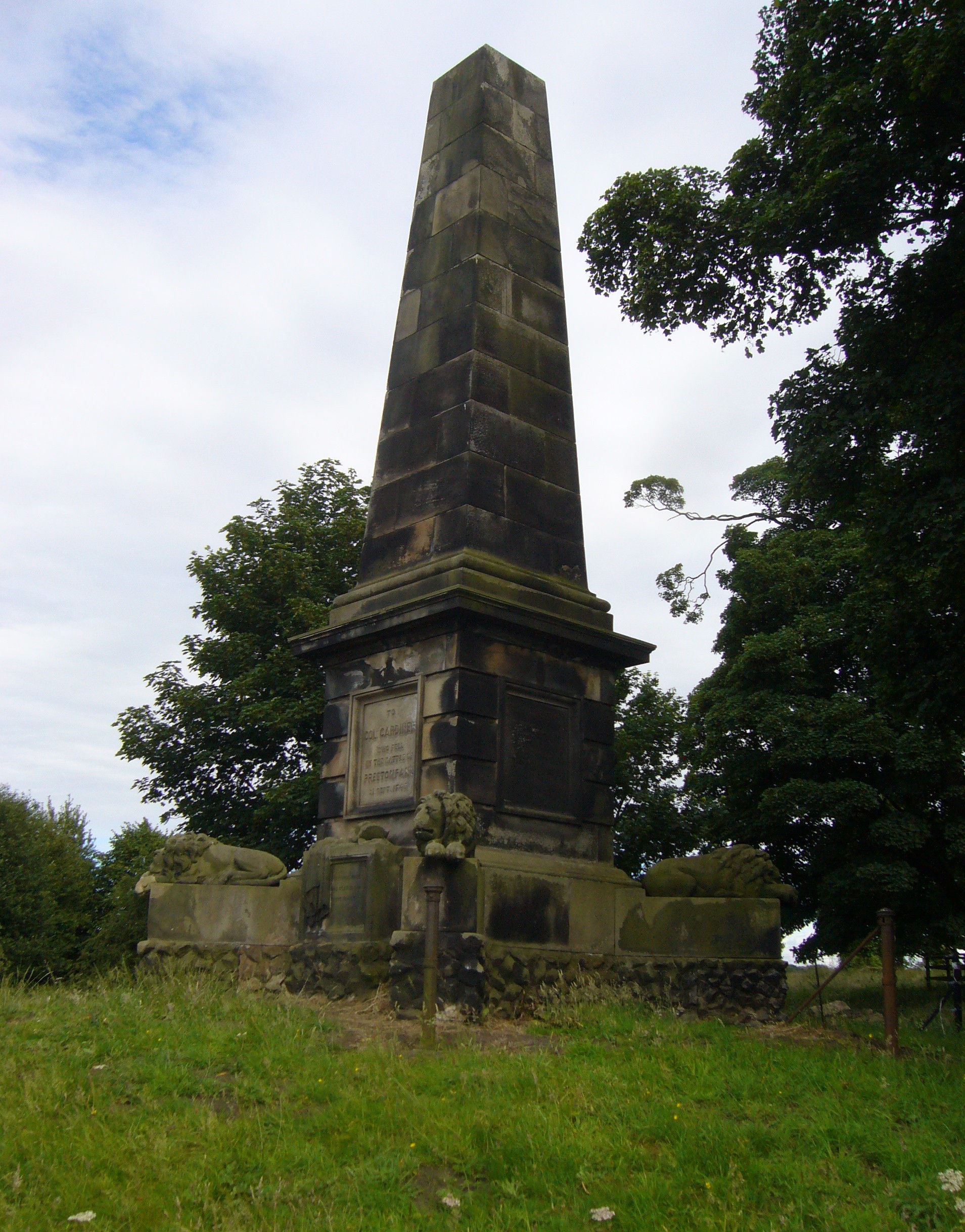
The battlefield sits east of Edinburgh near the Firth of Forth, partly developed now with housing and the former Cockenzie power station site. A memorial erected in 1953 commemorates the dead of both sides, and the Prestonpans 1745 Heritage Trust works to preserve the site, which is included in the Inventory of Historic Battlefields in Scotland. Colonel Gardiner's obelisk still stands nearby, a memorial to the officer whose death was romanticized by the minister Philip Doddridge and later by Sir Walter Scott in Waverley. The song that Adam Skirving wrote after visiting the battlefield later that day -- he was reportedly mugged by victorious Highlanders on the way home -- became one of Scotland's most enduring folk songs. The tune crossed oceans and centuries: the 51st Highland Division played 'Hey, Johnnie Cope' as they landed on Juno Beach on D-Day, 6 June 1944.
From the Air
Located at 55.95°N, 2.96°W near the south shore of the Firth of Forth, east of Edinburgh. The battlefield extends across flat coastal terrain between Prestonpans and Tranent. Nearest airport: Edinburgh (EGPH), approximately 8 nm west. The former Cockenzie power station chimney provides a visual reference point. Coal bing near the memorial is visible from altitude.