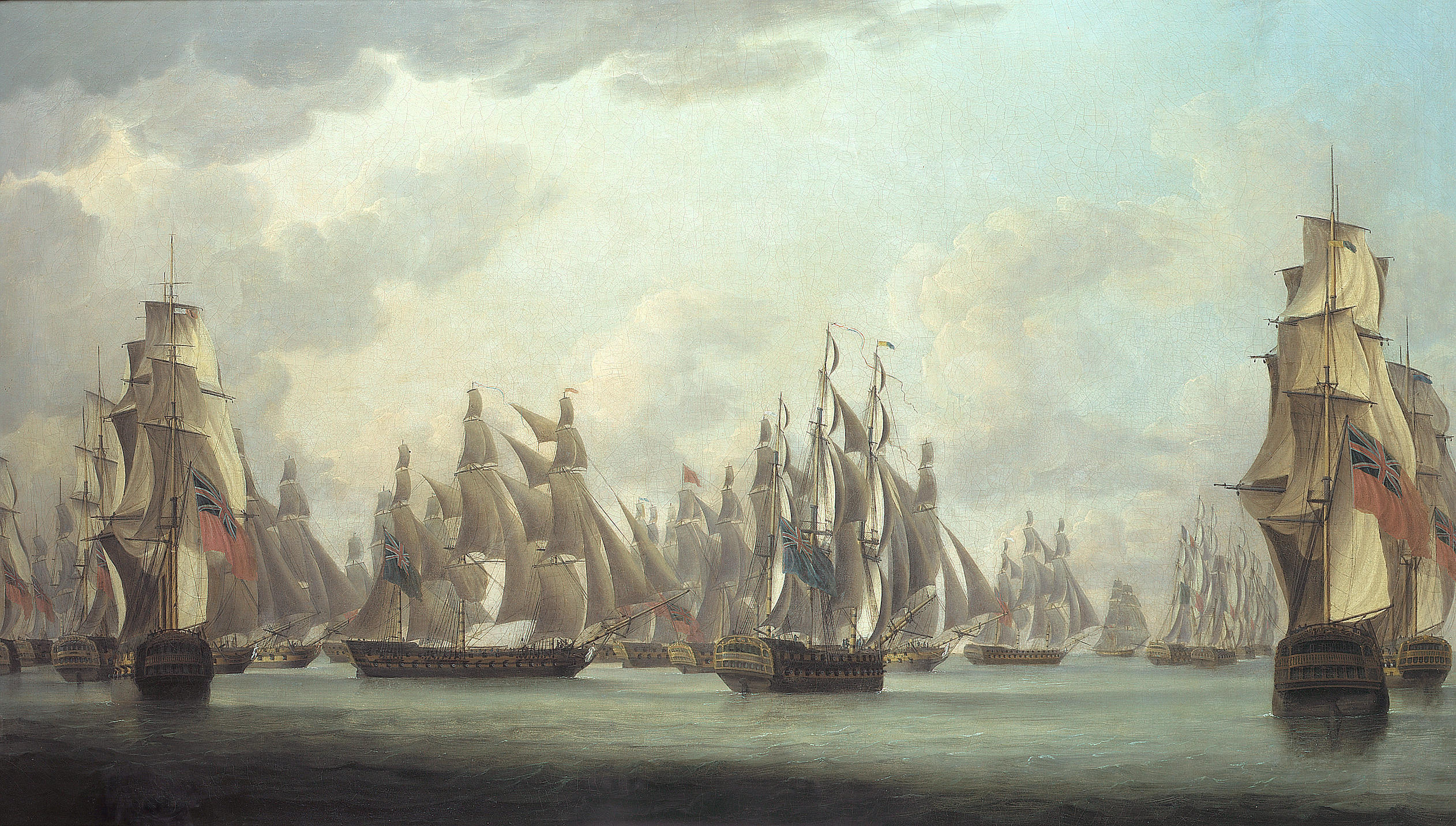
Battle of Pulo Aura
On the morning of 14 February 1804, Commodore Nathaniel Dance faced a problem that no amount of seamanship could solve. His convoy of merchant ships -- fat, slow East Indiamen loaded with tea, silk, and porcelain worth over eight million pounds -- had just spotted a French warship squadron bearing down from the direction of Pulo Aura island, near the eastern entrance to the Strait of Malacca. Dance had no warships. He had traders with painted-on gun ports and crews more accustomed to ledgers than broadsides. What he did next became one of the great bluffs in naval history.
The Prize and the Predator
The French squadron hunting Dance's convoy was led by Counter-Admiral Charles-Alexandre Leon Durand Linois aboard the ship of the line Marengo, accompanied by three frigates and a corvette. Napoleon himself had dispatched Linois to the Indian Ocean to menace British trade, and the annual China Fleet represented the richest single target afloat. Gathered at Canton, the convoy comprised 16 East Indiamen, 11 country ships, a Portuguese merchantman from Macau, and a vessel from Botany Bay. Its cargo included not only the expected tea, silk, and porcelain but also 80 Chinese plants ordered by Sir Joseph Banks for Kew Gardens. Dutch informants in Batavia had told Linois exactly where and when to intercept. He departed on 28 December 1803 with six months of provisions, expecting an easy haul. The only thing standing between Linois and a fortune in captured goods was a single armed brig, the Ganges, and the audacity of a 56-year-old merchant captain with over 45 years at sea.
The Gamble of Painted Hulls
Dance understood something about his ships that Linois did not: from a distance, a large East Indiaman looked remarkably like a warship. These merchantmen displaced up to 1,200 tons and carried as many as 36 guns -- inferior weapons manned by undertrained crews, but indistinguishable from proper naval armament through a telescope. Some captains enhanced the illusion with dummy cannon and warship-style paintwork. The trick had worked before. In the Bali Strait in 1797, an unescorted Indiaman convoy had stared down an entire French frigate squadron without firing a shot. Dance bet everything on the same deception. He formed his merchantmen into a line of battle as though they were ships of the Royal Navy. When dawn broke on 15 February, he ordered the Ganges and his four lead ships to fly blue ensigns -- the flag of a naval squadron -- while the rest hoisted the red ensigns of the merchant service. To French eyes, it would appear that several Royal Navy warships were escorting the convoy.
Forty-Five Minutes of Theatre
Linois hesitated. For hours he circled the convoy, studying the flags and formations but unwilling to commit. Dance used the reprieve to push his ships toward the Strait, hoping to outrun the French entirely. But Linois's faster warships began closing on the convoy's rear, and by early afternoon it was clear that flight alone would not save them. Dance ordered his lead ships to tack and cross directly in front of the French squadron -- an aggressive maneuver that no merchant captain fleeing a warship would attempt. Linois opened fire on the Royal George at 13:15. One sailor, Hugh Watt, was killed and another wounded; the ship took some hull damage. No other vessel on either side suffered more than superficial scratches. The exchange lasted barely 45 minutes. At 14:00, Linois broke off and ordered his squadron eastward under full sail. He had convinced himself he was outgunned. Dance, still playing his role, ordered the ships flying naval ensigns to give chase. Unarmed merchants pursued professional warships for two hours until the convoy was safely out of danger.
A Knighthood and a Humiliation
The consequences for both commanders were swift and dramatic. King George III knighted Dance, and merchants' guilds and patriotic societies showered him with prize money and honors. The convoy reached Britain with every ship and every crate of tea intact. Linois fared rather differently. Napoleon was furious. The admiral's own officers berated him openly for failing to press an attack against a manifestly weaker enemy. Linois remained in command of his squadron for two more years, but his record never recovered. He achieved only minor successes against undefended merchantmen and suffered a string of defeats against inferior British naval forces. The final irony came on 13 March 1806, when Linois encountered what he took to be another merchant convoy. This time, he attacked. The ships turned out to be a British battle squadron. Linois was captured.
Where the Waters Remember
Pulo Aura -- now known as Aur Island -- sits in the South China Sea off the eastern coast of Peninsular Malaysia, a small forested island surrounded by coral reefs. The waters here, where the South China Sea funnels into the Strait of Malacca, were among the most strategically important sea lanes of the Napoleonic era. Centuries of trade between Europe, India, and China flowed through this chokepoint, making it a natural hunting ground for commerce raiders. Today the strait carries roughly a quarter of the world's maritime trade, and Aur Island has become a quiet diving destination. Nothing marks the spot where Dance pulled off his bluff. The currents that carried those merchant ships still run, indifferent to the story the surface once held.
From the Air
Located at 2.45°N, 104.53°E in the South China Sea near Aur Island, off eastern Peninsular Malaysia. Best viewed from 5,000-10,000 ft for the island and surrounding reefs. Nearby airports include Sultan Ismail Petra Airport (WMKC) in Kota Bharu and Senai International Airport (WMKJ) in Johor Bahru. Clear skies offer views of the Strait of Malacca approaches to the west.