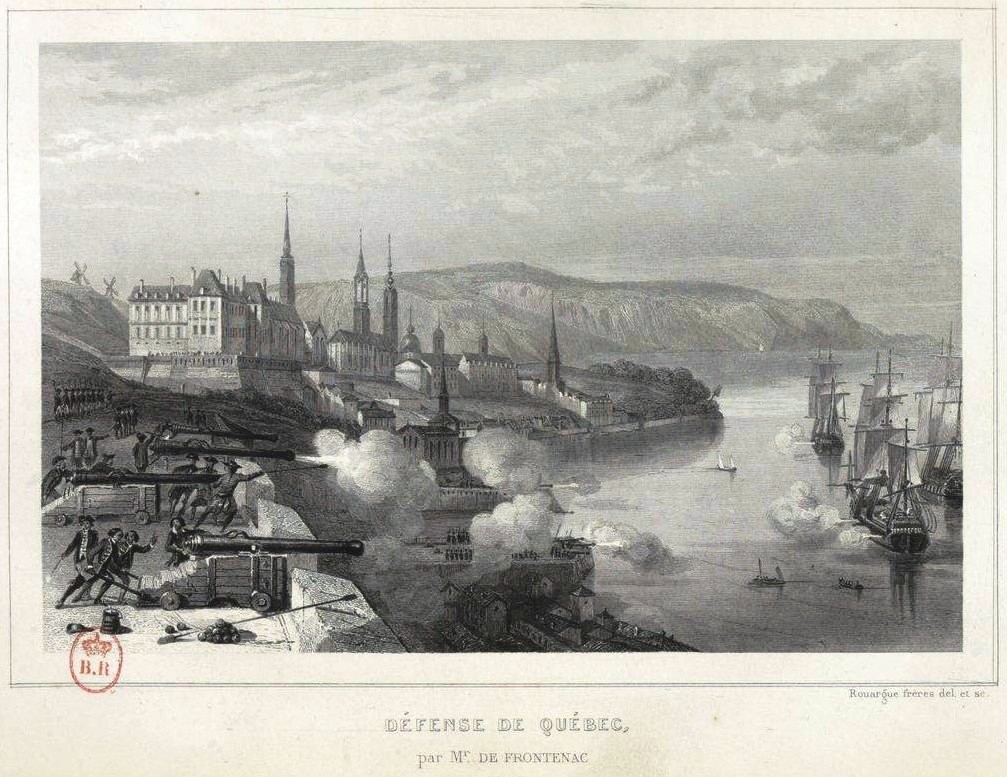
Battle of Quebec (1690)
"I have no reply to make to your general other than from the mouths of my cannons and muskets." With those words in October 1690, Governor-General Louis de Buade de Frontenac rejected the English demand for surrender and lit the fuse on the first true test of Quebec City's defenses. The Battle of Quebec pitted the colony of New France against a fleet from Massachusetts Bay during King William's War, and its outcome would echo through nearly seventy years of colonial rivalry along the St. Lawrence.
A Colony on Edge
The trouble began farther east. In the spring of 1690, New England forces captured Port Royal in Acadia, shocking the French colonial administration and exposing just how vulnerable their possessions were. Word traveled fast up the St. Lawrence, and Frontenac, the aging but fierce governor-general, ordered Quebec City prepared for siege. The city perched high on its promontory above the river, a natural fortress but still one without proper walls or gun batteries. What Frontenac had was terrain, determination, and a garrison of Canadian militia who knew the woods and riverbanks intimately. When Sir William Phips sailed upriver with a fleet of some thirty vessels and roughly 2,000 New England troops, Quebec was as ready as it could be.
Cannon and Musket
Phips anchored his ships in the Basin of Quebec and sent an envoy ashore demanding capitulation. Frontenac's famous refusal set the tone for what followed. Major John Walley led the land force ashore at Beauport, east of the city, where they slogged through marshy terrain under constant harassment from French-Canadian militia hidden among the trees and along the riverbanks. The English soldiers, unaccustomed to guerrilla tactics, struggled to advance. Meanwhile, Phips opened fire from his ships, but the cannons on the heights above the city answered with devastating volleys. Shot rained down on the English fleet from an almost unreachable elevation, splintering masts and punching through hulls. The English expended most of their ammunition without breaching the city's ad hoc defenses. After several days of futile bombardment and skirmishing, Phips ordered a retreat downriver.
The Fortress Takes Shape
Victory did not make Frontenac complacent. The battle revealed that Quebec's natural advantages alone would not hold forever. In 1692, he commissioned Ingenieur du Roi Josue Berthelot de Beaucours to design fortifications capable of withstanding a European-style siege. Construction began in the summer of 1693: an earth rampart reinforced with large bastions encircled the city, topped with pointed wooden stakes. A new shore battery, called the Royal Battery, rose immediately after the siege. Shaped like a small bastion, it mounted 14 gun embrasures covering both banks of the St. Lawrence and the river channel itself. Charles Le Moyne, who distinguished himself during the battle while his brother Jacques Le Moyne de Sainte-Helene was mortally wounded in the fighting, received a land grant for his service and became the first Baron de Longueuil. The fortifications that grew from 1690's hard lessons would define Quebec City's silhouette for generations.
A Long Shadow Over the St. Lawrence
The French victory taught the English a painful lesson: taking Quebec would require the heavy cannons of "Old England" itself, not just colonial militias. Another attempt came during Queen Anne's War in 1711, but that fleet never reached Quebec, wrecked with great loss of life in the Gulf of St. Lawrence. The city's strengthened walls stood untested until 1759, when General James Wolfe finally breached French defenses at the Battle of the Plains of Abraham. That famous confrontation, nearly seventy years later, unfolded on ground whose fortifications traced directly back to Frontenac's post-1690 building campaign. Standing on the heights today, the old cannon positions and rampart lines still mark the landscape, a physical reminder that Quebec City's identity as a fortified stronghold was forged not in 1759 but in the desperate autumn of 1690.
From the Air
Located at 46.97N, 71.27W on the promontory above the St. Lawrence River. From the air, look for the distinctive cliff face of Cap Diamant and the star-shaped outline of the Citadelle, the successor to Frontenac's fortifications. The Basin of Quebec, where Phips anchored his fleet, is the broad stretch of river below the city. Beauport, where Walley's troops landed, lies along the north shore to the east. Nearest airports: CYQB (Quebec City Jean Lesage International, 11 km west) and CYRQ (Trois-Rivieres, 125 km southwest). Best viewed at 2,000-4,000 ft AGL for the full river and cliff panorama.