Battle of Quifangondo
Holden Roberto was eating breakfast. It was the morning of 10 November 1975, and his army -- thousands of FNLA fighters backed by South African artillery and Zairean paratroopers -- sat waiting on the road above Quifangondo while their commander finished his meal. South African and Zairean gunners had been shelling the village since the previous evening. Three Canberra bombers had already made their pass, ordered to fly so high they could barely identify their targets. The psychological preparation was complete. The defenders appeared to be withdrawing. But Roberto's leisurely pace cost his forces nearly forty minutes, and by the time the advance finally began, every FAPLA soldier had returned to the trenches.
A War Before the War
Angola's road to independence was never going to be simple. Portugal had administered the territory since the late fifteenth century, and when the Carnation Revolution of April 1974 toppled Lisbon's authoritarian government, three rival liberation movements immediately began competing for control. The MPLA held Luanda and most provincial capitals. The FNLA, led by Roberto from across the border in Zaire, controlled the north. UNITA held the central south. The January 1975 Alvor Agreement was supposed to establish a transitional government leading to independence on 11 November, but the agreement collapsed almost immediately. By mid-1975, the three factions were fighting openly, and the Cold War powers were choosing sides. The Soviet Union and Cuba backed the MPLA. The United States and apartheid-era South Africa supported the FNLA and UNITA. Zaire's Mobutu Sese Seko, Roberto's brother-in-law, provided troops and staging areas. Angola's independence would be born in blood.
The Road to Death Road
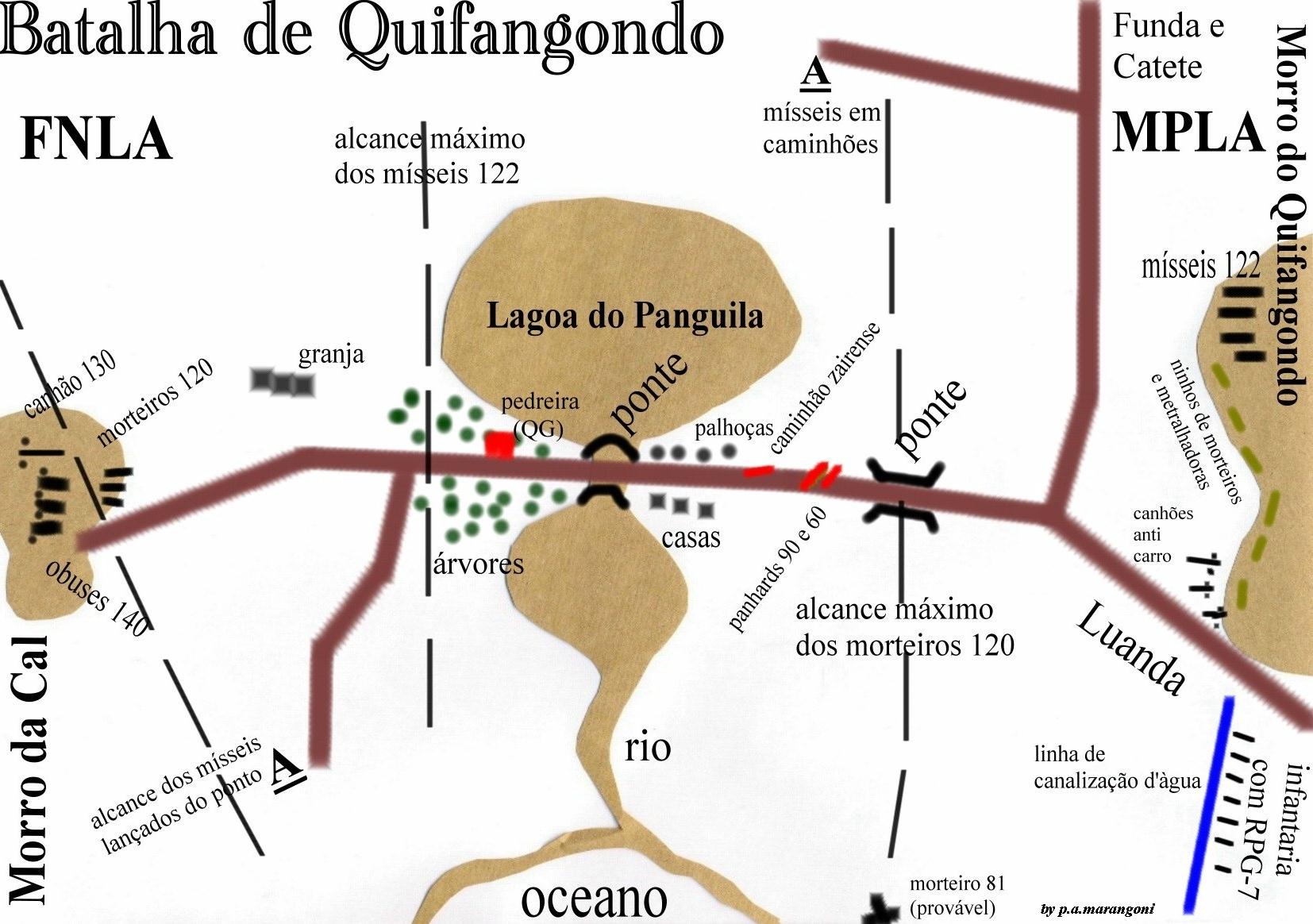
Quifangondo was an unremarkable village thirty kilometers north of downtown Luanda, known primarily for its waterworks -- the reservoir and pumping station that supplied the capital's drinking water. When damage to the Dondo hydroelectric complex made Luanda even more dependent on these facilities, the village became the key to the capital. Whoever held Quifangondo controlled Luanda's water supply. After being expelled from Luanda in street fighting, the FNLA had retreated to the port of Ambriz and begun planning a decisive thrust south. Roberto boasted he would capture the capital before independence day. His force assembled north of Quifangondo included about 600 FNLA regulars, 700 Zairean paratroopers, nine Panhard armoured cars crewed by Portuguese mercenaries, South African artillery crews manning antiquated BL 5.5-inch guns, and two Zairean 130mm field guns. Opposing them, FAPLA's 9th Brigade had dug in along the Bengo River with ZiS-3 divisional guns, B-10 recoilless rifles, six portable Grad-P rocket launchers, and a small contingent of Cuban military advisers.
Forty Minutes That Changed Everything
The assault began at 7:40 a.m. The nine Panhard armoured cars emerged from palm groves and advanced down the open highway toward the Bengo River bridge, trailed by jeeps mounting recoilless rifles and then the infantry on foot. Morale was high -- from the heights of Morro de Cal, the attackers could see Luanda itself. Roberto's entire force squeezed onto a single road flanked by lagoons and coastline, with no attempt to disperse. The FAPLA defenders held their fire. Commander Monteiro "Ngongo" had positioned his forces with strict orders: wait until the entire attacking column was enclosed in a predetermined kill zone on the elevated highway over Panguila Lake. When the lead armoured cars approached the river and opened fire on the trenches, Monteiro gave the order. The ZiS-3 guns knocked out the three trailing armoured cars first, trapping the rest of the column on the road with no avenue of retreat. In quick succession, all nine Panhards and six jeeps were destroyed. Cuban anti-aircraft guns, repurposed as ground weapons, raked the exposed infantry. Then the Grad-P rockets began falling on the road.
Collapse on the Highway
The FNLA infantry broke after the first rocket salvo. Soldiers fled or threw themselves into swampy ground beside the road. Roberto ordered his six CIA-supplied 120mm mortars forward, but when they reached the firing line, their firing pins were inexplicably missing. The Zairean artillery fared no better: one field gun exploded when its crew accidentally double-loaded the propellant, killing everyone manning it. The second gun was disabled by a misfire that wounded its crew. South African gunners kept firing but lacked the range to reach the Grad-P positions and could not match their rate of fire. John Stockwell, the CIA officer managing American involvement, later estimated that two thousand rockets rained on the task force as it broke and fled. The Kikongo name for the battle -- Nshila wa Lufu, "Death Road" -- came from the carnage on that narrow highway. The single South African casualty was a gunner wounded by a shell fragment; the FAPLA and Cuban defenders suffered minimal losses. By midday it was over.
Independence at Midnight
That evening, as the shattered remnants of Roberto's army streamed north toward Ambriz, MPLA leader Agostinho Neto stood in Luanda and proclaimed the People's Republic of Angola at midnight on 11 November 1975. The FNLA never recovered. Roberto's force disintegrated over the following weeks, and by December the movement had effectively ceased to exist as a military threat. For Cuba, Quifangondo validated its intervention and set the stage for a sixteen-year military commitment in Angola. For South Africa, the debacle exposed the limits of covert support and the consequences of fighting under self-imposed constraints -- Canberra pilots ordered too high to aim, artillery too old to compete. The battle also marked the first major deployment of Soviet-supplied BM-21 rocket artillery on the African continent, a weapon system that would reshape the military balance of the entire region. Today, the village of Quifangondo remains a quiet settlement north of Luanda. The waterworks still operate. The highway still crosses the same flat ground where a column of men drove into a kill zone on the last morning before their country became a nation.
From the Air
Located at 8.76S, 13.41E, approximately 30 km north of central Luanda along the main highway. The flat terrain around the Bengo River and Panguila Lake is visible from altitude. Best viewed at 3,000-5,000 feet to appreciate the narrow highway corridor between lagoons that funneled the FNLA assault. Nearest major airport: Quatro de Fevereiro International Airport, Luanda (FNLU), approximately 25 km to the south.