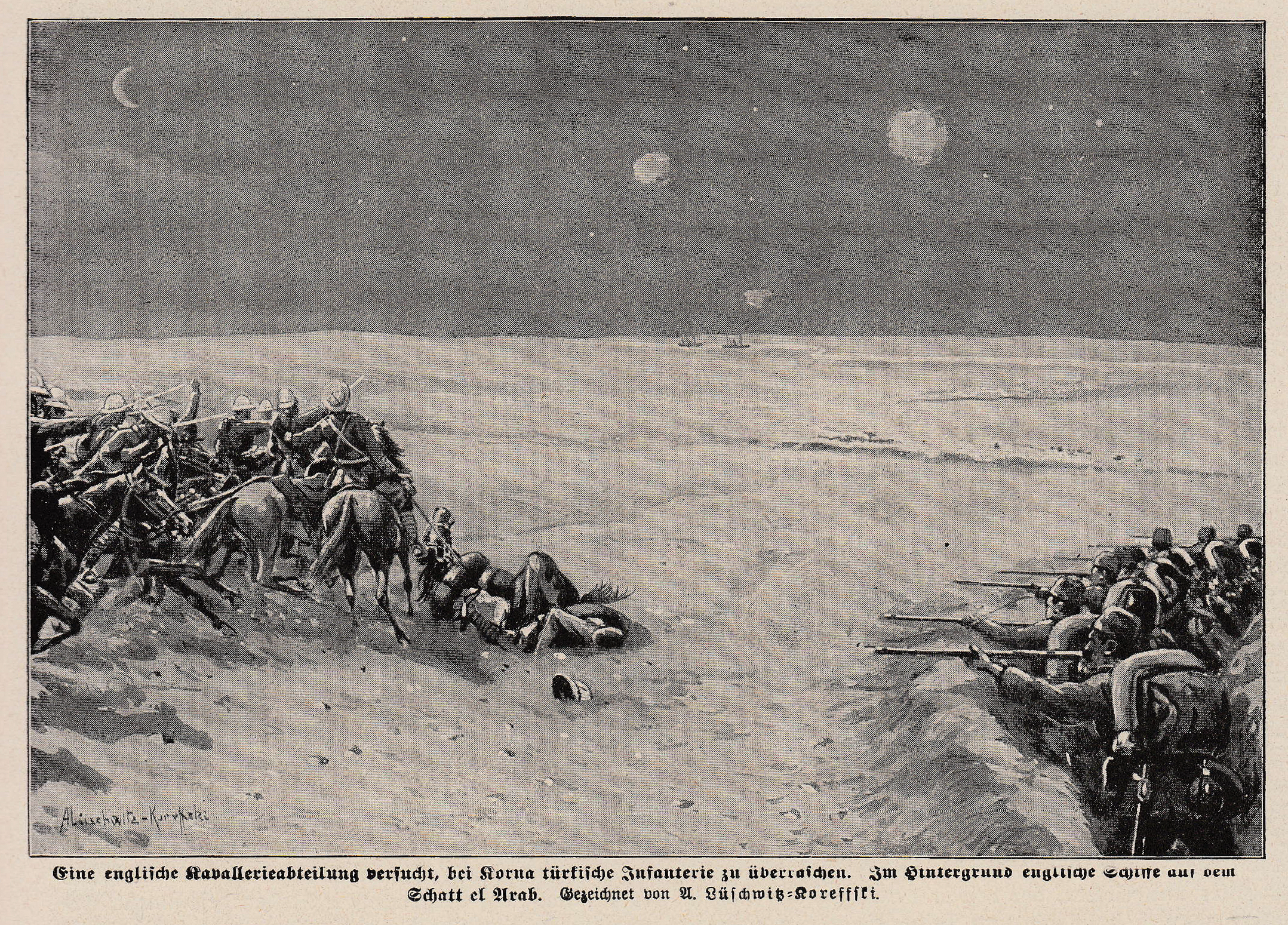
Battle of Qurna
The town of Qurna sits where the Tigris meets the Euphrates, a geographic fact that has shaped its fate for millennia. Local tradition holds this is the site of the biblical Garden of Eden. In December 1914, the garden became a battlefield. Ottoman forces retreating from the fall of Basra dug in at Qurna, recognizing that anyone controlling the confluence of Mesopotamia's two great rivers controlled the region. For six days, British and Indian soldiers tried to cross those rivers under fire. When they finally outmaneuvered the defenders, the Ottoman governor surrendered unconditionally, and Britain's grip on southern Mesopotamia was secured for the duration of the war.
Oil, Empire, and the Road North
The British did not come to Mesopotamia for its history. They came for oil. The Anglo-Persian Oil Company's refinery at Abadan, just across the border in Persia, supplied fuel for the Royal Navy, and its security was a strategic imperative from the moment the Ottoman Empire entered the war on Germany's side in late October 1914. British and Indian forces captured Basra in November, taking an important communications and industrial center. But holding Basra meant holding the rivers that fed it. The Ottomans retreated north up the Tigris, and their commander, Colonel Subhi Bey, the Wali of Basra, chose to make a stand at Qurna. The logic was straightforward: any British advance would require crossing both the Tigris and the Euphrates. With roughly 1,000 men entrenched in the town, Subhi Bey had geography on his side.
Six Days at the Confluence
Major General Charles Irwin Fry commanded the British force of about 2,100 soldiers. On December 3, two Indian battalions, the 104th Wellesley's Rifles and the 110th Mahratta Light Infantry, advanced alongside a double company of the Norfolk Regiment. Royal Navy gunboats on the Euphrates bombarded Ottoman positions while troops attempted to cross the Tigris. They reached the far bank but could not force a crossing into Qurna itself. The attack stalled, and Fry pulled back. Three days later, reinforced by the rest of the Norfolk Regiment, the 7th Rajputs, the 120th Infantry, and mountain guns, the British tried again. The Ottomans had reoccupied positions lost on the 3rd, so every meter of ground had to be retaken. Once more the infantry drove the defenders back. Once more the river crossing into the town proved impossible.
The Gunboat Negotiation
On December 8, Fry changed tactics. He sent the 104th and 110th Infantry upstream along the Tigris to find a crossing point north of the town. They found one, and in doing so cut off the Ottoman garrison's only line of retreat. With gunboats maintaining a steady bombardment from the river, the defenders were trapped. That night, an Ottoman steamer appeared on the dark water, its lights blazing and sirens wailing. Lieutenant Commander Wilfrid Nunn, commanding the gunboat HMS Espiegle, took three Ottoman officers aboard. They proposed terms: surrender the town, but allow the garrison to march away with their arms. Nunn, who had no way to contact Fry, refused anything less than unconditional surrender. The Ottoman officers balked. But with no escape route and no relief coming, they had little choice. On December 9, Colonel Subhi Bey surrendered. Forty-two Ottoman officers and 989 soldiers went into captivity.
The Cost and the Consequence
British and Indian casualties were 27 soldiers killed and 242 wounded. Two sailors died and 10 were wounded. The numbers were modest by the standards of the Western Front, where tens of thousands were already falling in a single engagement. Historians have sometimes classified Qurna as more of a skirmish than a proper battle. But its strategic consequences were significant. With the confluence secured, the British held a defensible front line across southern Mesopotamia. Basra was no longer vulnerable to a flanking attack from the north. The oil refinery at Abadan was safe. The Mesopotamian campaign would continue for four more years, and the next Ottoman challenge would come at the Battle of Shaiba in April 1915. Eventually the British would push all the way to Baghdad, a campaign that would cost far more blood and prove far more difficult than the relatively clean victory at Qurna suggested.
The Rivers Remember
Qurna, known today as al-Qurnah, remains a small town in Basra Governorate. The confluence of the Tigris and Euphrates still defines it. The rivers merge here to form the Shatt al-Arab, which flows southeast to the Persian Gulf. The surrounding landscape has changed dramatically since 1914. The vast marshes that once spread north and east of the town were largely drained in the late twentieth century and have only partially recovered. The soldiers who fought here, British regulars from Norfolk and Indian sepoys from Rajputana and Maharashtra, struggled through terrain that was as much water as land. Their battle secured a strategic crossroads that had mattered since the Sumerians first settled these banks. Geography does not change. Whoever holds the point where Mesopotamia's rivers converge holds the key to southern Iraq.
From the Air
Located at approximately 31.02N, 47.43E at the confluence of the Tigris and Euphrates rivers in Basra Governorate, Iraq. The town of al-Qurnah is visible where the two rivers merge to form the Shatt al-Arab. The nearest major airport is Basra International (ORMM), approximately 60 km to the southeast. From altitude, the junction of the two rivers is clearly identifiable. The surrounding terrain is flat marshland and agricultural land.