Battle of Raate Road
Among the equipment the Finns captured on the Raate Road in January 1940, they found something unexpected: a full set of musical instruments—tubas, drums, banners, sheet music. The Soviet 44th Rifle Division had packed a military band for the victory parade it planned to hold after cutting Finland in two. Instead, the division was destroyed in one of the most lopsided defeats of the Winter War. The instruments became a grim punchline, but the battle itself was anything but funny. Thousands of soldiers on both sides died in temperatures that plunged below minus thirty on a narrow road carved through frozen marshland.
A Rescue Column Walks Into a Trap
The battle grew from the larger fight at Suomussalmi. After the Soviet 163rd Rifle Division captured the village on 7 December 1939, Finnish forces under Colonel Hjalmar Siilasvuo systematically cut its supply routes. By 11 December, the Finns had blocked the Raate Road, the division's southern lifeline. Two days later, the northern supply route was also severed. The 163rd Division commander, Andrei Zelentsov, asked permission to retreat on 20 December. Instead, Moscow ordered the 44th Rifle Division—a well-equipped Ukrainian formation of nearly 14,000 men with tanks and artillery—to advance along the Raate Road and rescue the 163rd. Commander Vinogradov moved his division into position but, incredibly, made no serious attempt to relieve the 163rd as it was being destroyed virtually within earshot. By 28 December, he ordered his men to dig in for defense. The 44th Division was now stretched over 20 miles of narrow road between the Haukila farm and the Soviet border.
Motti by Firelight
On New Year's Day 1940, Siilasvuo deployed four task forces for coordinated flank attacks along the length of the Soviet column. That first night, Lassila's battalion of Regiment JR 27 overran a Soviet artillery position just 500 yards east of Haukila farm. The Finns set up roadblocks in both directions and positioned antitank guns against the counterattacks that came the following morning. Over the next six days, Finnish ski troops carved the Soviet column into isolated pockets—mottis—targeting field kitchens and their campfires with particular focus. Without hot food in sub-Arctic winter, soldiers die fast. By 4 January, Finnish guerrilla forces had cut the road at multiple points. Siilasvuo ordered the final assault for 5 January. Soviet resistance was fierce enough to slow the advance, but the Finns destroyed the Purasjoki bridge, eliminating any further truck movement.
Frozen Retreat
Despairing Soviet troops began fleeing north across frozen Lake Kiantajärvi. Many froze to death without proper clothing. Others tried to escape east toward the border but were blocked by Finnish squadrons. On 7 January, the last organized Soviet resistance was suppressed. For two more days, Finnish troops rounded up hundreds of starving, freezing Soviet soldiers. Remnants of the 44th Division scattered into the northern forests, pursued by Finns, finally reaching the Soviet border in small, broken groups. The scale of captured materiel was enormous—over 5,000 rifles, enough that the North Finland Group replaced 1,200 of its old weapons with newer Soviet models. Recent Finnish studies estimate Soviet losses at 7,000 to 9,000 men, though the Stavka's own commission reported 4,674 casualties from a division of nearly 14,000.
The Reckoning on Both Sides
The Soviet aftermath was brutal. Commander Vinogradov and two of his chief officers, Volkov and Pahomov, had retreated during the fighting. When they reached Soviet lines four days later, they were court-martialed and executed immediately. A Ukrainian veteran of the battle, Sergeant Pyotr Morozov, later told Finnish writer Leo Karttimo that the Finns returned prisoners of war after the conflict—but the NKVD executed every one of them in the summer of 1940. The fate of the 44th Division went unmentioned in Soviet histories for decades. The Finns buried the Soviet dead in mass graves as spring came, marking them with crosses and poles on maps that later disappeared.
Stones for the Fallen
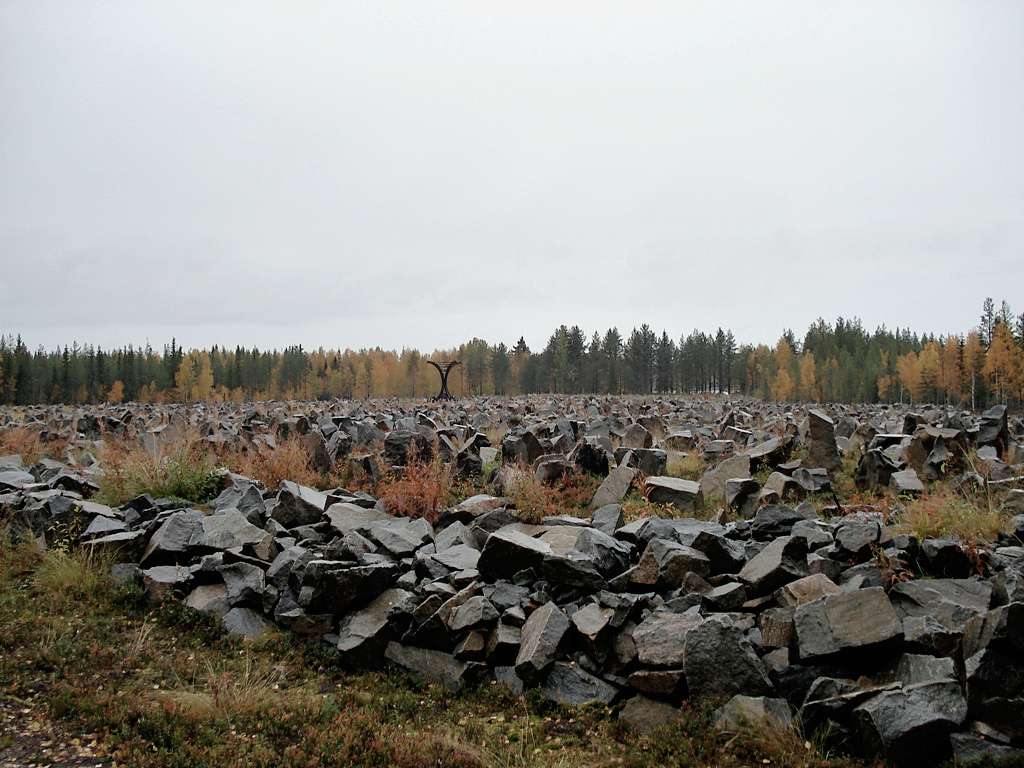
Today the Raate Road is the site of the Monument of the Winter War, designed by sculptor Erkki Pullinen and dedicated to all who died on both sides. The memorial's most striking element is a field of thousands of stones—symbolic gravestones for the Soviet soldiers who fell in the battle and whose actual graves were lost. Russia installed its own monument in September 1994. Ukraine added one in the spring of 1998, honoring the men of the 44th Division, many of whom had been recruited from Ukrainian territory. The road itself is quiet now, a narrow track through birch and pine where the only sounds are wind and the occasional call of a bird. The victory parade never happened, but the fallen are finally acknowledged.
From the Air
Located at 64.85°N, 29.33°E along the Raate Road east of Suomussalmi in the Kainuu region of eastern Finland. The road runs east toward the Russian border through dense boreal forest and frozen marshland. Lake Kiantajärvi is visible to the north. The Monument of the Winter War is located along the road. Recommended viewing altitude: 3,000–8,000 ft AGL to trace the road corridor through the forest. Nearest airport: Kajaani (EFKI), approximately 130 km southwest.