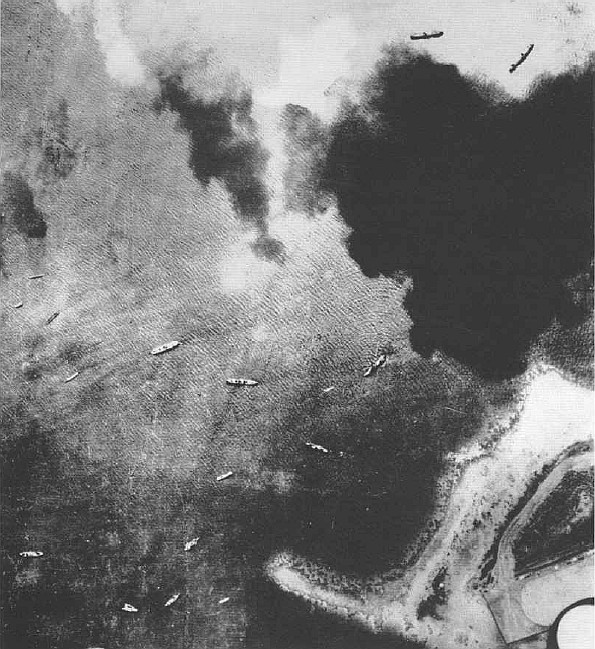
Battle of Rabaul (1942)
They were told to hold. Lark Force - 1,400 Australians built around the 2/22nd Battalion - had been sent to a forward observation post on the northeastern tip of New Britain, with orders to watch Japanese movements and provide surveillance from the RAAF airfield at Vunakanau. The garrison had no realistic prospect of reinforcement. Allied planners in Melbourne had quietly concluded as much, but the men in Rabaul were not told. The 2/22nd Battalion Band had been recruited entirely from the ranks of the Salvation Army - likely the only military unit in history to carry that distinction - and they had marched to their postings playing brass instruments. On 23 January 1942, the Japanese came ashore with a force many times their size.
A Forward Post With No Way Home
Rabaul sits at the eastern end of New Britain, the capital of what was then the Australian-administered Territory of New Guinea, taken from the Germans in 1914. Throughout 1941, as tensions with Japan rose, Australia sent small reinforcements - Lieutenant Colonel Howard Carr's 700-strong 2/22nd Battalion, a coastal defence battery, an anti-aircraft battery, an anti-tank battery, a field ambulance detachment, and the local New Guinea Volunteer Rifles. Lark Force, under Lieutenant Colonel John Scanlan, was to defend the airfield and flying boat anchorage. The RAAF contingent at Vunakanau, commanded by Wing Commander John Lerew, had only ten lightly armed CAC Wirraway training aircraft and four Lockheed Hudson light bombers. Plans for a radar station, a minefield, and a proper fleet anchorage had been discussed and shelved. The decision to keep the garrison in place, despite the certainty that it could not be reinforced or withdrawn if attacked, was deliberate.
The Invasion
The Japanese South Seas Detachment, under Major General Tomitaro Horii, was tasked with taking Kavieng on New Ireland and Rabaul on New Britain. The attack came on 23 January 1942, preceded by air raids that destroyed the Australian coastal artillery. Australian infantry were quickly forced back. An RAAF Catalina flying boat found the invasion fleet off Kavieng and got a signal away before being shot down. Within days, the battalion positions around Rabaul had collapsed. Some Australians escaped into the jungle and walked out over weeks, living on what the villages of New Britain could spare them. Hundreds more did not. They were captured. And some of those captured would not survive the weeks immediately following the battle.
Tol Plantation
In early February, roughly 160 Australian soldiers who had surrendered or been caught on the south coast of New Britain were taken to the Tol and Waitavalo plantations. Most were tied, hands behind their backs, in small groups. They were bayoneted or shot. A handful - perhaps six men - survived because they were knocked unconscious and left for dead, or because a bayonet missed something vital. They made it into the jungle and eventually to Australian lines. It is because of them that the massacre is known at all. The men who died at Tol were not combatants in that moment. They had been disarmed. Many had surrendered believing they would be treated as prisoners of war. The distinction meant nothing. Their names are recorded on Australian memorials; most were young men from Victoria, where the 2/22nd Battalion had been raised.
The Montevideo Maru
The Australians who had been taken into captivity at Rabaul - soldiers and civilian internees together - were held there through the first half of 1942. On 22 June, around 1,050 prisoners were loaded onto the Montevideo Maru, a Japanese merchant ship converted to carry them north to Hainan Island. The ship was unmarked. No one aboard the vessel wore anything to distinguish her cargo from a legitimate military target. On 1 July 1942, off the northwest coast of Luzon in the Philippines, the American submarine USS Sturgeon fired torpedoes at what her captain took to be a troop transport. The Montevideo Maru went down in about eleven minutes. At least 800 Australian soldiers and more than 200 civilian prisoners - planters, missionaries, administrators, many of them men Lark Force had been sent to protect - died in the water or with the ship. It remains the worst maritime disaster in Australian history. Only the Japanese crew survived, and the sinking was not reported to Australia until after the war; families waited three and a half years to learn what had happened. The wreck was located in 2023, resting on the seabed more than 4,000 meters deep.
What Rabaul Became
The Japanese held Rabaul for the rest of the war. They turned it into the largest Japanese base in New Guinea - the anchor of their defensive line in the South West Pacific - and from it launched the push toward Port Moresby that would grind itself to a halt on the Kokoda Track and at Milne Bay. The Australians tried to restrict Rabaul's development with a bombing counterattack in March 1942, but it was not until Operation Cartwheel in 1943 that the Allies began the systematic air campaign that would isolate the base rather than capture it. By 1945, tens of thousands of Japanese troops were still dug into Rabaul's tunnels and positions, cut off from supply and waiting for a war that had moved on without them. Cleanup efforts continued past the late 1950s. Relics still surface in the jungle: rusted aircraft, abandoned guns, tunnel entrances that reveal themselves after a heavy rain. For the families of the men of Lark Force, Rabaul is less a place than a question - about decisions made in Melbourne, about a promise of protection that could not be kept, and about the long silence after July 1942.
From the Air
Rabaul lies at 4.20 degrees S, 152.17 degrees E, on the Gazelle Peninsula at the northeastern tip of New Britain. The town sits on the rim of a massive volcanic caldera forming Simpson Harbour - one of the finest natural deep-water harbors in the Pacific and the strategic prize that drew Japanese forces here in 1942. The active volcanoes Tavurvur and Vulcan flank the harbor entrance; Tavurvur's 1994 eruption buried much of the old town. Tokua Airport (AYTK / RAB) now serves the area from the new town site 20 km east. Recommended viewing altitude 6,000-10,000 ft to see the caldera, the harbor, the volcanic cones, and the layout of the former Vunakanau and Lakunai airfields. Nearest alternates: Hoskins (AYKB) on the northern coast of New Britain roughly 200 nm west, and Kavieng (AYKV) on New Ireland 140 nm north.