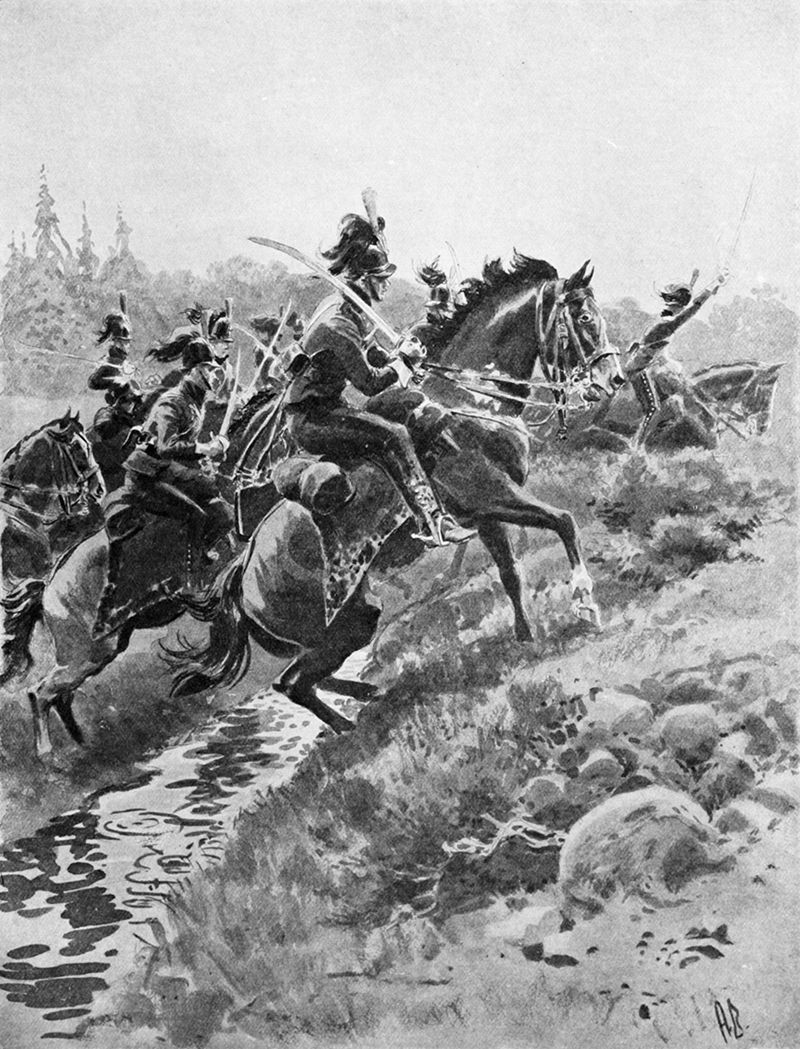
Battle of Rakkestad
On the morning of August 6, 1814, Swedish soldiers waded into the cold waters of a Norwegian river, building a bridge under enemy fire while their six-pounder cannons roared overhead. The Norwegians had destroyed the original crossing at Rakkestad and fortified themselves behind the river, certain their position was impregnable. They were wrong. Within hours, a disciplined bayonet charge would sweep them from their defenses and send shockwaves through the Norwegian command that would help end a war in just eight days.
A War for Independence
The Swedish-Norwegian War of 1814 erupted from the chaos of Napoleonic Europe. Norway, long united with Denmark, suddenly found itself promised to Sweden by the Treaty of Kiel. Rather than accept this fate, Norwegians drafted a constitution at Eidsvoll and declared independence under their own king, Christian Frederik. Sweden's Crown Prince Charles John, the former French Marshal Bernadotte, was not about to let this prize slip away. He sent his armies across the border, beginning a brief but bloody campaign that would decide Scandinavia's future.
The Trap That Failed
Christian Frederik had assembled between 5,000 and 6,000 men to break the Swedish blockade of Halden and its formidable Fredriksten fortress. But when news arrived that Swedish forces had captured Fredrikstad, the king's confidence collapsed. His southern flank was exposed, his army risked encirclement, and he ordered a retreat to the Glomma River. General Frederik Wilhelm Stabell took position at Rakkestad with somewhere between 1,700 and 4,000 troops, destroying the bridge and digging in behind the water. They had the advantage of terrain, the river as their moat, and time to prepare their defenses. What they lacked was the will to hold them.
Bayonets at the River
Swedish General Eberhard von Vegesack arrived with between 2,000 and 3,000 men and four guns. His reconnaissance revealed the Norwegian weakness: their right flank. Under covering fire from his six-pounders, which vastly outclassed the Norwegian one-pounders, his engineers threw up a temporary bridge. The Varmland Jagers exchanged fire across the water, keeping the Norwegian center pinned. The moment the crossing was complete, Vegesack personally led the Varmland Jagers and Skaraborg infantry in an all-out bayonet assault. The Norwegian right buckled, then broke. With the flank collapsing, a second Swedish force crossed at another temporary bridge. Norwegian reinforcements under P. H. Butenschon arrived too late, using a forest for cover to briefly slow the Swedish advance before being thrown back by the relentless Jagers.
The Price of Defeat
The casualty figures told the story of a rout: the Swedes lost as few as 11 to 15 dead and 36 to 45 wounded. The Norwegians suffered 100 to 150 killed and wounded, with 40 captured including a captain. But the true damage was psychological. King Christian Frederik, already shaken by Fredrikstad's fall, saw his defensive strategy crumbling. Vegesack pressed his advantage, joining forces with Bror Cederstrom and pushing on to Flatestad, Tromborg, and Askim. At Trogstad on August 11, he captured 200 more Norwegian soldiers. The Swedes now controlled everything east of the Glomma, south of Oyeren.
Eight Days to Peace
The Battle of Rakkestad did not merely defeat a Norwegian force; it broke Norwegian resolve at the highest levels. Eight days after those bayonets cleared the river crossing, on the same day as the Battle of Kjolberg Bridge, the Convention of Moss was signed. Norway would enter a personal union with Sweden, though it would keep its new constitution. For the soldiers who fought and died at that river crossing, the battle had determined the shape of Scandinavian politics for nearly a century, until Norway finally gained full independence in 1905.
From the Air
Located at 59.37N, 11.42E near the village of Rakkestad in Ostfold county, southeastern Norway. The battlefield sits in the rolling agricultural landscape between the Glomma River and the Swedish border. Best viewed at 3,000-5,000 feet AGL. The river crossing that defined the battle can be identified by following the waterway through the village. Nearest airports: ENGM (Oslo Gardermoen) 50nm northwest, ENRY (Rygge) 30nm southwest. The terrain is relatively flat farmland interspersed with forests typical of this border region.