Battle of Ramnagar
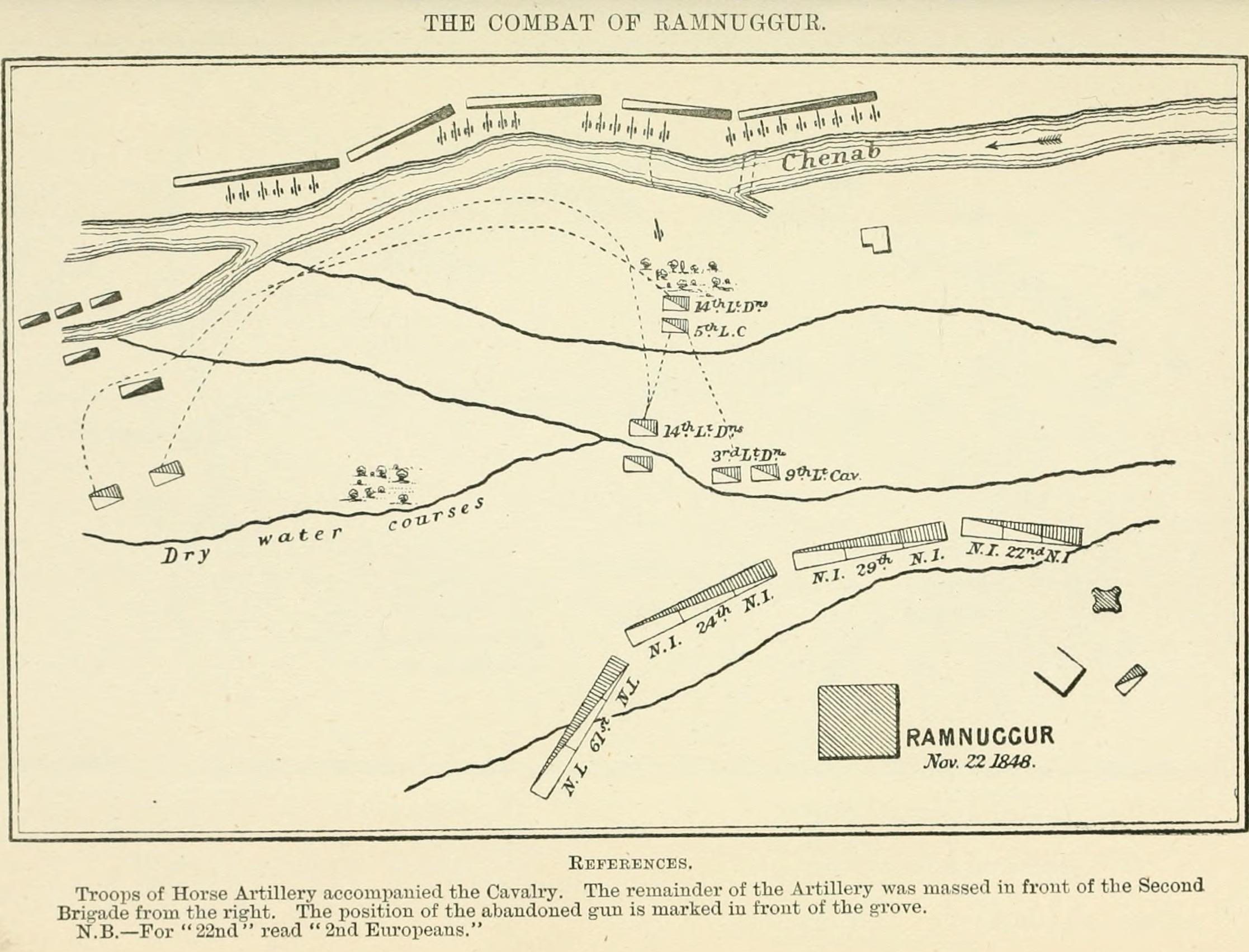
Colonel William Havelock led his charge without orders. The 14th Light Dragoons thundered down the riverbank after retreating Sikh horsemen, and then the trap closed -- Sikh artillery opened up from concealed positions, and the cavalry that had appeared to flee wheeled around and struck. Havelock and his leading troopers were surrounded and cut down. When Brigadier Charles Robert Cureton galloped forward to order a retreat, a musket ball killed him too. It was 22 November 1848, and the British Empire had just been humiliated at the Chenab River crossing near Ramnagar by a Sikh army that had done everything right while the British had done almost everything wrong.
A War Born of Betrayal
The Second Anglo-Sikh War grew from the wreckage of the first. After the Sikh defeat in 1846, British commissioners and political agents had effectively taken control of the Punjab, using the Sikh Khalsa Army as their instrument while stripping it of autonomy. The Khalsa seethed under this arrangement, convinced -- with considerable justification -- that they had been betrayed by their own leaders rather than truly defeated in battle. When a popular uprising in Multan forced the local ruler Dewan Mulraj into open rebellion in April 1848, the British Governor-General Lord Dalhousie initially responded with a modest force under General Whish. He also ordered Sikh detachments to reinforce the British contingent -- a decision that several junior political agents viewed with alarm, since one of the largest detachments, 3,300 cavalry and 900 infantry, was commanded by Sher Singh Attariwalla, whose father Chattar Singh was openly plotting rebellion in the northern province of Hazara.
The Chenab Trap
On 14 September 1848, Sher Singh made his choice and rebelled. Rather than joining forces with Mulraj at Multan, he moved north and began fortifying the crossings of the Chenab River. It was a shrewd decision. The Chenab in November was reduced to a narrow stream, but the wide riverbed it occupied during monsoon season remained a treacherous expanse of soft sand -- ground that would bog down cavalry and artillery. Sher Singh positioned forces on both banks and on an island midstream, with batteries concealed behind earthworks. When the British finally assembled their army on the Punjab frontier under Commander-in-Chief Sir Hugh Gough -- a general already notorious for ordering costly frontal attacks during the First Anglo-Sikh War -- Sher Singh was ready. Gough sent a force of cavalry and horse artillery with a single infantry brigade toward the Chenab crossing in the early hours of 22 November, apparently hoping to take the position by surprise. There would be no surprise.
Charges Into Sand
At dawn, the British assembled opposite the fords. The 3rd Light Dragoons and 8th Bengal Light Cavalry pushed some Sikh defenders back across the river from positions on the east bank. Then the concealed batteries opened fire. British cavalry found themselves struggling in the soft sand, unable to maneuver. Gough's horse artillery was outgunned and forced to retire, abandoning a 6-pounder cannon hopelessly bogged in the riverbed. Brigade commander Sir Colin Campbell called for troops to recover the gun but was overruled by Gough. Sher Singh then sent 3,000 horsemen splashing across the fords to exploit the British confusion. Gough ordered a countercharge -- the 14th Light Dragoons and 5th Bengal Light Cavalry drove the Sikh horsemen back but pursued too far along the riverbank, straight into the killing zone of Sikh artillery. The Sikh cavalry reversed course and struck the 5th Light Cavalry, inflicting heavy casualties. It was at this point that Havelock led his unauthorized, fatal charge, and Cureton rode to his death trying to restore order.
Lessons Written in Sand
Official British casualties were modest in absolute terms: 26 killed or missing, 59 wounded. But among the dead were a brigadier general and a regimental commanding officer, and the damage to British prestige was far greater than the body count suggested. Sher Singh had used every advantage of terrain and preparation with skill. His concealed batteries, his feigned withdrawals, his exploitation of the soft ground -- all spoke to a commander who understood his enemy's weaknesses. Gough had ordered an attack with almost no reconnaissance. Havelock had charged without orders. Cureton, the one officer with a reputation for steadiness from the First Sikh War, had been relegated to a subordinate role instead of commanding from the start. The Sikh army's main positions remained intact, their morale surging. For the soldiers of the Khalsa, Ramnagar was proof that the British could be beaten -- that courage combined with tactical intelligence could turn imperial confidence into confusion among the sand and water of the Chenab.
From the Air
Located at 32.32N, 73.83E on the Chenab River in present-day Punjab, Pakistan. The wide Chenab riverbed and its crossing points are visible from altitude. Ramnagar sits on the east bank. Nearest airports include Sargodha (OPSR) approximately 80 km to the southwest and Islamabad (OPIS) approximately 200 km to the northwest. The flat Punjab plain and river system are clearly visible from 5,000-10,000 feet AGL.