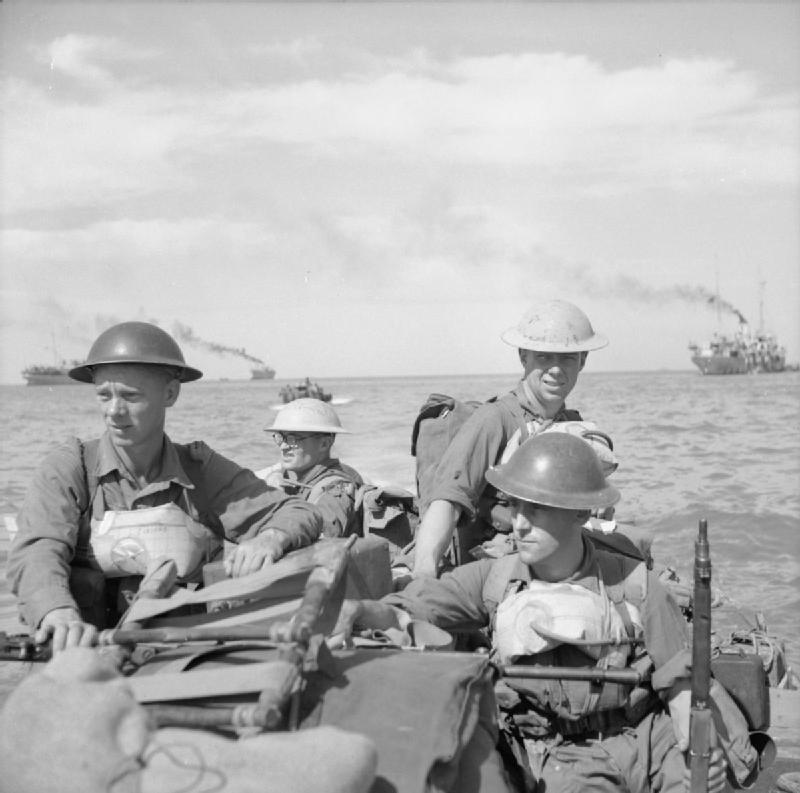
Battle of Ramree Island
Of about one thousand Japanese soldiers that entered the swamps of Ramree, only about twenty were found alive. So wrote Bruce Wright, a Canadian naturalist and Burma veteran, in 1962 -- and the Guinness Book of World Records duly recorded it as the deadliest animal attack in history. The story is almost certainly wrong. But the battle that inspired it, Operation Matador, was real enough: a five-week amphibious campaign on a flat, mangrove-fringed island off Burma's Arakan coast, fought between the 26th Indian Infantry Division and a determined Japanese garrison in the closing months of World War II. What happened in those swamps remains one of the war's most persistent and contested legends.
Why Ramree Mattered
By January 1945, Lieutenant General William Slim's Fourteenth Army was advancing into central Burma, but its supply lines were stretched dangerously thin. The airbases at Imphal and Agartala would soon be out of range. The Allies needed forward airfields, and Ramree Island -- flat, long, and sitting just south of recently captured Akyab -- was an obvious site. A plan was ready by 2 January. The island's Japanese garrison consisted of the II Battalion, 121st Infantry Regiment under Colonel Kan'ichi Nagazawa, part of the 54th Division, reinforced with artillery and engineer detachments. They were outnumbered and isolated, but they intended to fight. The 26th Indian Infantry Division, freshly available after the capture of Akyab, received orders on 14 January to attack within a week.
Fire from the Sea
The assault opened on 21 January 1945 with a bombardment that left little doubt about Allied naval superiority. An hour before the 71st Indian Infantry Brigade was to land, the battleship Queen Elizabeth opened fire with her main battery, while aircraft from the escort carrier Ameer spotted the fall of shot. The light cruiser Phoebe added her guns, and B-24 Liberators, B-25 Mitchells, and P-47 Thunderbolts of 224 Group RAF strafed and bombed the beaches. Despite this overwhelming firepower, the landing did not go perfectly -- a motor launch and a landing craft struck mines. But the assault troops reached the beaches west of Kyaukpyu without opposition and secured the beachhead by afternoon. The following day, the 4th Indian Infantry Brigade landed and occupied the port town. On nearby Cheduba Island, Royal Marines landed on 26 January and found it unoccupied.
Into the Swamps
The Japanese garrison resisted with what the British official historian Stanley Woodburn Kirby later called great determination. As the 71st Brigade advanced south down the west coast and then swung inland toward Ramree town, the defenders fought at every river crossing and chaung. The town of Ramree fell on 9 February after tanks reinforced the infantry assault. But the real crisis for the Japanese came when the British outflanked their strongholds. Retreating soldiers attempted to cross the island through miles of mangrove swamp to reach the eastern coast, where rescue craft from the mainland might evacuate them. The British encircled the swamp. Trapped in deep, mud-filled terrain, the Japanese soldiers faced not only enemy fire but tropical disease, scorpions, mosquitoes, and the saltwater crocodiles that inhabited the tidal channels. The navy blockaded the eastern chaungs while the 26th Division tightened the cordon. Resistance ended on 17 February, and the blockade held until 22 February, sinking many of the forty small craft Japan sent from the mainland. Some soldiers escaped. Most did not.
Anatomy of a Legend
On 24 February 1945, Reuters correspondents reported that Japanese soldiers were 'being forced by hunger out of the mangrove swamps and many have been killed by crocodiles.' Wright's 1962 account elaborated the story into something cinematic, and it entered popular culture through the Guinness Book of World Records. But the evidence does not support a mass crocodile attack. In 2000, herpetologist Steven Platt visited Ramree and interviewed residents who had lived through the battle. They unanimously dismissed the crocodile narrative, telling him the only crocodile-related deaths occurred when ten to fifteen soldiers were killed trying to ford Min Chaung, a tidal creek. Platt also established that Wright had not been on the island during the battle itself. Historian Sam Willis, researching in 2016, found documents indicating the Japanese soldiers mostly drowned or were shot, with crocodiles scavenging corpses afterward. Woodburn Kirby's official history recorded about 500 Japanese killed and 20 taken prisoner, calling British losses 'trifling' -- but he attributed the deaths to combat and the hazards of the retreat, not to a reptilian massacre.
What Remains
The airfield that justified the entire operation did not become operational for transport sorties until 16 April 1945, weeks after Akyab's field came into use on 1 April. The urgency had been real: Operation Dracula, the assault on Rangoon, needed to launch by early May to beat the monsoon. The cooperation between the 26th Indian Division and the Royal Navy in the chaungs and small ports of the Arakan coast provided valuable experience for that coming operation. But Ramree is remembered less for its strategic outcome than for its legend. The crocodile story persists because it is vivid, horrifying, and difficult to fully disprove -- soldiers did die in those swamps, crocodiles do inhabit them, and the circumstances were genuinely nightmarish for the men trapped there. The truth is grim enough without embellishment: nearly a thousand Japanese soldiers died on Ramree Island, most of them in a desperate retreat through terrain that killed as effectively as any enemy.
From the Air
Ramree Island is located at approximately 19.43N, 93.55E off the western coast of Myanmar (Burma) in Rakhine State. The island is flat and elongated, separated from the mainland by a narrow strait. Mangrove swamps are visible along the eastern shore. The town of Kyaukpyu sits at the northern end. Nearest airport is Sittwe (VYSW) approximately 80 km to the north. Cheduba Island is visible to the southwest. Recommended viewing altitude 3,000-8,000 feet to see the island's shape, the mangrove channels, and the strait separating it from the mainland.