Battle of Raphia
It is the only battle in recorded history where African elephants fought Asian elephants, and the Africans lost. On June 22, 217 BC, two Hellenistic superpowers collided near the small town of Raphia -- modern Rafah -- in a contest that would determine control of Coele-Syria and alter the course of Egyptian civilization. Ptolemy IV Philopator of Egypt fielded 73 African elephants against the 102 Indian war elephants of Antiochus III of the Seleucid Empire. The African elephants, according to the historian Polybius, could not bear the smell, sound, and sight of their Indian counterparts and broke in panic. What happened next, however, was far more consequential than any elephant charge.
Two Kingdoms, One Prize
The third century BC was defined by the rivalry between the two largest successor states of Alexander the Great's empire. Ptolemaic Egypt, ruled from Alexandria, and the Seleucid Empire, stretching from Anatolia to the borders of India, fought a series of conflicts known as the Syrian Wars over control of the Levant. The Fourth Syrian War began in 219 BC when Antiochus III -- energetic, ambitious, and later called "the Great" -- pushed into Coele-Syria, the territory roughly corresponding to modern Lebanon and western Syria. His advance was facilitated by the defection of Theodotus the Aetolian, a former Ptolemaic officer who handed over key positions. One night during the campaign, Theodotus even sneaked into the Ptolemaic camp to assassinate Ptolemy himself, but reached the wrong tent. The king was elsewhere.
The Armies Assembled
The forces that met at Raphia were staggering in scale. According to Polybius, Antiochus commanded 62,000 infantry and 6,000 cavalry drawn from across his vast empire -- Macedonian phalangites, the elite silver-shielded Argyraspides, Persian archers, Thracian warriors, Arabian contingents under Zabdibelus, Greek mercenaries, Cretan bowmen, and 102 Indian war elephants brought overland from the subcontinent. Ptolemy answered with 70,000 infantry and 5,000 cavalry, including his own Macedonian phalanx, Greek mercenaries, Cretan archers, and Libyan troops. Critically, his army also included 20,000 native Egyptians trained in the Macedonian manner under the chief minister Sosibius -- the first time in Ptolemaic history that such a large proportion of Egyptian-born soldiers fought in the phalanx alongside Macedonians.
Elephants and Phalanxes
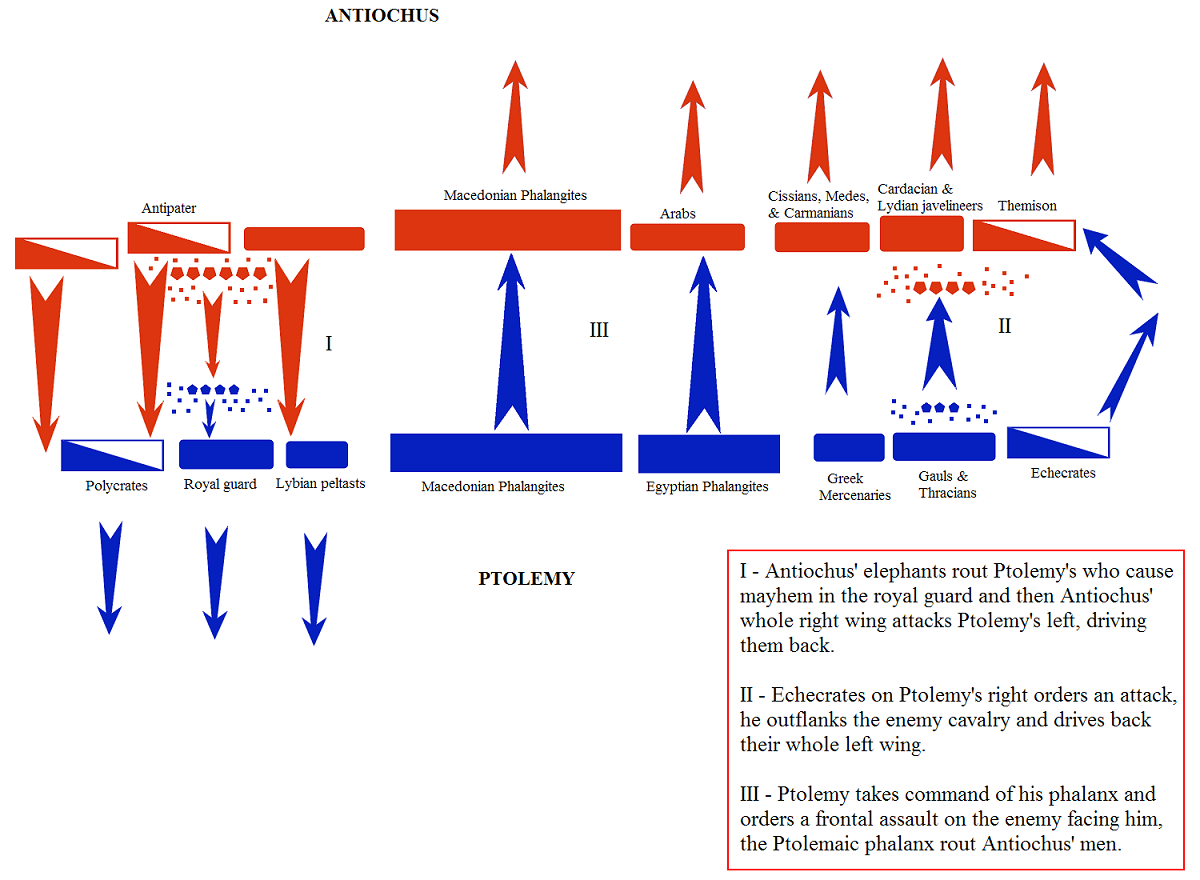
After five days of skirmishing, the two kings arranged their armies for battle. Both placed their phalanxes in the center, light infantry and mercenaries on the flanks, elephants in front of the wings, and cavalry on the far edges. The battle opened with the elephant contingents charging. Ptolemy's African elephants -- likely a smaller variety, possibly from populations still found in Eritrea or the now-extinct North African subspecies -- panicked before the larger Indian animals and stampeded through their own infantry, sowing chaos. On the right wing, Antiochus personally led his cavalry to rout the Ptolemaic horsemen and chased them from the field, believing he had won. He was wrong. In the center, Ptolemy rode among his phalangites, urging them forward "with alacrity and spirit," as Polybius records. The Ptolemaic phalanx, reinforced by the newly trained Egyptians, drove the Seleucid phalanx backward. By the time Antiochus turned around, his army was broken.
The Victory That Changed Egypt
Seleucid losses were severe: nearly 10,000 infantry dead, 300 cavalry killed, 5 elephants lost, and 4,000 men captured. Ptolemaic casualties were lighter -- 1,500 infantry and 700 cavalry -- though most of their elephants were captured. Antiochus retreated to Gaza and requested a truce to bury the dead, which Ptolemy granted. The victory secured Coele-Syria for Egypt, though only temporarily; seventeen years later, at the Battle of Panium in 200 BC, Antiochus would defeat Ptolemy's young son and reclaim the territory. But Raphia's true significance was internal. The 20,000 Egyptian soldiers who had fought in the phalanx emerged with a new self-confidence. Polybius credited this directly as one of the causes of a major secession: between 207 and 186 BC, Upper Egypt broke away under native pharaohs Hugronaphor and Ankhmakis, forming a separate kingdom that lasted nearly twenty years.
A Turning Point Written in Stone
The battle of Raphia marked a fundamental shift in Ptolemaic civilization. The native Egyptian element in administration and culture grew steadily more influential, driven by the recognition that Egyptians had saved the dynasty at its moment of greatest military need. A stele recording a convocation of priests at Memphis in November 217 BC, giving thanks for the victory, was inscribed in Greek, hieroglyphic, and demotic Egyptian. For the first time, it gave Ptolemy full pharaonic honors in the Greek text as well as the Egyptian -- a symbolic merger of the two traditions that became standard practice for subsequent rulers. The Greek overlords of Egypt, it turned out, needed Egyptian soldiers to win their wars. And once those soldiers knew their own worth, the balance of power within the kingdom shifted permanently.
From the Air
Located at 31.289N, 34.252E near modern Rafah on the Egypt-Gaza border. The battlefield was on flat coastal plain terrain. Best viewed at 5,000-10,000 feet AGL. The area is near the Mediterranean coast in the southern Levant. Nearest airports include LLBG (Ben Gurion International) approximately 45 nm north-northeast and HEAR (El Arish International) approximately 50 nm southwest. Terrain is flat, low-lying coastal plain.