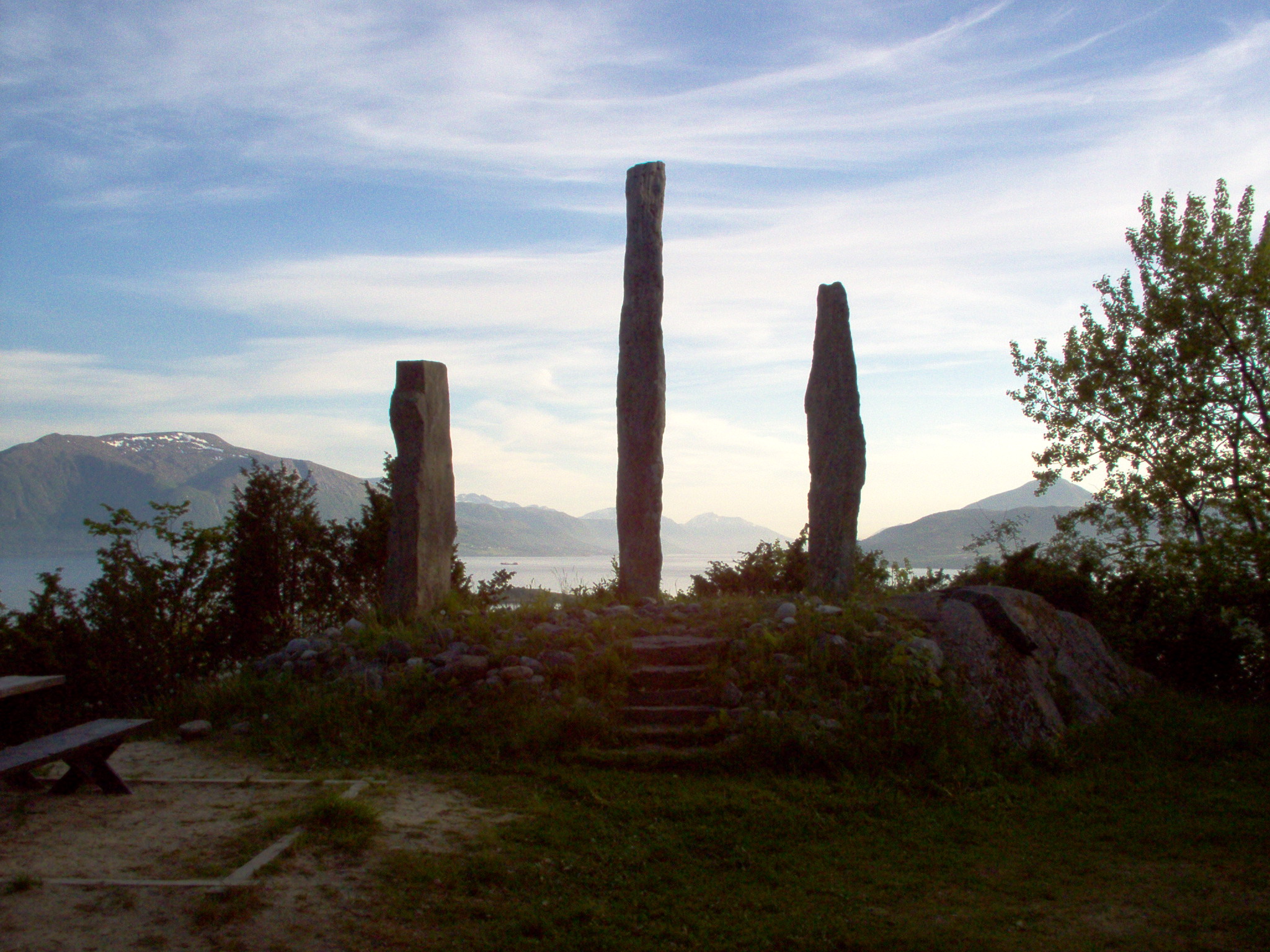
Battle of Rastarkalv
The fires started at Stadlandet and spread north along the coast, cairn by cairn, hilltop by hilltop. Each blaze was a single word in a language every Norwegian understood: enemy fleet approaching. By the time the chain of beacon fires reached Nordmore, King Haakon the Good already knew what was coming. The sons of Eirik Bloodaxe, backed by King Harald Bluetooth of Denmark, were sailing north to seize the Norwegian throne. In 955, on the southern coast of the island of Frei, the two forces collided in a battle that would shape the Viking Age struggle for control of Norway.
The Bloodaxe Legacy
The roots of Rastarkalv lay in a family feud of extraordinary violence, even by Viking standards. Eirik Bloodaxe, the eldest son of Norway's first king Harald Fairhair, had ruled briefly and brutally before being driven from the kingdom. After Eirik's death, his sons, led by Harald Greycloak, refused to accept their exile. They allied with King Harald Bluetooth of Denmark, gaining both men and ships for repeated attempts to reclaim what they considered their birthright. Haakon the Good, who had taken the throne from his half-brother Eirik, responded by building a coastal warning system of signal cairns stretching along the Norwegian seaboard. When the Danish-backed fleet appeared off Stadlandet, the beacons flared in sequence, giving Haakon time to gather his forces and choose his ground.
The Trap on Frei
Haakon was a warrior, but at Rastarkalv he won with cunning before the swords were drawn. When the sons of Eirik arrived at the southern end of Frei, Haakon managed to convince them that they were badly outnumbered. The deception worked: the invaders broke and fled toward the beach where their ships waited. But the beach held a second surprise. While the battle was being joined, Haakon's men had pushed the Danish ships out to sea. The retreating warriors reached the waterline and found nothing but empty waves where their escape had been moored. With no ships, no retreat, and Haakon's army behind them, the Danish forces were slaughtered. Gamle Eirikssen, one of the sons of Eirik Bloodaxe, died in the fighting. The survivors had nowhere to go.
Egil Ullserk's Last Stand
Victory came at a cost. Egil Ullserk, Haakon's most trusted warrior and leading man, fell in the fighting. The king honored him with a ship burial, one of the most significant rites in Norse culture: Egil was laid in a vessel along with the warriors who had died alongside him, a funeral that acknowledged not just his personal valor but his bond with the men he led. Haakon's grief at the loss was recorded in the sagas, a reminder that even in an age that celebrated battlefield glory, the human toll of these clashes was felt deeply by those who survived them.
A Thousand Years of Memory
The Battle of Rastarkalv did not end the conflict between Haakon and the sons of Eirik. More battles would follow, and Haakon himself would eventually die of wounds received at the Battle of Fitjar around 961. But Rastarkalv demonstrated Haakon's tactical brilliance and secured his reputation as a king who could outthink as well as outfight his enemies. A millennium later, in 1955, King Haakon VII traveled to Frei to commemorate the anniversary of the battle. Near Frei Church in Nedre Frei, an obelisk memorial stands in honor of Egil Ullserk and the men who died at Rastarkalv. The landscape has changed, the island now connected to the mainland and absorbed into Kristiansund Municipality, but the monument ensures that the story of the beacon fires, the stranded ships, and the warrior buried with his men endures.
From the Air
The Battle of Rastarkalv took place on the southern part of the island of Frei at approximately 63.063N, 7.803E, now part of Kristiansund Municipality in More og Romsdal county, Norway. The memorial obelisk near Frei Church in Nedre Frei is difficult to spot from altitude but the island itself is a recognizable landmark. Nearest airport is Kristiansund Airport, Kvernberget (ENKB), approximately 8 km to the north. Best viewed at 2,000-4,000 ft AGL. The island of Frei is bounded by fjords and connected to the mainland by bridges, making it identifiable from the air.