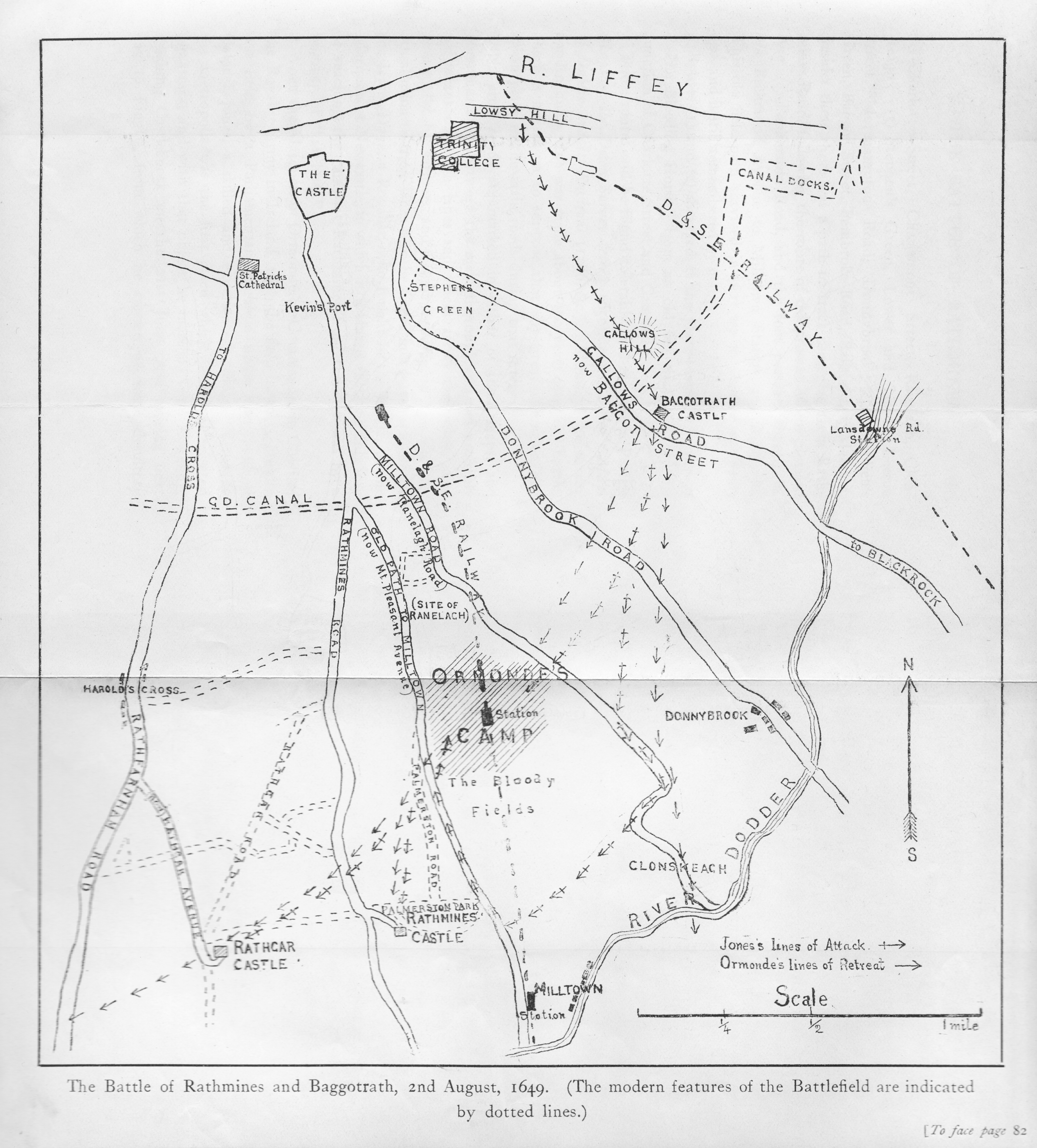
Battle of Rathmines
A pub called the Bleeding Horse still stands on Upper Camden Street in Dublin. According to local tradition, its stables were used to treat wounded cavalry horses after a battle fought in the fields nearby on 2 August 1649. The Battle of Rathmines is one of those engagements that reshapes an entire island's history in a few hours. By midday it was over. The Royalist-Confederate alliance that controlled most of Ireland was broken outside the walls of Dublin, and Oliver Cromwell had his landing ground.
Tangled Loyalties
The Wars of the Three Kingdoms produced alliances so convoluted that participants changed sides more than once. The Earl of Ormond, Charles I's commander in Ireland, had already handed Dublin to the Parliamentarians in 1647 rather than let Irish Catholic Confederates take it. He then went into exile, returned in 1648, and assembled a coalition of Catholic Confederates, Irish Royalists, Church of Ireland Protestants, English Catholic exiles, and -- after the execution of Charles I on 30 January 1649 -- even Ulster Presbyterians who considered regicide sacrilegious. Against this motley alliance, the Parliamentarian garrison in Dublin under Michael Jones held the city with fewer than 3,000 men, though these were veterans of the New Model Army.
Ormond's Miscalculation
By late July 1649, Ormond commanded over 11,000 troops and controlled most of Ireland. He moved on Dublin, knowing that Cromwell was assembling an expeditionary force in England. If he could take the port, Cromwell would have nowhere to land. Ormond stationed his main army on the south bank of the Liffey and sent 2,500 men under Viscount Dillon to invest the northern approaches. But on 26 July, Jones received four regiments of reinforcements from Chester under Robert Venables, raising his effective strength to 4,000 infantry and 1,200 cavalry. On 28 July, the Royalists captured Rathfarnham Castle, cutting Dublin's water supply. Just after midnight on 2 August, Ormond ordered 1,500 men under Major-General Patrick Purcell to occupy the partially demolished Baggotrath Castle, near the site of today's Baggot Street bridge.
Four Hours at Baggotrath
Purcell's advance should have been quick -- Baggotrath was less than a mile from camp. Instead, his force took several hours to reach the position, for reasons that remain unclear. The noise alerted Jones, who understood immediately what possession of that castle would mean: Royalist artillery firing on ships entering Dublin harbour. Jones drew up his troops with the Liffey at his back and attacked before Purcell could fortify the position. He scattered Purcell's men and killed the cavalry commander Sir William Vaughan. By 10:00 a.m., the castle was back in Parliamentarian hands. Ormond ordered his full army into battle formation, but Jones pressed forward, sending cavalry around the Royalist flanks and capturing the artillery train. Ormond's left wing collapsed without firing a shot, and by midday the rout was complete.
Blood in the Bloody Fields
Hundreds of Royalist and Confederate soldiers died in the pursuit that followed. Ormond acknowledged losing between 600 and 1,000 men, claiming that 300 were shot after surrendering. Jones reported inflicting 4,000 casualties including 2,517 prisoners, though his own losses were minimal. Among the dead was the Earl of Fingall, who was wounded, captured, and died in Dublin Castle days later. The bitterness of eight years of warfare showed in the treatment of prisoners: one captured Royalist officer, Richard Elliott, was Jones's own nephew, the son of his sister Mary. Jones had him executed alongside other captives. An area near Milltown in south Dublin was known for generations as the "Bloody Fields," where some of those killed in the pursuit were believed to have been buried.
The Door Opens for Cromwell
The immediate consequence of Rathmines was the security of Dublin's port. Jones's victory allowed Parliamentarian forces to establish a defensive line along the road between Dublin and Ringsend, where Cromwell landed on 15 August with 12,000 troops. The Cromwellian conquest of Ireland had begun. Ormond's defeated coalition splintered: Protestant Royalists deserted in large numbers over the following months. Eoghan O Neill, the Gaelic Catholic commander in Ulster, finally agreed to join Ormond, but negotiations dragged on until shortly before O Neill's death in November. His army played little role in the Parliamentarian campaign that overran Ulster between September and December and was destroyed at Scarrifholis the following year. Rathmines had opened the door, and everything that followed -- Drogheda, Wexford, the Penal Laws -- walked through it.
From the Air
Located at 53.33N, 6.26W in the Rathmines suburb of south Dublin. The battlefield site is now entirely built over with residential streets. Baggot Street bridge, near the site of the demolished Baggotrath Castle, crosses the Grand Canal. The area near Milltown, known historically as the Bloody Fields, lies to the south. Nearest airports: Dublin (EIDW) 12km north, Weston (EIWT) 14km west. Best understood as part of a south Dublin overflight at 2,000-3,000 feet.