Battle of Raymond
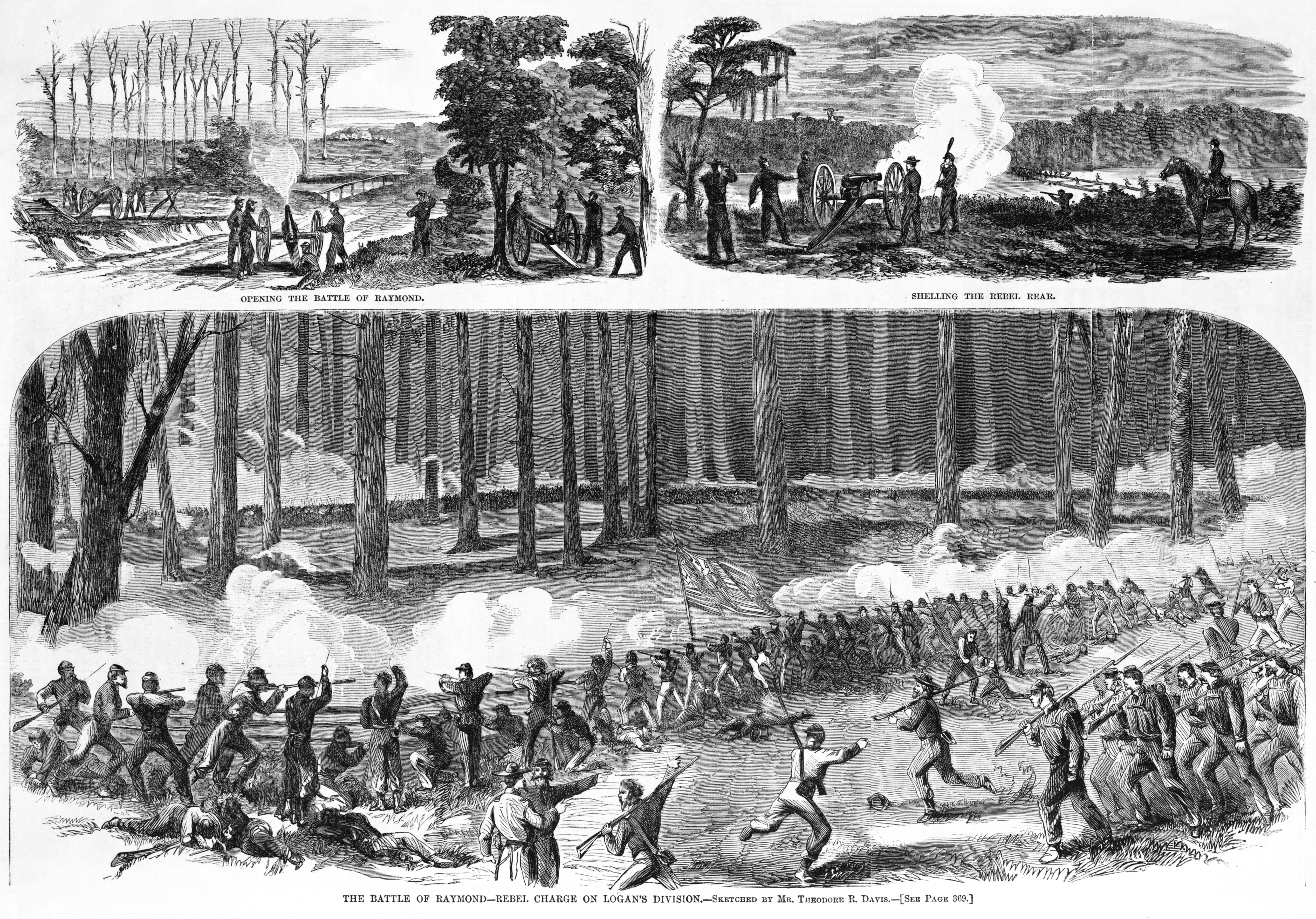
The women of Raymond, Mississippi, had prepared a feast. Fried chicken and lemonade waited in town for the Confederate soldiers who would surely rout the small Union raiding party reported nearby. What Brigadier General John Gregg did not know on the morning of May 12, 1863, was that the force approaching down the Utica Road was not a brigade of 1,500 men but an entire Union army corps of 10,000 to 12,000 soldiers under Major General James B. McPherson. And what McPherson did not know was that the Confederates in his path, though outnumbered three to one, had no intention of stepping aside. The collision that followed would be chaotic, bloody, and strategically transformative -- the battle that made Ulysses S. Grant change his mind about how to take Vicksburg.
Blind Men Swinging
Neither commander entered the fight with an accurate picture of his opponent. Confederate General Pemberton in Vicksburg had ordered Gregg to Raymond expecting him to intercept a lone Union brigade, and Gregg's meager cavalry -- just fifty horsemen who arrived the night before -- could not provide a reliable count of Union strength. Gregg's scouts reported roughly 2,500 to 3,000 Union troops, and since scouts habitually overestimated, Gregg dismissed even that number as inflated. He set an aggressive trap: the 7th Texas and 3rd Tennessee would pin the Union force frontally near Fourteenmile Creek, while two Tennessee regiments would swing around the Gallatin Road and strike the exposed Union flank. McPherson, for his part, overestimated Confederate numbers and deployed cautiously, feeding brigades into the fight piecemeal rather than overwhelming Gregg with his full strength. Historians have since criticized both commanders -- Gregg for reckless aggression, McPherson for timidity -- but on that smoky May morning, both men were fighting blind.
The Creek Runs Red
Fighting erupted when Union cavalry ran into Gregg's skirmishers on the morning of May 12. Bledsoe's Missouri Battery opened with its three cannons, and Union artillery answered. Smoke from the exchange blanketed the field, neutralizing much of the artillery advantage on both sides. The terrain conspired against clear vision: heavy undergrowth along Fourteenmile Creek turned the battlefield into a tangle of separate, chaotic fights where units lost contact with their commanders. Gregg's Texans hit the 20th and 68th Ohio hard, buckling the Union line until division commander John A. Logan personally rallied his men. The 3rd Tennessee drove back the 23rd Indiana across the creek. But Gregg's carefully planned flanking attack fell apart. The 50th Tennessee opened fire prematurely, alerting the Union to the threat. Its commander tried to warn Gregg that the Union force was far larger than expected, but the messenger could not find him. One flanking regiment withdrew without informing the other, which sat waiting for orders that never came.
The Weight of Numbers
As the afternoon wore on, McPherson's numerical advantage became irresistible. He massed twenty-two cannons on the field and pushed infantry across Fourteenmile Creek. Colonel Randal William MacGavock of the 10th and 30th Tennessee, knowing his men would be shattered by Union artillery if they held their ground, ordered a desperate charge against the 7th Missouri. MacGavock was killed early in the assault, but his soldiers drove the Missourians back before fire from the 31st Illinois stopped them cold. The Confederate line was crumbling from both ends. Gregg ordered the 1st Tennessee Battalion to feign an attack, and the bluff worked long enough for the spent 7th Texas and 3rd Tennessee to disengage. By 4:00 p.m., Gregg's battered brigade was retreating through the streets of Raymond, past the untouched feast of fried chicken and lemonade that Union soldiers happily consumed. Gregg lost about sixteen percent of his force -- roughly 515 casualties -- while McPherson's losses amounted to around 446, just three percent of his command.
A Battle That Changed the Campaign
Raymond's true significance lay not in its casualty figures but in its effect on Grant's thinking. Before the fight, Grant had planned to swing west toward the Big Black River and approach Vicksburg directly. The unexpected strength of Gregg's resistance at Raymond convinced Grant that the Confederate force assembling at Jackson was more dangerous than he had realized. Leaving it in his rear while attacking Vicksburg risked being caught between two enemy armies. Grant pivoted. He ordered all three of his corps to converge on Jackson, captured the Mississippi state capital on May 14, then wheeled west and crushed Pemberton's army at Champion Hill on May 16. Within weeks, Vicksburg was under siege. It surrendered on July 4, 1863, splitting the Confederacy in two. The fried chicken of Raymond had fed the wrong army, and the battle that Gregg never should have started rewrote the script for the entire campaign.
Fourteenmile Creek Today
The Raymond battlefield was listed on the National Register of Historic Places on January 13, 1972. As of 2010, approximately seventy-nine percent of the battlefield remained intact, including the Union artillery position, Fourteenmile Creek, and portions of the old Utica Road. The Friends of Raymond group manages a portion of the site as Raymond Military Park, with walking trails and interpretive signage. The American Battlefield Trust and its partners have preserved more than 149 acres through mid-2023. The Civil War Sites Advisory Commission ranked the battlefield in the highest tier of priority for protection. Construction of a newer route for Mississippi Highway 18 once required disinterring Confederate dead from a burial trench -- a reminder that the landscape, for all its quiet pastoral beauty, still holds the remains of that violent May afternoon.
From the Air
Located at 32.24N, 90.45W near Raymond, Mississippi, in Hinds County. Fourteenmile Creek and the surrounding farmland mark the battlefield. Nearest airports: Jackson-Medgar Wiley Evers International Airport (KJAN) approximately 15 nm northeast, and Hawkins Field (KHKS) approximately 12 nm north-northeast. Recommended viewing altitude: 2,000-3,000 ft AGL for the creek crossing and open agricultural fields where the battle unfolded.