Battle of Refugio
When General Urrea sent a captured Texan prisoner to deliver surrender terms to the men barricaded inside the old Mission Nuestra Senora del Refugio on March 14, 1836, Lt. Colonel William Ward sent him back with a five-word answer: "The Georgians would not surrender." Ward and his roughly 120 volunteers from the Georgia Battalion were outnumbered at least ten to one, nearly out of ammunition, and cut off from any hope of reinforcement. What had begun as a simple rescue mission to evacuate Anglo families from the South Texas town of Refugio had devolved into one of the Texas Revolution's most harrowing episodes -- a three-day battle followed by a seven-day fighting retreat through swamps and bayous that would cost most of these men their lives but delay the Mexican advance long enough to reshape the war.
A Rescue Turns to Ruin
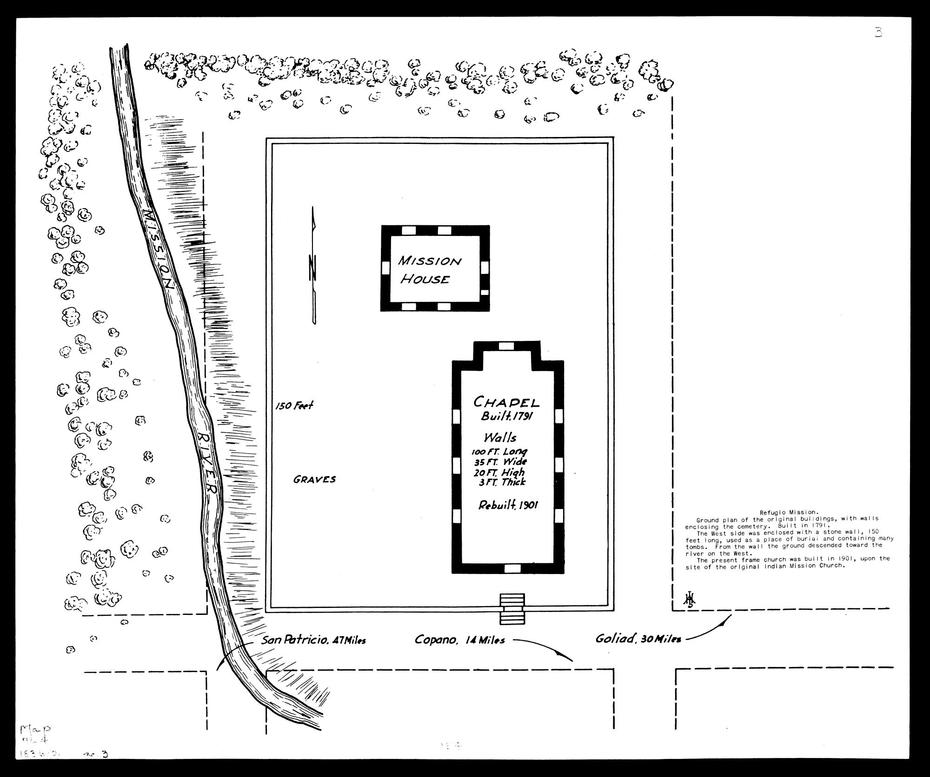
The trouble started with good intentions. On March 7, 1836, Lewis Ayers rode into Colonel James Fannin's garrison at Goliad with desperate news: the Victoriana Guardes, a pro-centralist Tejano militia under Captain Carlos de la Garza, had ransacked the town of Refugio, and several Anglo families were trapped, too afraid to flee. Fannin agreed to send help once transport was available. On March 11, Captain Amon B. King led 28 volunteers and a train of carts south to evacuate the settlers. They reached the crumbling mission that evening and found some of the families sheltering inside -- Irish immigrants had recently patched the roof and doors just enough to hold services when a priest could be found. The next morning, King arrested six Tejanos accused of looting, then made a fateful unauthorized decision: he split his small force and rode south to pursue more raiders. His men rode straight into an ambush by de la Garza's militia and Karankawa Indians. They fought their way free and retreated to the mission, but the element of surprise was gone.
Stone Walls and Rifle Fire
Fannin dispatched Ward and the Georgia Battalion on the morning of March 13 with strict orders: avoid offensive contact, gather the civilians, and return immediately. The Georgians carried only 36 rounds of ammunition per man. They arrived that afternoon after a forced march over muddy roads to find the mission already under attack by Mexican cavalry and militia. A volley or two from the Georgians scattered the attackers, but the relief brought a new crisis. King refused to accept Ward's authority despite being outranked, and in the early hours of March 14 he led his men away on another unauthorized raid. He and his company would be captured and executed at Refugio on March 16. Left at the mission, Ward faced mounting odds. Mexican Army units poured in throughout the day, adding musket fire and artillery. The thick stone walls absorbed the cannon shot. When Mexican troops massed in the open at 200 to 300 yards, the Georgians opened fire with devastating effect. Samuel Hardaway, a 15-year-old from Macon, Georgia, later described the enemy ranks coming to within feet of the low perimeter wall before melting away. The Georgia Battalion repulsed three, possibly four, major assaults. Mexican casualties for the day are estimated between 150 and 600; only three Georgians were wounded.
Escape Through the Swamps
By evening on March 14, Urrea had concentrated an estimated 1,200 soldiers, 100 to 200 mounted militia, and several artillery pieces around the mission. Ward's ammunition was nearly gone. Under cover of a driving rainstorm on the night of March 14-15, the Georgia Battalion slipped through the Mexican lines undetected, leaving behind their wounded, the civilians, and about 25 unharmed Mexican prisoners. What followed was a seven-day ordeal through the coastal lowlands. The men waded hip-deep through swamps for hours each day, slept in trees, and ate frogs and snakes. They heard gunfire from the direction of Coleto Creek -- Fannin's disastrous battle -- two days before reaching Victoria, only to find it swarming with Urrea's troops. After a brief skirmish with Mexican cavalry, the survivors scattered toward Lavaca Bay. Ten men eventually escaped. The rest, including Ward, were captured on March 22 just two miles from Dimmit's Landing. Promised the same surrender terms given to Fannin, 55 of them were marched to Goliad and executed on March 27 under Santa Anna's direct orders. Twenty-six were saved by the interventions of Colonel Telesforo Alavez and his wife, Francita Alavez, known as the Angel of Goliad.
Seven Days for Houston
The sacrifice at Refugio accomplished what no one planned. King's insubordination and the resulting chain of disasters forced Fannin to delay his own evacuation of Goliad, leading to the Battle of Coleto and the Goliad Massacre. But the Georgia Battalion's fierce resistance and Ward's grueling weeklong retreat inflicted severe casualties on Urrea's command and tied down hundreds of Mexican soldiers who might otherwise have reinforced Santa Anna's main army. Those seven days gave Sam Houston and his forces precious time to organize the fight that would culminate at San Jacinto. Today, the King Monument stands in the public square across from the Refugio County courthouse. Texas promised Georgia a monument to the Georgia Battalion in the 1850s in gratitude for the young Georgians' sacrifice and for weapons Georgia had supplied. More than 170 years later, that debt of honor remains unpaid -- though the city of Albany, Texas erected a fountain honoring Ward and the Georgia Battalion in 1976.
From the Air
Located at 28.31N, 97.27W on the South Texas coastal plain near Refugio, Texas. Flat terrain with scattered trees and ranchland. The old mission site is in the town of Refugio itself. Nearest airports include KRKP (Aransas County Airport, approximately 25 miles southeast) and KVCT (Victoria Regional Airport, approximately 30 miles north). Low elevation, humid subtropical climate. The area between Refugio and Goliad (about 30 miles north) encompasses the broader Goliad Campaign battlefield corridor.