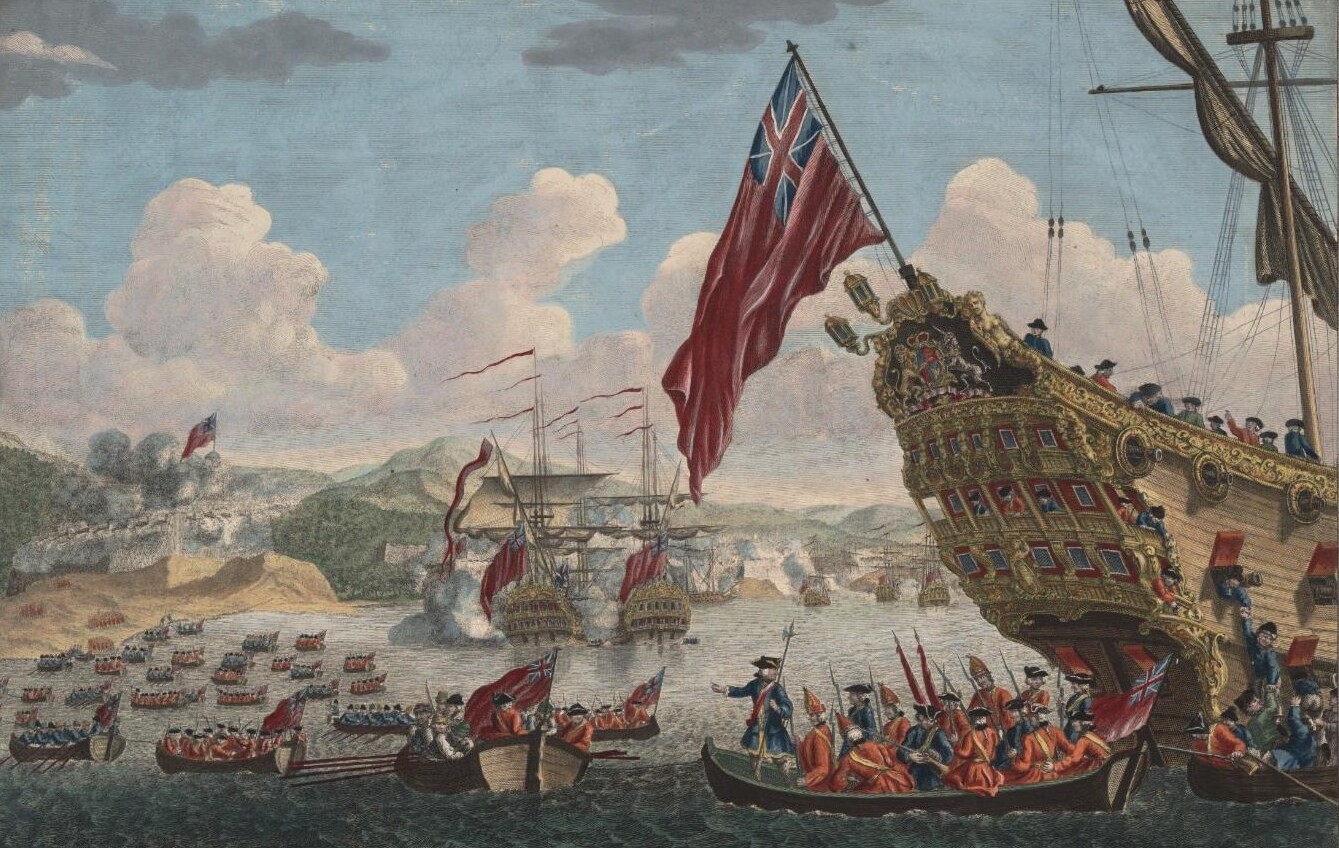
Battle of Restigouche
By the summer of 1760, New France was dying. Quebec had fallen the previous September at the Plains of Abraham, the French navy had been shattered at Quiberon Bay, and the colonies that stretched from the Gulf of St. Lawrence to the Mississippi were being strangled for lack of supplies they could not produce themselves. Into this collapsing world sailed the frigate Le Machault, carrying 2,000 casks of provisions and 400 troops from Bordeaux -- the last serious attempt by France to hold its North American territories. What happened when that frigate reached the Restigouche River was not a grand fleet action but something rawer and more desperate: French sailors, Acadian militia, and Mi'kmaq warriors fighting together on a remote river, scuttling their own ships to keep them from the enemy.
A Flotilla Running the Blockade
Lieutenant Francois La Giraudais sailed from Bordeaux on April 10, 1760, with Le Machault and five merchant ships. The mission was simple in concept and nearly impossible in execution: break through the British blockade of France, cross the Atlantic, and deliver enough supplies and reinforcements to keep New France alive. The flotilla scattered almost immediately to run the blockade. Two merchant vessels were captured. A third ran aground in the Azores. The three surviving ships rendezvoused in the Gulf of St. Lawrence on May 15 -- only to discover that a British fleet had already reached Quebec. There would be no triumphant arrival at the colonial capital. Instead, La Giraudais turned south toward Chaleur Bay, seeking shelter. On May 18, the remnants of his flotilla anchored in the estuary of the Restigouche River, near the Mi'kmaq settlement of Listuguj.
An Alliance of the Desperate
What La Giraudais found at Listuguj was not an empty refuge but a community of people who had their own reasons to fight. Acadian refugees, displaced by the British deportations that had been devastating their communities since 1755, had gathered along the river. The Mi'kmaq of Listuguj had been allies of the French for generations. Together with the French sailors and soldiers, they formed a combined force of approximately 1,500 fighters. The French fed and armed the Acadians and Mi'kmaq in exchange for their participation. It was an alliance born of mutual necessity -- each group needed the others to survive. Notably, this was one of the few battles the Acadians and Mi'kmaq fought without the sanction of their French missionary priests, several of whom had already begun negotiating local peace agreements with the British.
Scuttled Ships and Shore Batteries
Captain John Byron -- grandfather of the poet Lord Byron -- arrived in Chaleur Bay on June 22 with a force of Royal Navy warships from Louisbourg, blockading the bay's entrance. La Giraudais responded by retreating upriver where the deeper-draft British ships could not easily follow. He turned Le Machault broadside, scuttled schooners to create barriers, and placed batteries of cannon on shore. The fighting began on June 27 and continued in sporadic engagements for nearly two weeks. At Pointe-a-la-Batterie, the Acadian and Mi'kmaq militias fired on the British from behind their improvised blockade. When Byron finally overwhelmed that position on July 3, he burned 150 to 200 buildings -- the entire Acadian village. The militias fell back, regrouped with Le Machault, and built new batteries on both shores. They held out through two more British assaults before being overrun on the third.
The Last Ships of New France
By July 8, La Giraudais knew he could not win a battle of attrition. He ordered Le Machault and the merchant ship Bienfaisant scuttled to prevent the British from capturing their cargo. A third vessel, the Marquis-de-Malauze, was spared because she carried prisoners in her hold. The French force withdrew to the shore and the safety of Listuguj, while Byron returned to Louisbourg. The battle ended with every French ship and most of the Acadian boats at the bottom of the river, but the British never managed to land -- too many muskets waited on shore. The Acadian and Mi'kmaq fighters survived, even as their cause did not. Within a year, the Mi'kmaq and other local First Nations signed treaties promising peace and trade with Britain. France's presence in North America was effectively finished.
Artifacts from the River
Today, an interpretive centre in Pointe-a-la-Croix, Quebec, houses artifacts recovered from the Restigouche River, including pieces of Le Machault and a 1:32 scale model of the 18th-century frigate. In summer, costumed interpreters portray Acadians, Mi'gmaq, French sailors, and soldiers, bringing the 1760 battle back to the riverbank where it was fought. The Listuguj Mi'gmaq First Nation has sought a greater role in the site's interpretation, a recognition that the battle was not merely a footnote in the imperial contest between Britain and France. For the Mi'kmaq and Acadians, Restigouche was a last stand -- a place where communities that had been uprooted, dispersed, and dispossessed chose to fight together on a river they called home.
From the Air
Located at 48.00N, 66.72W on the Restigouche River, which forms the border between New Brunswick and Quebec. The battle site is near the present-day towns of Campbellton, NB and Pointe-a-la-Croix, QC, where the river opens into Chaleur Bay. From the air, the wide river estuary and the town of Listuguj on the north shore are visible landmarks. Nearest airport: Charlo Airport (CYCL), approximately 30 km east. The Matapedia valley approach from the west is dramatic from 3,000-5,000 feet AGL.