Battle of Riachuelo
Admiral Ignacio Meza's flotilla was supposed to arrive before dawn. That was the whole plan: slip downriver from the Fortress of Humaita under cover of darkness, catch the Brazilian squadron anchored at Riachuelo while its crews slept, and board them before a single gun could be fired. Instead, a chain of delays pushed the Paraguayan fleet's arrival to nearly eleven in the morning on June 11, 1865, and what was meant to be a surprise boarding action became the largest river battle in South American history.
A War on Water
The Paraguayan War had been raging for barely six months when Marshal-President Francisco Solano Lopez recognized that control of the Parana River was essential. His armies had invaded the Brazilian province of Mato Grosso and the Argentine province of Corrientes, but those forces depended on river supply lines. The Brazilian Imperial Navy, though spread thin, possessed a squadron of nine steamers mounting 58 guns anchored near the town of Riachuelo in Corrientes Province. If Lopez could destroy or capture that squadron, his invasion corridor would remain open and Argentina's heartland would lie exposed. He assembled everything Paraguay had: nine armed steamers, seven cannon-carrying barges with 44 guns, and 22 shore-based guns supplemented by two Congreve rocket batteries positioned along the riverbank.
The Element Lost
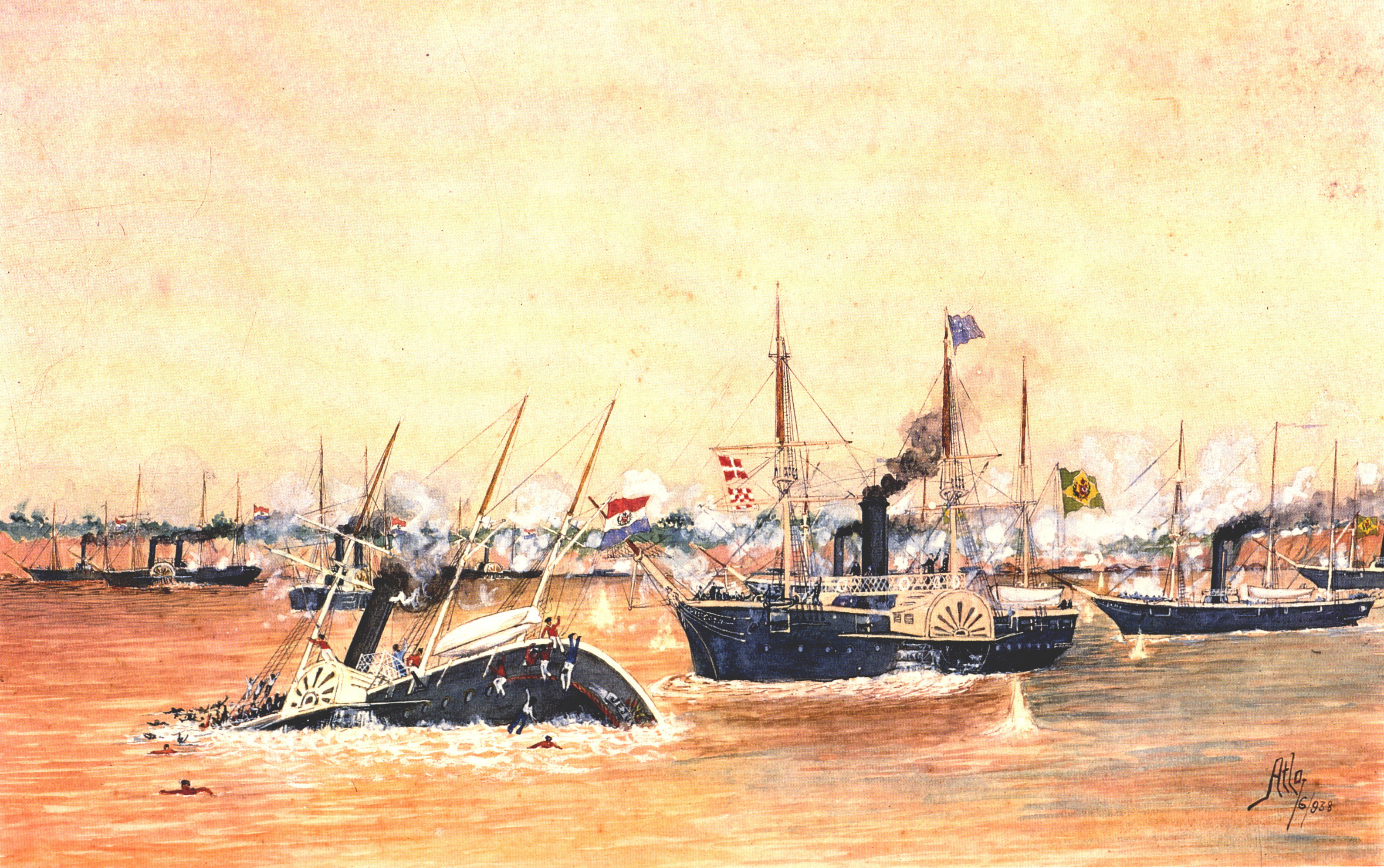
Lopez's orders were explicit: approach under cover of night and board the sleeping vessels. But the Paraguayan fleet, departing Humaita on the night of June 10, moved slowly against the current. By the time the ships rounded into view of the Brazilian anchorage, the sun had been up for hours. The Brazilian commander, Francisco Manuel Barroso da Silva, had time to raise steam and clear for action. What followed was a grinding riverine slugfest. The Paraguayan shore batteries opened fire from the right bank while the two fleets maneuvered in the narrow channel. The Brazilian corvette Jequitinhonha ran aground on a sandbar, trapping her under the Paraguayan guns. But the flagship Amazonas, flying Barroso's pennant, turned the battle's momentum by ramming and sinking the Paraguayan steamer Jejuy, one of the earliest ramming actions in modern naval warfare.
Iron and Fire
For hours, the two fleets fought at ranges so close that sailors could see each other's faces. The Paraguayan barges, towed into position and anchored to serve as floating batteries, poured fire into the Brazilian line. Brazilian gunboat Araguary set the Paraguayan steamer Paraguay ablaze while under fire from the shore batteries. The smoke from burning ships mixed with gun smoke until visibility dropped to almost nothing. Brazilian sailors boarded and captured several Paraguayan barges. The Jequitinhonha, still stranded, had to be abandoned by her crew and was eventually set on fire to prevent capture. The Brazilian steamer Parnahyba withstood the simultaneous assault of three Paraguayan warships, a scene later immortalized by war artists in both Rio de Janeiro and Paris.
A River Decided
By late afternoon, the Paraguayans were in retreat upriver. Four of their nine steamers had been sunk or destroyed, and every surviving vessel bore heavy damage. The Brazilians lost one ship but held the anchorage. The strategic consequences were immediate and irreversible. Without control of the Parana, Lopez could no longer sustain his invasion of Argentina. Within weeks, he ordered his land forces to withdraw back into Paraguayan territory, abandoning every gain his armies had made. The war, which Lopez had launched as an offensive campaign, became a grinding defensive struggle that would last another five years and cost Paraguay most of its adult male population.
Remembered in Bronze and Oil
June 11 is still commemorated as Dia da Marinha, Brazilian Navy Day. The battle inspired some of the most celebrated military paintings in South American art. Victor Meirelles produced a monumental canvas of the engagement that hangs in Rio de Janeiro, while the Italian-Brazilian marine painter Edoardo De Martino captured the chaos of burning ships and close-quarters combat. Today the battlefield site on the Parana River in Argentina's Corrientes Province is a quiet stretch of water. The sharp bend where the Jequitinhonha ran aground looks unremarkable from the air, just another curve in a wide, brown river. But in June 1865, the fate of three nations turned on what happened in this channel.
From the Air
Located at 27.56S, 58.84W on the Parana River in Corrientes Province, Argentina. The battle site is a horseshoe bend visible from cruising altitude. Nearest airport: Corrientes Airport (SARC), approximately 30 km northeast. The river channel where the engagement occurred is wide and brown, running through flat agricultural land. Best viewed at 3,000-5,000 ft AGL to appreciate the river bend geography.