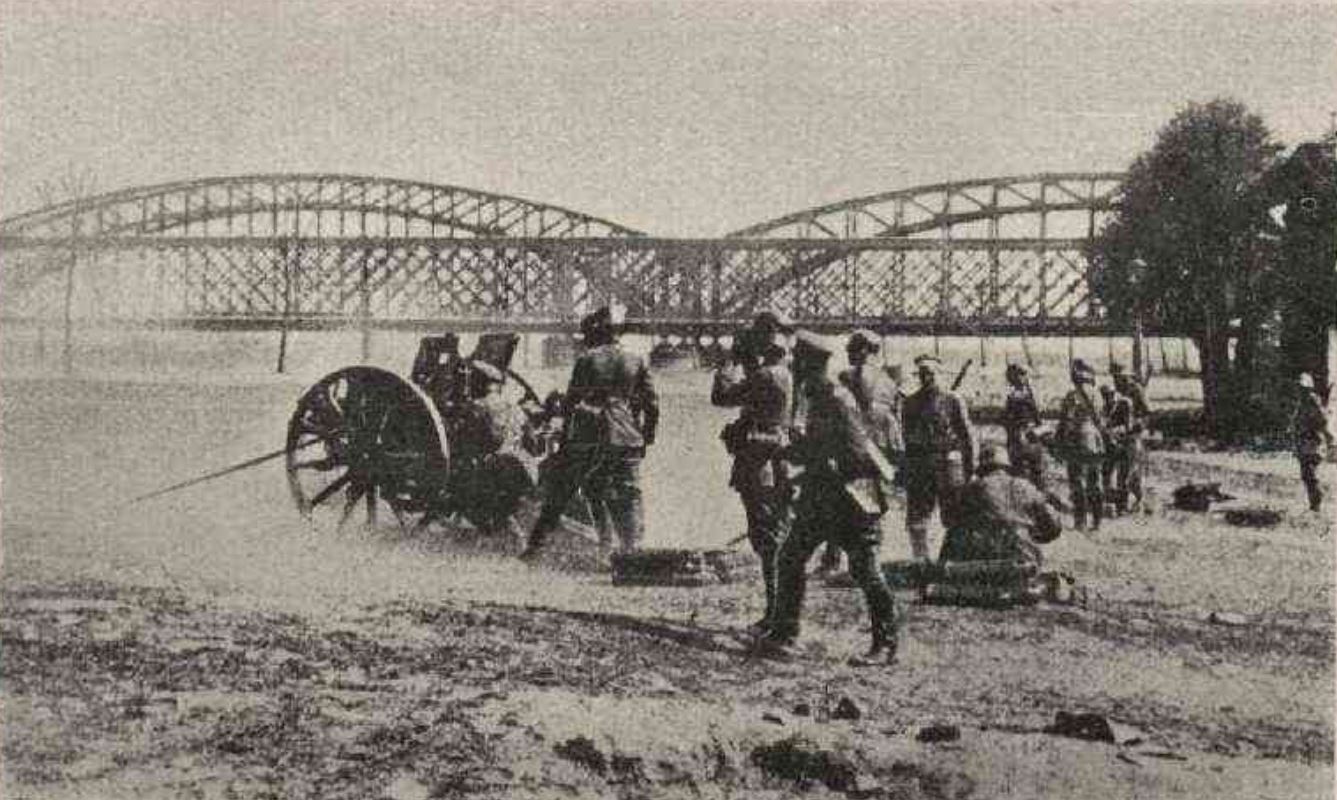
Battle of Riga (1919)
Three armies attacked Riga at once on the morning of 22 May 1919, and only one of them was Latvian. The first column, under the German Landeswehr commander Alfred Fletcher, came from the southwest at 1:30 in the morning. The second, commanded by Colonel Jānis Balodis with the South Latvian Brigade and Russian White units, set out at 4:30 a.m. through the marshes and lakes south of the city. The third, the German freikorps Iron Division of Rüdiger von der Goltz, advanced from the south after a 90-minute artillery preparation. By eleven that morning their forces had reached the Daugava bridges. By seven that evening Riga had fallen. And by sunset the next day the streets had begun to fill with bodies.
The thinnest of independence movements
Latvia in May 1919 was a country that existed mostly on paper. The Latvian Provisional Government under Kārlis Ulmanis had declared independence on 18 November 1918, in a chamber that other governments would have called a foyer, with no army, no treasury, no controlled territory, and a Soviet-backed Latvian Bolshevik government — the Latvian Socialist Soviet Republic — already organizing in Riga to take power. By April 1919, Soviet Latvia held most of the country. Ulmanis's government had been driven onto a steamship in Liepāja harbor by a coup of pro-German Latvian and Baltic German officers and was effectively in exile aboard the SS Saratov, protected by British warships in the Baltic. The actual fighting against the Bolsheviks was being done by an unstable coalition: Latvian volunteers, Baltic German nobles defending their estates and class, German freikorps soldiers paid by Berlin, and Russian White Army units under Colonel Anatol von Lieven. They distrusted each other. They were going to take Riga together anyway.
Why Berlin had to look the other way
On 7 May 1919 the Allied powers handed the first draft of the Treaty of Versailles to the German delegation. Article 433 required the withdrawal of all German forces from the Baltic states and forbade Germany from sending new units to the region. Rüdiger von der Goltz — the German general who had effectively organized the freikorps occupation of the Baltic and who had ambitions to use the region as a launchpad against the Bolsheviks all the way to Petrograd — went to Berlin to demand permission to take Riga anyway. The new German government, which could not afford to publicly violate the treaty, told him the Latvians would have to do it. Then it gave him freedom of action and looked the other way. He moved his headquarters to Jelgava, gave the operational command to the Landeswehr, and on 22 May threw the whole coalition forward at once.
A morning of street fighting
The Soviet Latvian Army defending Riga had nominal strength of 28,000 to 45,000 soldiers but, riddled by hunger and typhus and stretched along a 600-kilometer front against Germans, Estonians, and Poles, could put only a fraction of that into the actual defense of the city. Roughly eight thousand Red Army soldiers faced perhaps fifteen thousand attackers. German aircraft under a pilot named Sachsenberg conducted reconnaissance and strafing runs over the Soviet positions. The Landeswehr columns broke through the defensive line between Sloka and Asari by mid-morning. By 11 a.m., Fletcher's column had reached the Daugava bridges. A small assault group under Hans von Manteuffel-Szoege crossed the bridge under fire, ran for the Riga Citadel where hundreds of political prisoners — Baltic German nobles, priests, and others arrested by Soviet authorities — were being held, and freed them. Manteuffel was killed in the assault. As the Bolsheviks retreated, sixty of the prisoners they were holding were shot before the building could be liberated. The biggest street fighting was on what is now Brīvības iela, Riga's main avenue, and continued until about 7 p.m.
The cleansing
The next morning, 23 May, the Latvian flag was raised on the Daugava embankment to crowds of cheering residents, and the killing began. Alfred Fletcher declared martial law and a 6 p.m. curfew. The Landeswehr — Baltic German units, German freikorps soldiers, and some Latvian troops alongside — began a systematic block-by-block search of the city. People who lived in working-class districts were targeted. People wearing anything that looked like a uniform were targeted. Women with short hair, taken as a sign of revolutionary sympathies, were targeted. In the first days the killings happened in the streets without trial — at least 204 bodies were brought to the Matīsa cemetery alone in the first week. Detainees were thrown into the city canal off the theater boulevard. The Latvian units under Jānis Balodis usually released the people they detained after questioning, and Balodis's brigade soon left the city for the front; the participation of Latvians in the wider terror was real but more limited than that of the German forces. By the time the British and American military missions in Riga began to protest publicly, the death toll was running into the thousands. On 28 May, field courts-martial were established to replace the street executions; more than 300 people were shot in Pārdaugava under their sentences. On 9 June, after Allied diplomatic pressure, the executions officially stopped. The killings tapered through June. The freikorps left Riga on 5 July.
The ugly birth of a country
Two weeks after the Battle of Riga, an Estonian-Latvian counterattack at Cēsis defeated the Landeswehr in the field — the moment Latvia generally remembers as its War of Independence's turning point. The German freikorps were pushed out of the Baltic over the rest of 1919. Latvia would not finally consolidate its independence until 1920, after fighting Bolsheviks in the east as well. Kārlis Ulmanis returned to Riga and led the country until a Soviet annexation in 1940. The Battle of Riga itself sits awkwardly in Latvian national memory: a victory over the Bolsheviks that brought independence one step closer, but accomplished by foreign troops fighting under a German-controlled umbrella, and immediately followed by what Latvian historians today straightforwardly call the White Terror. The dead of those two weeks in Riga, mostly working-class Latvians and Russian sympathizers of the Soviet republic, are buried in unmarked graves around the Riga Central Prison and the Matīsa cemetery. They were among the thousands of casualties of the cycle of red and white terror that swept Eastern Europe in the wake of the First World War — a violence that would go on, in different forms and under different flags, for most of the century to come.
From the Air
The 1919 battle was fought across the Riga metropolitan area at 56.95°N, 24.11°E. From cruising altitude in clear weather the broad Daugava River, the Gulf of Riga to the north, and the modern city center are dominant landmarks. Key locations include the Daugava bridges (axis of the German assault), the Riga Citadel just north of the Old Town, and Brīvības iela running northeast through the city center where the heaviest street fighting took place. Nearest major airport is Riga International (EVRA), about 10 kilometers west. Tallinn (EETN) lies about 160 nautical miles north. Vilnius (EYVI) is about 160 nautical miles south.