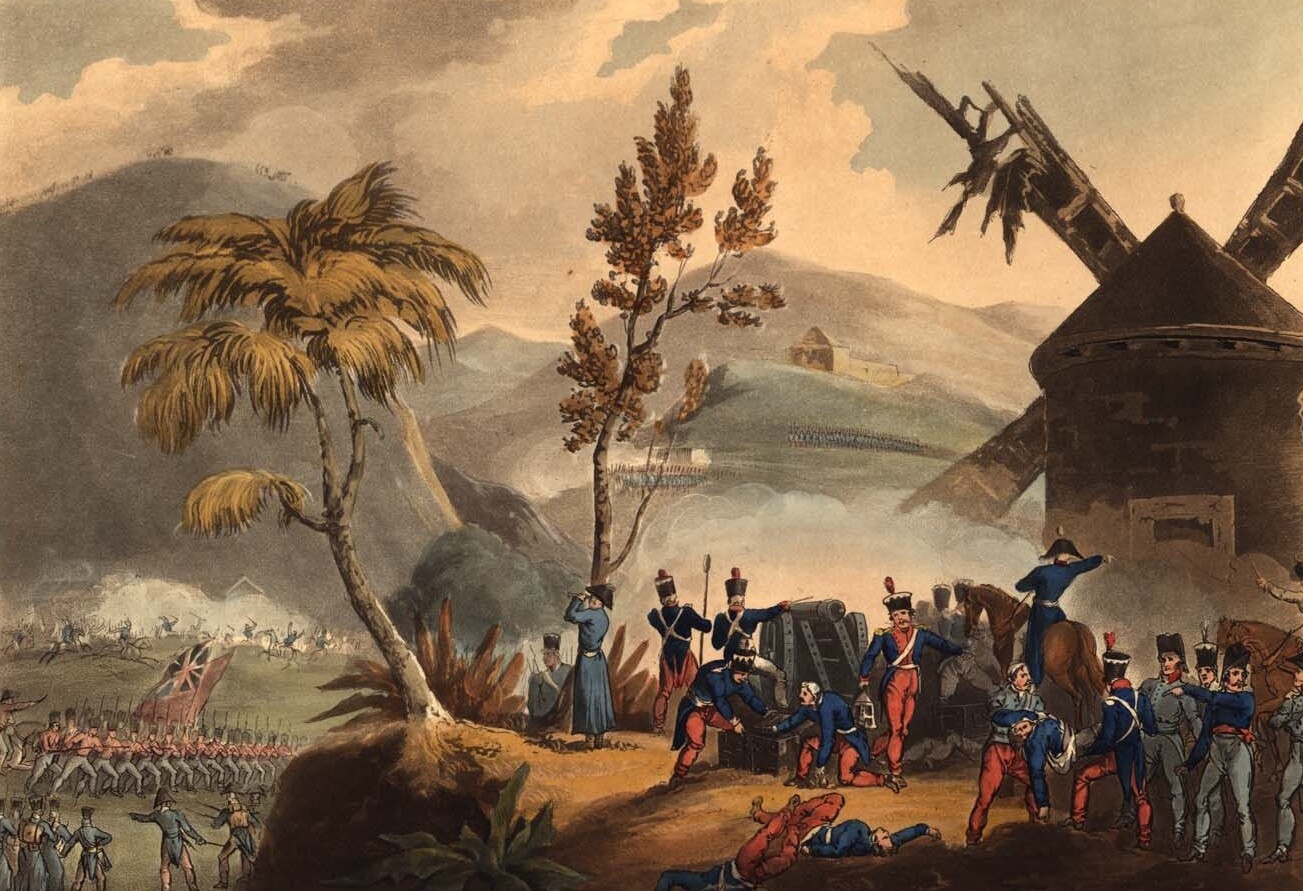
Battle of Rolica
Colonel George Lake knew the order had not been given. On 17 August 1808, with French musket fire raking down from the rocky hilltop above the village of Rolica, he charged his 29th Regiment of Foot up a narrow gully anyway. It cost him his life and most of his men. But that reckless dash up the boulder-strewn defile triggered a general assault that won the day, and with it began Britain's long, grinding campaign to drive Napoleon from the Iberian Peninsula. This was the Battle of Rolica, the very first engagement of the British Army in the Peninsular War, and the opening act in a conflict that would consume the next six years.
An Ambitious General in a Hurry
Arthur Wellesley, the future Duke of Wellington, had every reason to move fast. He had landed his 16,000 troops at Mondego Bay in early August, choosing the spot because students from Coimbra University had seized the local fort, making it safe. But Wellesley knew reinforcements were coming, and with them would come senior generals to take command away from him. Five officers outranked him, including Sir Hew Dalrymple, the 60-year-old Governor of Gibraltar whose last active service had been a failed campaign in Flanders fifteen years earlier. If Wellesley wanted to prove himself, he had to do it before those men arrived. On 10 August, his army began the hot, sandy march south toward Lisbon, following the coast where the Royal Navy could supply them.
A Horseshoe of Steep Hills
The village of Rolica sits in the center of a horseshoe-shaped ridge of steep, wooded hills, roughly a mile wide and two miles deep, with its open end pointing northeast toward Obidos. General Henri Delaborde had positioned his 4,000 French troops at the northern edge of this natural amphitheater, backed up against the high ground that controlled the roads south to Lisbon. He was outnumbered more than three to one, but his mission from General Junot was not to win a pitched battle. He needed only to delay the British long enough for the main French army to concentrate. The terrain worked in his favor: four narrow gullies led up to his hilltop position, their steep sides littered with boulders that made any organized assault nearly impossible.
The Fight on the Rock Face
Wellesley's plan was a double envelopment. He sent Colonel Trant and the Portuguese to the west, a stronger force under Ferguson to the east, and kept his main body in the center to make noise and fix the French in place. Starting at nine in the morning, he tried the maneuver twice, but Delaborde spotted the flanking movements each time and withdrew to successively stronger positions. By early afternoon, the French held the summit in a nearly unassailable stance. That was when Colonel Lake made his fateful decision, leading his men up one of the gullies without orders. The 29th paid dearly, taking over half the British casualties of the entire battle, but their sacrifice forced Wellesley's hand. He ordered a general advance, and thousands of redcoats swarmed up the rock face from multiple directions. Ferguson's force crested the eastern hills. Delaborde held on until nearly four in the afternoon before his army's discipline finally broke and his men ran.
Victory and What Followed
The Anglo-Portuguese won at the cost of 487 casualties, while the French lost 700 men and three of their five guns. Delaborde himself took a wound. It was a small engagement by Napoleonic standards, but its significance outweighed the numbers. Wellesley had proven that British infantry could fight and win on the continent, setting the tone for six years of increasingly decisive victories. He did not pursue the retreating French, however. The very next day, he learned that 4,000 additional British troops had arrived off the coast and marched his men to cover their landing. Four days later, on 21 August, came the larger Battle of Vimeiro, another British victory that confirmed the Peninsular War had truly begun.
From the Air
Located at 39.31N, 9.18W, about 75 km north of Lisbon near the village of Rolica in the Leiria District. The battlefield occupies a horseshoe-shaped ridge visible from altitude. Nearest major airport is Lisbon/Humberto Delgado (LPPT). The terrain of rolling wooded hills and agricultural land is best appreciated at 3,000-5,000 ft AGL.