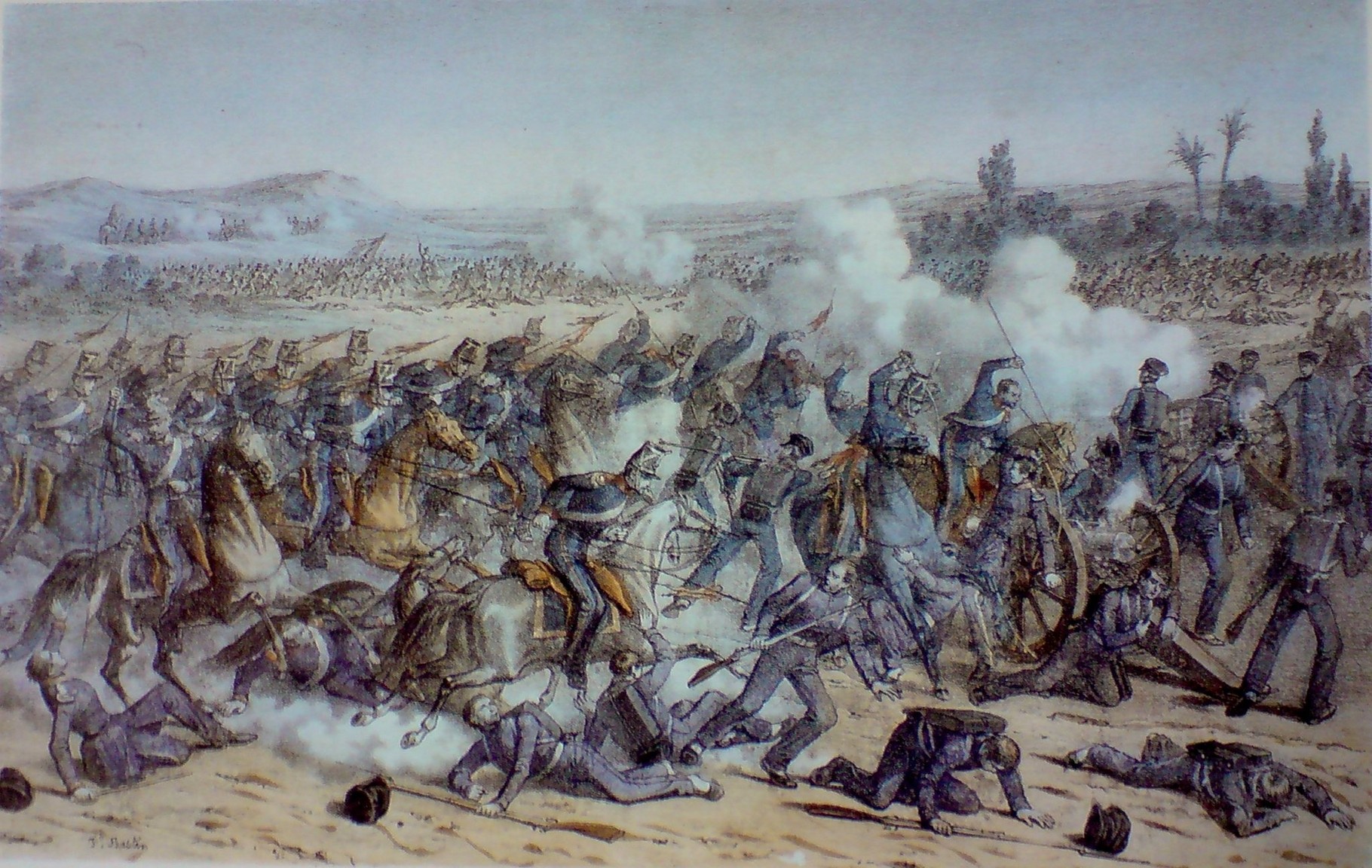
Battle of Sacramento (Mexico)
The wagons came for the dead. In Mexican oral histories recorded decades after the battle, one phrase echoes through the generations: "Los americanos vinieron con sus carretas y se llevaron a sus muertos, mas de doscientos, para darles sepultura cristiana cerca del rio." The Americans came with their wagons and took their dead, more than two hundred, to give them a Christian burial near the river. On February 28, 1847, at a crossing of the Sacramento River roughly fifteen miles north of Chihuahua City, a small American force achieved one of the more improbable victories of the Mexican-American War, a battle that would fade from American memory but linger in the collective Mexican consciousness as a tale of foreign invasion and local resistance.
Doniphan's March
Colonel Alexander Doniphan was not supposed to be here. Leading a force of 924 Missouri volunteers and approximately 300 civilian traders with their wagon train, he had left El Paso del Norte on February 8, 1847, marching south toward Chihuahua despite learning that General John E. Wool had abandoned his own planned march to that city. Doniphan pressed on anyway, his column of rough frontiersmen, merchants, and adventurers trudging through the Chihuahuan Desert toward an enemy they knew awaited them. The Mexican defenders had prepared fortified positions at the Sacramento River crossing, choosing terrain that favored their superior numbers. But Doniphan's Missourians were veterans of frontier warfare, and their wagon train would prove more than a supply caravan.
The River Crossing
The Americans arrived at Sacramento to find the Mexican army entrenched and waiting. What followed was a decisive engagement that showcased the mobility and firepower Doniphan's volunteers could bring to bear. The battle lasted a single afternoon, with the Americans outmaneuvering Mexican positions and breaking their defensive lines. American casualties were relatively light compared to the Mexican losses, though the oral histories passed down through Mexican families tell a different story, one of hundreds of American dead carried away in wagons for burial. Whatever the true count, the battle broke Mexican resistance in the region. Doniphan's men marched into Chihuahua City on March 2, occupying the state capital.
The Long March Home
Victory at Sacramento did not end Doniphan's campaign. On April 23, 1847, he received orders to bring his command to Saltillo, far to the east. His men reached Encantada on May 21, having completed one of the longest marches in American military history. From Missouri to Santa Fe to El Paso to Chihuahua and finally to Saltillo, Doniphan's expedition covered thousands of miles through hostile territory with minimal support. The Battle of Sacramento stood as its crowning achievement, proof that volunteer soldiers could defeat regular forces when led with audacity. Today, a marker in Clay County, Missouri commemorates the colonel who led farmers and frontiersmen to victory in a foreign land.
Echoes in Fiction
The Battle of Sacramento found its way into American literature through an unexpected channel. In Cormac McCarthy's 1985 novel Blood Meridian, widely considered one of the darkest works in American fiction, the battle appears as a remembered horror. While imprisoned in Chihuahua City, McCarthy's protagonist meets a veteran who recounts the events at Sacramento, weaving the historical engagement into a narrative of violence and chaos on the Mexican frontier. The novel transformed an obscure military engagement into a touchstone of literary brutality. For those who know the battle only through McCarthy's pages, Sacramento represents something more than military history. It is a glimpse into the savage heart of manifest destiny, preserved in both Mexican memory and American imagination.
From the Air
Located at 28.87°N, 106.19°W, approximately 15 miles north of Chihuahua City, Mexico, at the crossing of the Sacramento River. The battlefield site lies in the high desert of Chihuahua state. From altitude, the terrain appears as scrubland dissected by seasonal watercourses. The nearest major airport is General Roberto Fierro Villalobos International Airport (MMCU/CUU) in Chihuahua City, roughly 25 km to the south. View at 4,000-6,000 feet AGL to appreciate the river crossing terrain that shaped the battle.