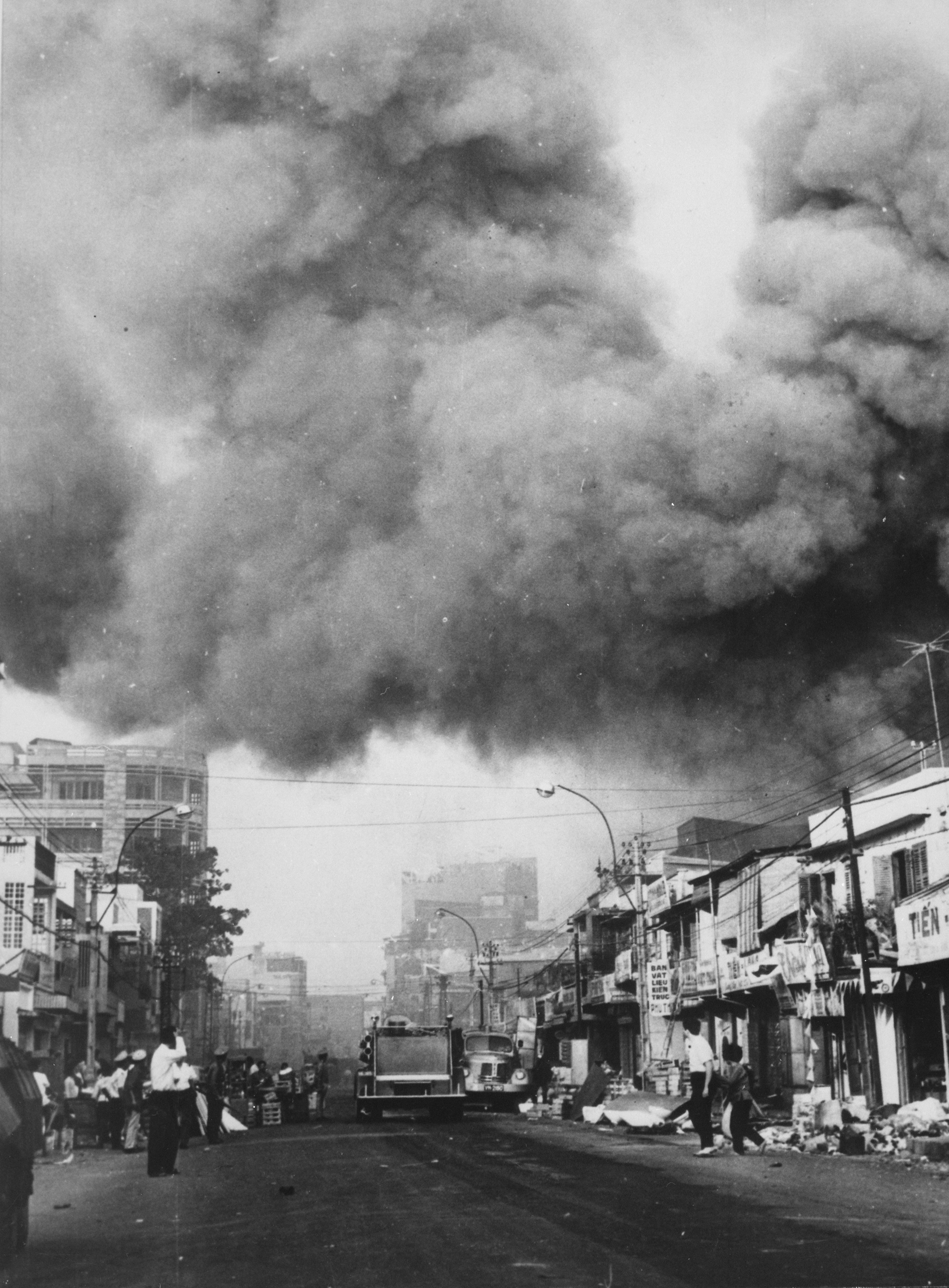
Battle of Saigon (1968)
Firecrackers masked the gunfire. On the night of January 30, 1968, as Saigon celebrated Tet -- the Vietnamese New Year -- thirty-five battalions of Viet Cong fighters moved through the capital's streets toward six targets that, if captured, would have decapitated South Vietnam's government and military command. They hit the Independence Palace, the U.S. Embassy, Tan Son Nhut Air Base, the ARVN Joint General Staff compound, the Long Binh Naval Headquarters, and the National Radio Station. The holiday ceasefire was supposed to guarantee a pause in hostilities. Instead, it provided cover for the largest coordinated assault of the entire Vietnam War.
Firecrackers and Gunfire
The Tet Offensive was not limited to Saigon -- communist forces struck more than a hundred cities and towns across South Vietnam simultaneously. But Saigon was the main focal point. The plan was ambitious without being suicidal: a total takeover of the capital was never the objective. Instead, the VC targeted command-and-control nodes, hoping that spectacular strikes against the most visible symbols of American and South Vietnamese power would trigger a popular uprising. Sapper battalions and local forces hit the Presidential Palace, while the VC 5th Division attacked the sprawling military bases at Long Binh and Bien Hoa. The North Vietnamese 7th Division struck the U.S. 1st Infantry Division at Lai Khe, and the VC 9th Division assaulted the 25th Infantry Division base at Cu Chi. For a few hours in the predawn darkness, with firecrackers still popping across the city, it was impossible to tell celebration from combat.
The Photograph That Changed a War
On February 1, the fighting in Saigon's streets produced one of the most consequential images in the history of photojournalism. Photographer Eddie Adams was standing near South Vietnamese national police when they brought a captured Viet Cong prisoner before Brigadier General Nguyen Ngoc Loan, the chief of the National Police. The prisoner, Nguyen Van Lem, had been identified as the captain of an assassination platoon and was accused of murdering the families of police officers. Without warning, Loan drew his sidearm and shot the man in the head. Adams captured the instant of impact. An NBC television crew filmed the same moment. The photograph ran on front pages worldwide, winning the Pulitzer Prize for Spot News Photography and a World Press Photo award. General Westmoreland called it "an isolated incident of cruelty in a broadly cruel war, but a psychological blow against the South Vietnamese nonetheless." Adams himself later expressed regret, feeling the image had destroyed Loan's life while stripping the moment of its agonizing context -- Loan had reportedly just learned that the prisoner had killed his aide-de-camp, the aide's family, and Loan's six godchildren.
The Cost of Counterattack
By early February, Hanoi's military planners understood that none of their battlefield objectives were being met. No popular uprising materialized. The fortified positions held. The high command halted further attacks, and sporadic fighting tapered off by March 8. But the damage to Saigon was devastating -- not only from the initial assault but from the American counterattack. U.S. retaliatory air and artillery strikes tore through entire neighborhoods. The Chinese district of Cholon suffered the worst, with hundreds of civilians killed in the bombardment. The human toll across Vietnam during this period was staggering. From January to July 1968, the rate of soldiers killed in action exceeded that of the Korean War and the Mediterranean and Pacific theaters of World War II. It was the bloodiest phase of the entire conflict.
Victory in Defeat
The Tet Offensive was a military failure for the Viet Cong. Their forces were decimated, and the southern insurgency never fully recovered its strength. Yet the offensive achieved something no battlefield victory could: it shattered the credibility of American officials who had been insisting the war was nearly won. Television footage of fighting inside the U.S. Embassy compound -- the most fortified piece of American real estate in Southeast Asia -- contradicted every optimistic briefing the public had heard. Within weeks, President Lyndon Johnson's approval rating on the war collapsed. By March, he announced he would not seek reelection. The Viet Cong returned to Saigon again during the May Offensive from May 5 to 30, attacking targets with considerable success. The city that Americans had been told was secure proved anything but, and the political reverberations of that revelation would shape the war's final years.
From the Air
Located at 10.77N, 106.67E in what is now Ho Chi Minh City, Vietnam. Tan Son Nhat International Airport (VVTS) sits immediately northwest of the city center -- it was one of the primary targets during the battle. The Independence Palace (now Reunification Palace) and former U.S. Embassy site are visible landmarks in District 1. Recommended viewing altitude: 3,000-5,000 feet for urban layout context. The Cholon district, heavily damaged during the fighting, lies west of the city center along the Saigon River bend.