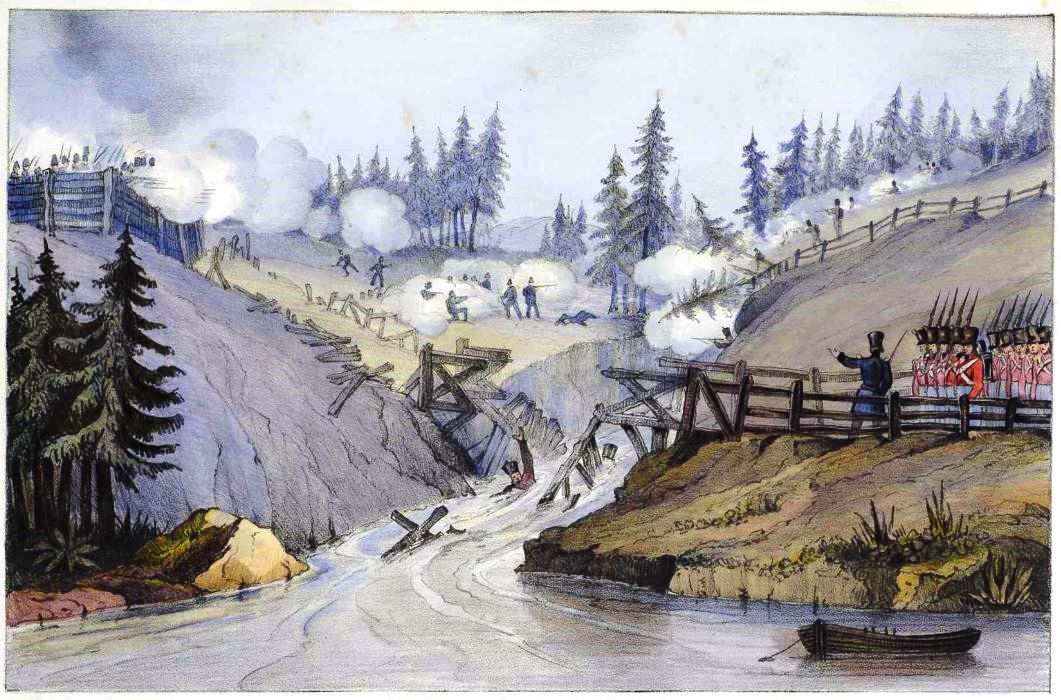
Battle of Saint-Charles
Thomas Storrow Brown was attending to the baking of bread when the cannonball struck the church steeple. The failed Montreal merchant turned rebel commander had two hundred men, fifty rifles, and a brick manor house surrounded by frozen mud and log breastworks. Marching toward him along the Richelieu River on that November morning in 1837 were four hundred British regulars, twenty cavalry, and two artillery pieces. The Battle of Saint-Charles would last just two hours, but the grievances that brought those Patriotes to this riverbank had been building for half a century.
The Seigneuries and the Simmering
Lower Canada in the 1830s was a colony at war with itself. French-Canadian habitants -- farmers bound to the old seigneurial system -- watched English-speaking immigrants claim the best new land with British bureaucracy smoothing the way. The French elite educated at Catholic colleges could win seats in the Legislative Assembly, but the English-dominated Legislative Council blocked every attempt to control government spending. Disease compounded injustice: dysentery, typhus, and cholera swept through in the mid-1830s, carried by the same immigrant ships. Then wheat fly, grasshopper, and caterpillar infestations devastated farms across the Beauce, Chaudiere, and Richelieu regions. With families hungry and political channels sealed shut, Louis-Joseph Papineau, leader of the Parti Patriote, called an open-air assembly at Saint-Charles. There he argued for armed rebellion and published a declaration of independence.
A Fortified Camp on Frozen Ground
The Patriotes seized the brick manor house of seigneur Pierre Dominique Debartzch on November 19, sending the family under guard to Quebec City. Brown turned the house into a barracks and built earthen breastworks of logs and branches sealed with frozen mud, stretching from the Richelieu's western bank toward the main road. He smashed bridges and felled trees to slow any approach from the south. Hundreds of volunteers flocked to Saint-Charles, but Brown had only about fifty rifles to distribute among his roughly 200 to 250 defenders. Critically, neither the manor house nor the breastworks were positioned to support each other. When Wolfred Nelson, the victorious Patriote commander at nearby Saint-Denis, offered Brown 300 men and two cannon, Brown refused. He believed he could hold the camp with what he had.
Wetherall's March North
Lieutenant Colonel George Wetherall departed Fort Chambly on November 18 with three companies of the Royal Regiment, one company of the 66th, twenty Royal Montreal Cavalry, and two field guns. His orders came from Sir John Colborne, veteran of the Peninsular War and commander of British forces in the Canadas. Wetherall paused at Chambly for four days, waiting for weather and instructions. At dusk on November 22, his column crossed the Richelieu to its western bank and began marching north. At Saint-Hilaire, news arrived that Colonel Gore's northern force had been defeated at Saint-Denis. Colborne sent messengers ordering Wetherall to withdraw -- but both were intercepted by Patriote scouts. Wetherall, unaware of the recall, summoned a grenadier company from Fort Chambly, who floated down the Richelieu on scows. By November 25, his force numbered 406 infantry, 20 cavalry, and 2 cannon.
Two Hours at the Breastworks
Wetherall's column came under Patriote sniper fire from roadside houses and barns beginning at 1 p.m. He ordered the buildings burned. Upon reaching Saint-Charles, he deployed his cannon and offered Brown terms: safe passage in exchange for the road. Brown demanded the British lay down their arms first. The response took too long. Wetherall opened fire. Captain John Glasgow's guns sent grapeshot and canister into the Patriote lines. Brown was thrown from his horse by the blast and, once remounted, fled for Saint-Denis. Within fifteen minutes, a small British unit west of the road had seized a hill overlooking both the breastworks and the manor house, repositioning the artillery to fire down into the camp. After two hours, Wetherall ordered three companies to fix bayonets and charge. The log-and-mud abatis proved pitifully low. The Royal Regiment broke through and entered the camp. At least 56 Patriotes lay dead; the British lost 3 killed and 18 wounded.
The Fires After
Wetherall burned every building in the fortified camp except Debartzch's manor house. Twenty-five prisoners were locked in the Saint-Charles church. Brown, stripped of command by Nelson at Saint-Denis, disappeared into the countryside. The 1,000-strong Patriote force at nearby Saint-Mathias simply dissolved. A second major defeat followed at Saint-Eustache in December 1837, ending the first uprising. Government troops executed some captured Patriotes on the spot, burned houses, and set an entire village ablaze. But the embers had not fully died. Survivors fled to the United States, regrouped, and returned in November 1838 to fight again -- only to be crushed once more. Of those captured in the full rebellion, 25 were hanged and 58 were deported to penal colonies in Australia. The Richelieu valley, which had dreamed of self-determination, paid the price in blood and exile.
From the Air
The Battle of Saint-Charles took place at 45.683N, 73.183W along the west bank of the Richelieu River at Saint-Charles-sur-Richelieu, Quebec. From the air, the Richelieu runs clearly north-south through agricultural lowlands between Montreal and the US border. The battlefield site is roughly 40 km east of Montreal. Fort Chambly, where Wetherall's column originated, lies about 20 km to the south along the same river. Nearest airports: Montreal/Saint-Hubert (CYHU) approximately 20nm west, Sorel (not towered) to the north. Recommended viewing altitude: 2,000-4,000 feet AGL for the river corridor context.