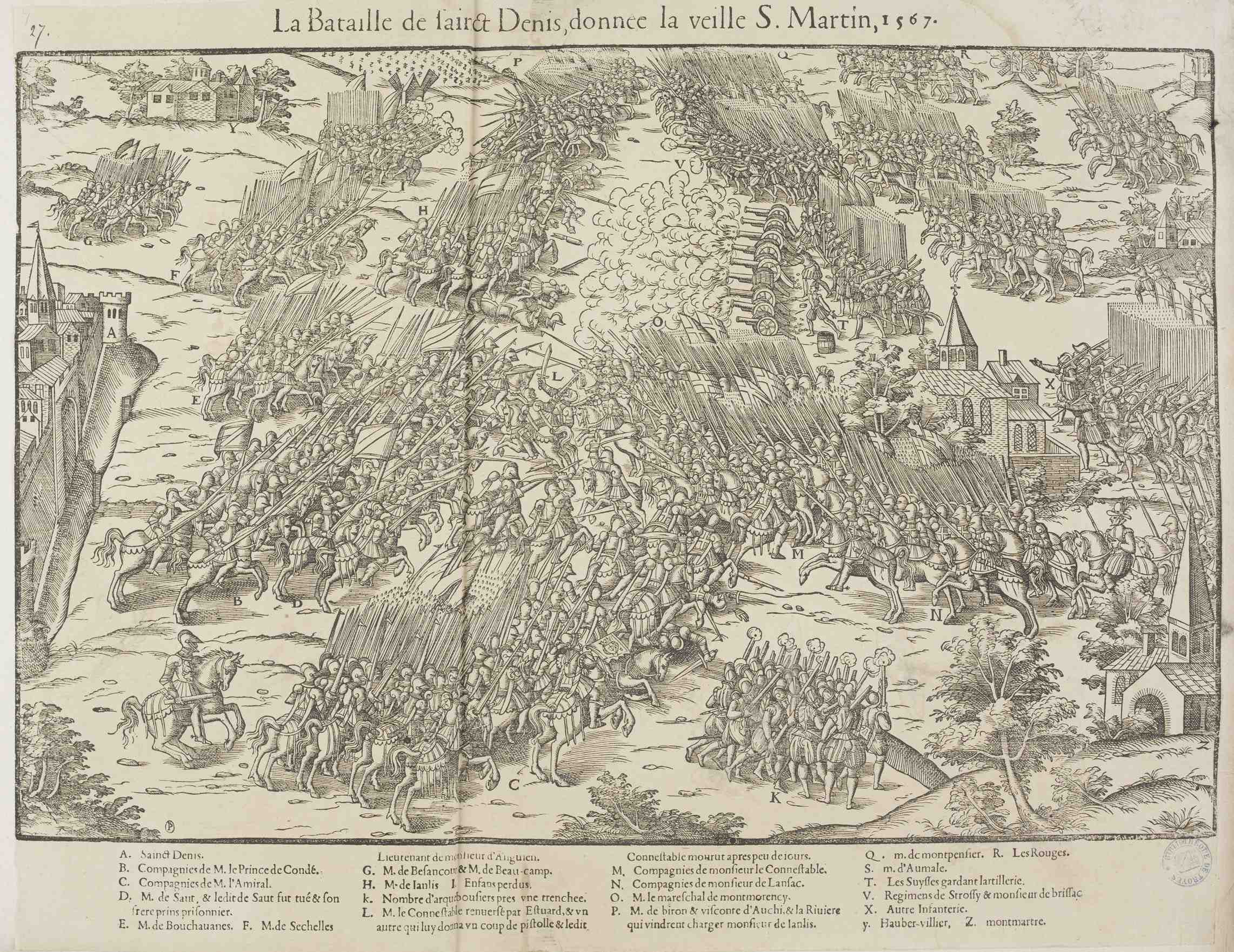
Battle of Saint-Denis (1567)
Anne de Montmorency was 74 years old, which in 1567 was an almost inconceivable age for a man who had spent his life at war. On November 10, the Constable of France rode out from Paris to break a Protestant siege that had been strangling the capital for five weeks. By the time the fighting ended at Saint-Denis, Montmorency had taken a fatal wound. His body was carried back to Paris, where he died two days later. The royalists claimed victory because the Huguenots withdrew. The Huguenots claimed they had held their ground against superior numbers. In truth, neither side won. The battle's real function was to buy time, and time, as it turned out, favored no one in the French Wars of Religion.
A Capital Surrounded
The crisis began with a failed kidnapping. In September 1567, Huguenot forces attempted to seize King Charles IX in the Surprise of Meaux. The plot failed, and the young king and his mother Catherine de Medici rushed to Paris. The Prince of Conde, leader of the Protestant cause, decided to exploit his mobilized forces rather than disband them. On October 2, he established his camp at Saint-Denis, just north of the capital, and set about starving Paris into submission. Simultaneous Huguenot risings erupted across France in Orleans, Nimes, and Montpellier. Conde's forces seized Charenton-le-Pont, which supplied Paris with its grain and flour, then took Lagny-sur-Marne, Argenteuil, and Aubervilliers. The capital was encircled. Further out, Montereau, Etampes, and Dreux fell, each controlling vital roads into the city. Merchants were forced into loans. Peasants were conscripted into corvee labor for the besiegers.
The Art of Stalling
Paris was not defenseless. The city offered 400,000 ecus to the king's cause, and the clergy contributed another 250,000. But the royal army needed time to assemble, so the crown turned to negotiation as a tactic of delay. The moderate Chancellor Michel de l'Hopital, Marshal Vielleville, and Jean de Morvilliers were sent to parley with Conde. The prince, feeling confident, laid out aggressive demands: the expulsion of Italian financiers, repeal of all taxes created since Louis XII, free exercise of religion, an Estates General, and four fortified towns as security. When the crown offered a simple pardon on October 8, Conde raised his terms further, demanding Calais, Boulogne, and Metz as surety towns. He was overplaying his hand. Behind the negotiations, the tide was shifting. Montmorency was appointed Lieutenant-General to consolidate the royal forces, and Brissac raised 20 companies in Paris.
The Old Constable's Last Ride
By early November, Conde's position was eroding. On November 6, Strozzi destroyed one of the boat bridges the Huguenots were using to blockade Paris. The next day, the Duke of Nemours captured another. On November 9, Conde was forced to abandon Charenton, setting it ablaze as he retreated. His remaining force was modest: 1,200 infantry and 1,500 cavalry, with no artillery at all. Coligny commanded his right flank near Saint-Ouen, while Genlis held the left near Aubervilliers. Montmorency attacked on November 10. The fighting was savage but inconclusive. Conde's horse was shot from under him, and he had to be carried from the field. Montmorency was wounded badly enough that he, too, was pulled from the battle. His battered body was taken to Paris, where he died on November 12, the last of the great constables of France.
Neither Victory Nor Peace
Conde withdrew from Saint-Denis on November 14, granted breathing room by the death of his opposing commander. He moved south to Melun, linked up with La Rochefoucauld's forces, and then completed the consolidation of his army with troops from the Viscounts of Quercy and Rouergue, who had just relieved the royal siege of Orleans. The combined Huguenot army marched toward the German border and joined with reinforcements under John Casimir of the Palatinate-Simmern before besieging Chartres in February 1568. The war ended with a truce declared on March 23, the Peace of Longjumeau, which satisfied no one and lasted barely six months before the third war of religion erupted. Saint-Denis, the ancient burial place of French kings just north of Paris, had witnessed a battle that embodied the entire conflict: furious, inconclusive, and ultimately a prelude to more bloodshed. The wars would continue for another thirty years.
From the Air
Coordinates: 48.561N, 2.211E. Saint-Denis is located immediately north of Paris, visible as a dense urban area adjacent to the capital. The Basilica of Saint-Denis, the burial place of French kings, is a prominent landmark. Recommended viewing at 3,000-5,000 ft AGL. Nearest airports: Paris Le Bourget (LFPB) and Paris Charles de Gaulle (LFPG).