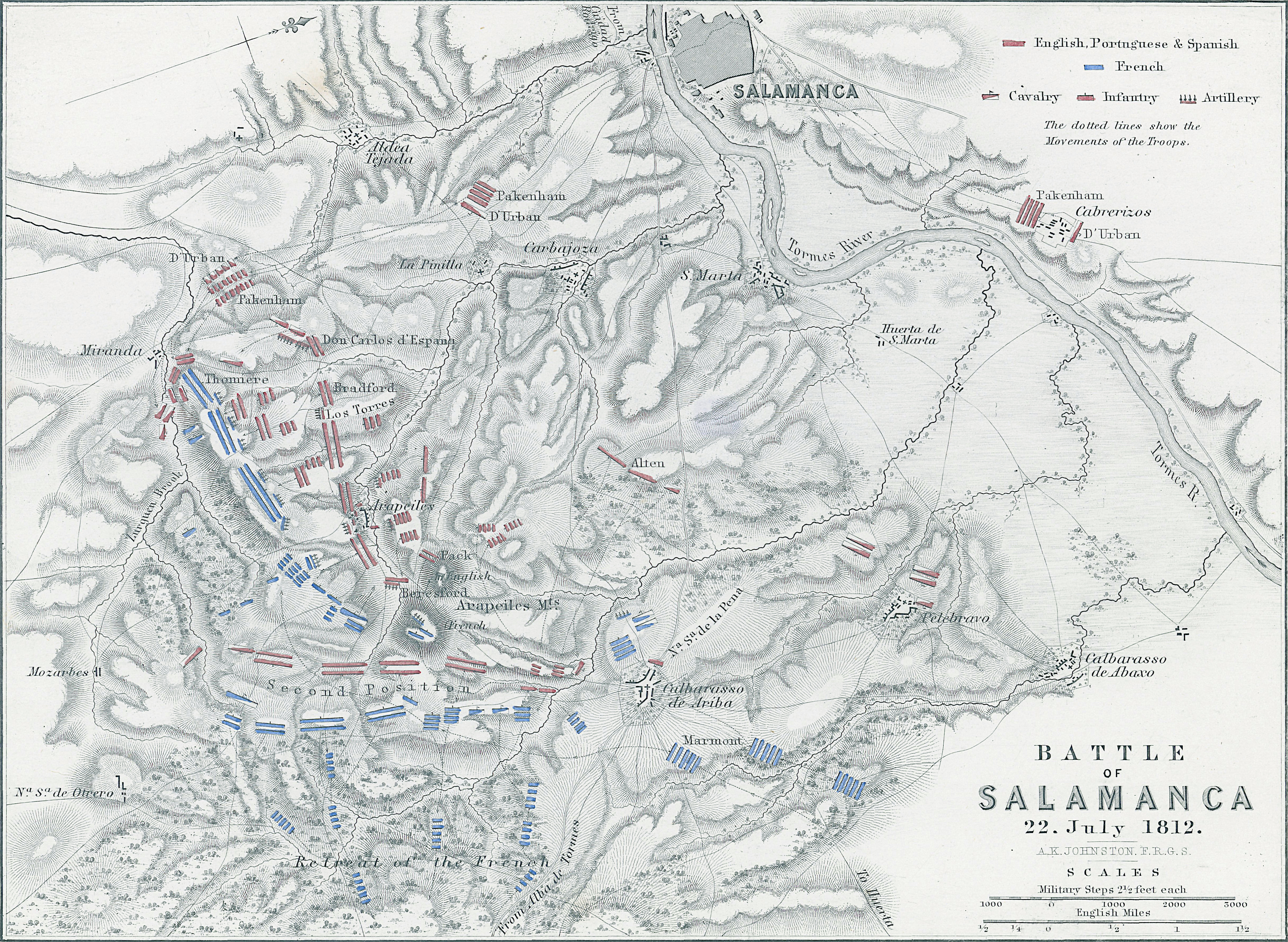
Battle of Salamanca
Marshal Marmont made two mistakes on 22 July 1812. The first was assuming the dust cloud he saw moving southwest of Salamanca meant the British were retreating. The second was stretching his army into a long, thin line to cut off that retreat. Wellington, watching from a ridge, saw the French formations pulling apart like taffy and is said to have lowered his telescope, muttered that Marmont had lost the battle, and ordered the attack that would change his reputation forever.
Two Armies in the Heat
The forces were closely matched. Marmont's Army of Portugal fielded roughly 50,000 men with 78 cannon. Wellington's Anglo-Portuguese army numbered about 48,000 with 60 guns. The quality of the infantry on each side was comparable, though the French troops were not the elite soldiers of Austerlitz and Jena -- constant campaigning in Spain had worn them down. Where Wellington held a decisive edge was in cavalry, both more numerous and more skilled, an advantage that would prove devastating on the broken, hilly terrain south of Salamanca known as the Arapiles. A Spanish division was present but took no part in the fighting.
Forty Minutes
Marmont's army was moving south and west in a long column when Wellington saw his opportunity. The French had spread themselves into a rough L-shape, with dangerous gaps between divisions. Wellington unleashed the 3rd Division under Edward Pakenham against the head of the French column while simultaneously launching the 4th, 5th, and 6th Divisions against its flank. The British heavy cavalry brigade charged into the gap. The French division at the tip of the L -- Thomieres's 7th -- was routed by a bayonet charge after initially repulsing its attackers. Thomieres himself was killed. Division after division crumbled as the attack rolled down the French line. Marmont was badly wounded early in the action; his replacement, General Bonnet, was hit almost immediately after taking command. By the time Bertrand Clausel, the third French commander of the day, organized a counterattack, the battle was already decided.
The General Revealed
Before Salamanca, Wellington was respected as a defensive genius -- a commander who chose strong positions and let the enemy break against them. Salamanca revealed something different: a general capable of seizing a fleeting opportunity and striking with the speed and violence of a cavalry charge. The French general Maximilien Foy, no admirer of the British, wrote in his diary that the battle was the most cleverly fought, the largest in scale, and the most important in results of any the English had won in recent times, raising Wellington's reputation to the level of Marlborough. The day after the battle, Wellington's King's German Legion dragoons performed the extraordinary feat of breaking a French infantry square at Garcia Hernandez -- something cavalry almost never achieved.
The Road to Madrid
The French lost heavily: approximately 7,000 killed and wounded and another 7,000 captured, along with two Imperial Eagles and twenty cannon. Allied casualties were around 5,200. More than the numbers, the battle shattered French confidence in the Peninsula. Wellington marched into Madrid on 12 August to a rapturous welcome, though his hold on the capital would prove temporary. The strategic consequences were lasting. The French were forced to abandon Andalusia, and the initiative in Spain shifted permanently to the Allies. At the Arapiles, on ground you can still walk today, Wellington proved that he could not only defend a position but destroy an army -- and do it in the time it takes to eat lunch.
From the Air
Located at 40.889N, 5.625W on rolling terrain south of the city of Salamanca. The battlefield area around the two Arapiles hills (Greater and Lesser Arapiles) is agricultural land with scattered villages. The distinctive paired hills are visible from the air. Nearest airport is Salamanca-Matacan (LESA), approximately 15 km to the east. The terrain is Castilian meseta at roughly 800 m elevation. Best viewed at 3,000-5,000 ft AGL to see the relationship between the hills and the rolling ground where the French line was destroyed.