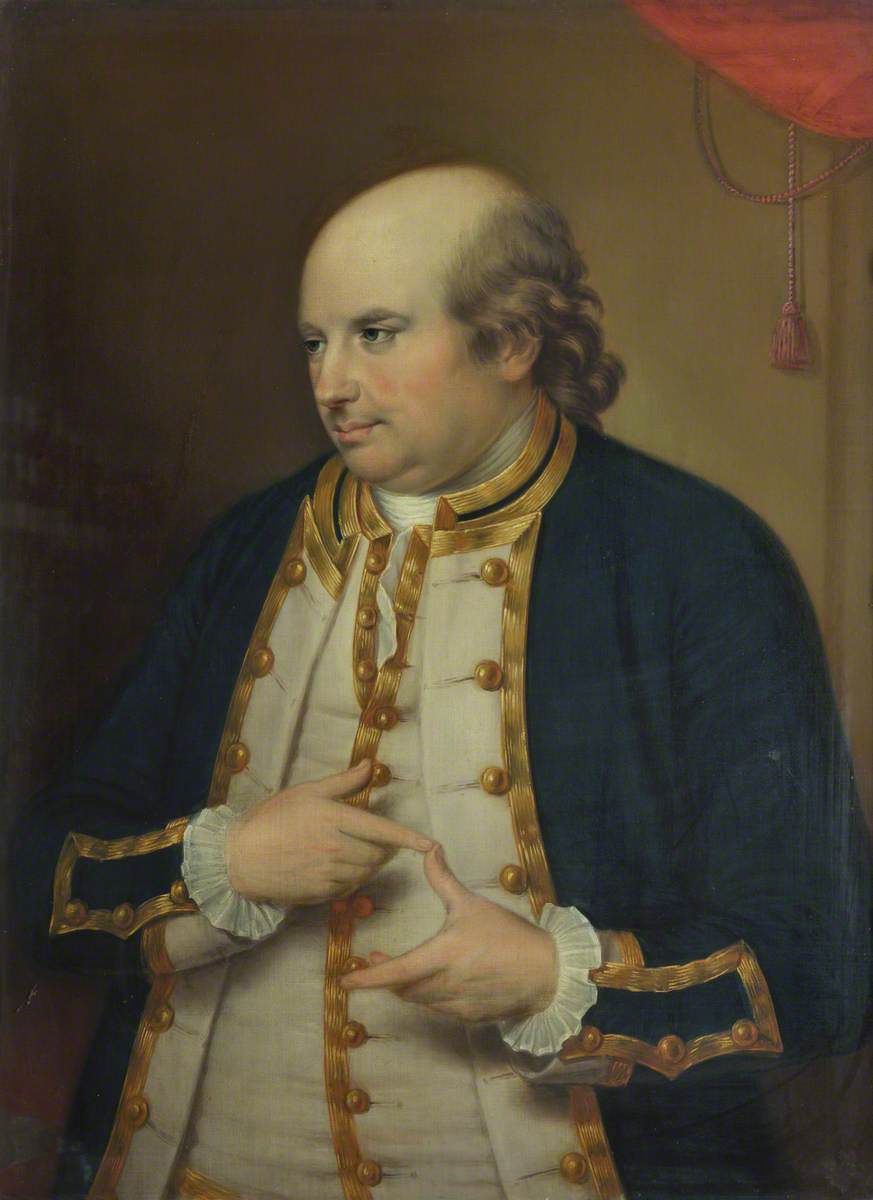
Battle of Saldanha Bay (1781)
Commodore George Johnstone had learned from a captured Dutch vessel, the Held Woltemade, exactly where the merchantmen were hiding. In July 1781, during the Fourth Anglo-Dutch War, he brought his squadron bearing into Saldanha Bay on the southwestern coast of South Africa and did something audacious: he flew French colors. The Dutch ships anchored in the bay, seeking refuge from the threat of British attack on Cape Town, mistook him for an ally. By the time Johnstone raised the British ensign and opened fire, the element of surprise was total. What followed was not so much a battle as a desperate act of self-destruction by the outmatched Dutch, and a scramble by the British to save the prizes from the flames.
Fire in the Bay
The Dutch had no means of escape. Trapped in the shallow bay with a British squadron blocking the exit, they made the bitter calculation that destroying their own ships was preferable to letting them fall into enemy hands. Crews cut their anchor cables, loosened their topsails, and drove the vessels onto the shore. Then they set about torching their own fleet. The British, now launching boats, raced to extinguish the fires before the ships were consumed. They managed to save four: the Dankbaerheid, the Paerl, the Honcoop, and the Hoogcarspel. The fifth, the Middelburg, burned too fiercely for anyone to approach. She eventually blew up, nearly colliding with two of the captured prizes in a final act of violent defiance. Meanwhile, the British sloop Rattlesnake discovered a hooker -- a small coastal craft -- hidden behind Schaapen Island, loaded with the sails stripped from the Dutch ships, a clever but ultimately futile attempt to make the captured vessels useless.
A Costly Journey Home
Johnstone sent his four prizes back to England, but the Atlantic had its own ideas. Only two ships reached their destination, and both arrived battered. The Hoogcarspel was attacked by a French frigate in the English Channel but managed to reach Mount's Bay, where she received an escort. The Paerl fought off two French privateers and escaped. But the Dankbaerheid and the Honcoop were lost in January 1782 when a gale struck at the mouth of the Channel. The prize crew aboard the Dankbaerheid abandoned ship and eventually reached Lisbon safely. The Honcoop simply disappeared -- believed to have foundered with all hands, her fate never confirmed. The British, characteristically pragmatic, had insured their prizes. The total prize money for the Paerl and Hoogcarspel, divided between Johnstone's naval squadron and the army under General Sir William Meadows, amounted to 68,000 pounds -- a substantial sum that softened the loss of the other two vessels.
A Wider War's Local Echo
The Battle of Saldanha Bay was a sideshow within a sideshow. The Fourth Anglo-Dutch War was itself a secondary conflict, entangled with the larger struggle of the American Revolutionary War and the broader Anglo-French rivalry. Johnstone's expedition had originally been dispatched to seize Cape Town, but the battle in the bay was the only significant achievement of that mission as far as South Africa was concerned. The Dutch East India Company, which owned the captured merchantmen, was already in its twilight years -- it would go bankrupt in 1799. The bay where the burning ships lit up the winter sky would go on to accumulate new layers of military history: World War II gun emplacements, a naval training base, and eventually the modern iron ore port that dominates the harbor today. But in 1781, for a few hours, Saldanha Bay was the unlikely stage for one of the more colorful naval episodes of the eighteenth century -- a story of false flags, burning ships, and prizes that never made it home.
From the Air
Located at 33.02S, 17.95E in Saldanha Bay on the southwestern coast of South Africa. The bay is a large natural harbor approximately 11 km long and 12 km wide, facing southwest. Best viewed at 3,000-5,000 ft AGL. Schaapen Island, where the Dutch hid the sails, is visible in the bay. Nearest airports: Cape Town International (FACT) approximately 105 km southeast. The modern iron ore jetty and naval installations at Saldanha are prominent visual landmarks.