Battle of Sambisa Forest (2021)
Abubakar Shekau had been declared dead so many times that the claim had become a running joke among Nigeria watchers. Ambushes, air strikes, internal coups -- each supposedly fatal incident was followed by a new video of the Boko Haram leader, wild-eyed and defiant, laughing at the rumors. So when reports emerged in late May 2021 that Shekau had killed himself during a battle with rival jihadists in the Sambisa Forest, skepticism was reasonable. But this time, no video followed. No audio message. No comeback. For the first time since he had seized control of Boko Haram in 2009, Abubakar Shekau had nothing to say.
Two Factions, One Forest
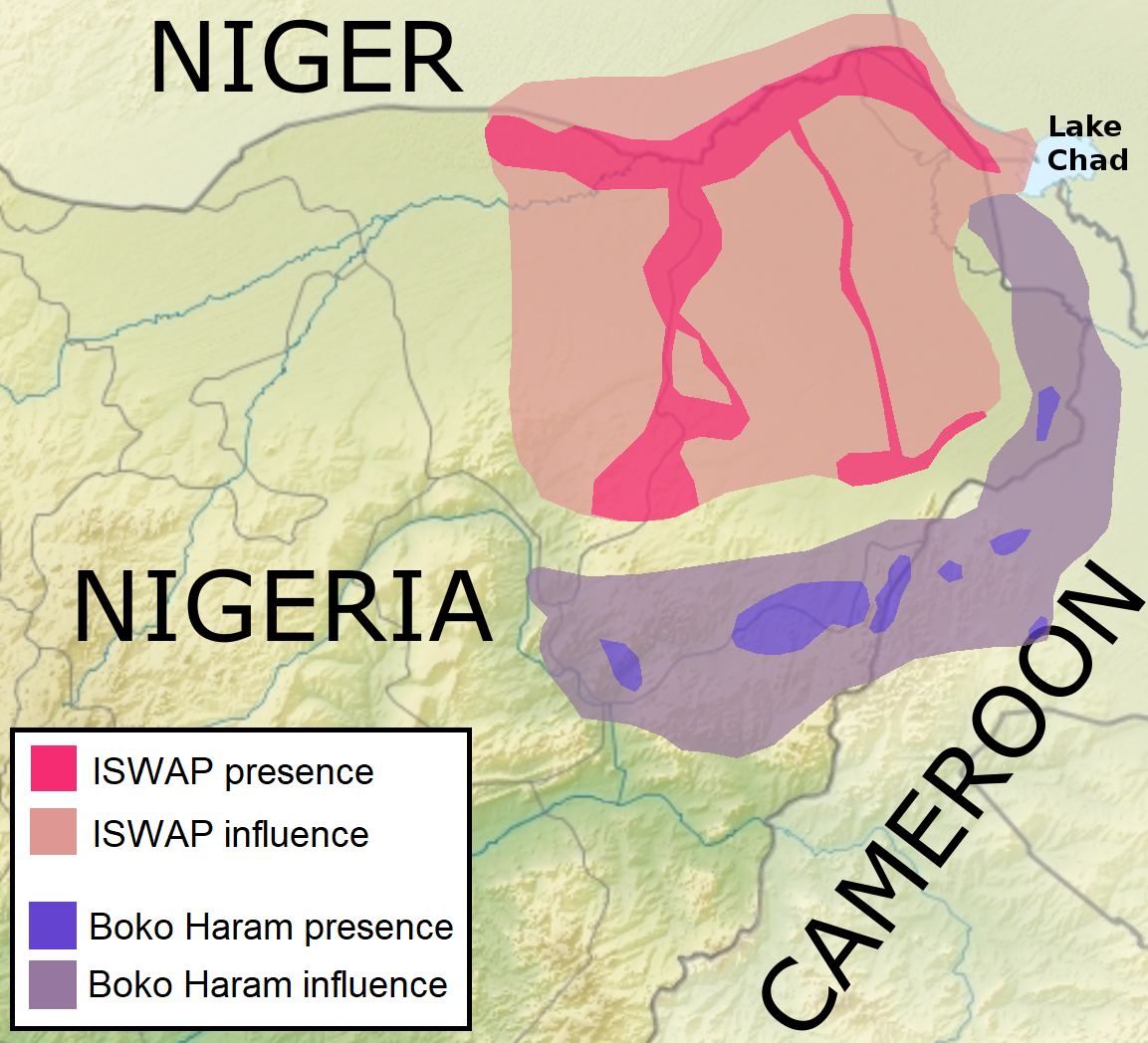
The battle that ended Shekau's life was not waged by the Nigerian military or a multinational coalition. It was fought by the Islamic State's West Africa Province -- ISWAP -- an organization that had once been part of Boko Haram itself. The split occurred in 2016 after the Islamic State's central command removed Shekau as provincial leader, deeming him too extreme even by their standards. Shekau refused to submit and broke away, retaining a loyal faction under the original Boko Haram banner. The pro-IS fighters rallied around Abu Musab al-Barnawi and continued as ISWAP. The two groups had clashed intermittently ever since, but by 2021 ISWAP had grown significantly stronger. It had established four governorates, collected taxes, and offered limited governance services in areas it controlled. Shekau's faction, by contrast, had become increasingly isolated and autocratic. The Nigerian newspaper Vanguard reported that ISWAP had sent fighters abroad for training in Libya, Somalia, and Syria; these reinforcements returned in early 2021, tipping the balance decisively.
The Offensive
ISWAP launched its assault on May 14, 2021, targeting four minor Boko Haram camps and Shekau's main base deep in the Sambisa Forest -- a dense woodland in Borno State that had served as the group's operational heart for years. The timing was calculated: the attack came shortly after Ramadan, following an April ambush by Boko Haram that had killed several ISWAP fighters. Internal dissent within Boko Haram further weakened its position; Shekau had recently executed his own chief of staff, Abu Fatima, fueling resentment among his ranks. ISWAP's frontline commander for the operation was Bako Gorgore, the group's Timbuktu governor. His forces overwhelmed Shekau's personal bodyguards in heavy fighting. According to HumAngle, a Nigerian investigative outlet, the Islamic State fighters drove through the defenses to reach Shekau's inner compound, where negotiations briefly commenced over Boko Haram's surrender.
The End of Shekau
What happened next remains partially obscured by the fog of an insurgent war, but the broad outline has been confirmed by multiple sources including Nigerian intelligence agencies. Cornered and facing capture, Shekau detonated himself -- possibly using a suicide vest. He chose death over surrender to a rival faction that he had spent five years fighting. His end carried a grim symmetry: the man who had sent countless suicide bombers to their deaths in markets, mosques, and schools died by the same method. ISWAP captured large quantities of weapons from Shekau's camp and freed fighters' family members who had been forcibly held at the Sambisa base after the 2016 split. Nigerian security expert Kabir Adamu later confirmed that every available source verified Shekau's death. The Islamic State's official spokesman, Abu Hamza al-Qurashi, publicly commended ISWAP for the killing in a late June address.
A Turning Point, Not an Ending
Analyst Bulama Bukarti warned that Shekau's death would be "a huge turning point" -- but not necessarily a positive one. The battle eliminated a notorious leader whose brutality had defined the insurgency for over a decade, yet it also consolidated power in the hands of ISWAP, a more organized and strategically sophisticated organization with direct ties to the global Islamic State network. Some Boko Haram fighters initially pledged allegiance to ISWAP after the Sambisa battle, while others refused. A dissident faction led by four commanders from the Njimiya camp waged a low-level guerrilla campaign against ISWAP in the forest before finally surrendering to Nigerian security forces in December 2022, exhausted and defeated. For the millions of civilians in northeastern Nigeria, the Chad Basin, and bordering regions of Cameroon, Chad, and Niger, the battle settled a power struggle among their oppressors. The suffering of ordinary people -- displaced, impoverished, terrorized -- continued regardless of which faction controlled the Sambisa Forest.
From the Air
The Sambisa Forest is located at approximately 11.25N, 13.42E in Borno State, northeastern Nigeria. From altitude, it appears as a large area of dense woodland in otherwise sparse Sahel terrain, making it distinctive on approach. The nearest major airport is Maiduguri Airport (DNMA), approximately 100 km to the north. The forest covers roughly 60,000 hectares and was originally a colonial-era game reserve. The terrain is flat to gently rolling, with the forest canopy providing significant cover. The area borders Cameroon to the east.