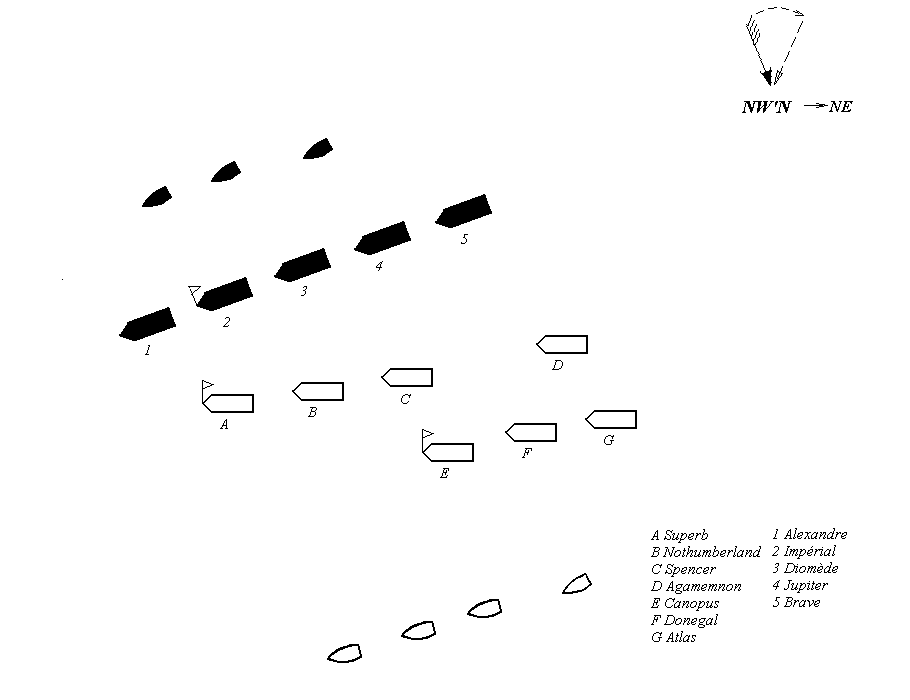
Battle of San Domingo
Before the guns opened, Captain Richard Keats hung a portrait of Horatio Nelson from the mizzen stay of HMS Superb. Nelson had been dead barely four months, killed at Trafalgar in October 1805, and Keats - who had chased Villeneuve's fleet to the West Indies and back without firing a shot - was determined that his crew would not miss another fight. The ship's band struck up 'God Save the King' and 'Nelson of the Nile' as the Superb bore down on the French line off the southern coast of Santo Domingo. It was 6 February 1806, and the last fleet engagement of the Napoleonic Wars to be fought in open water was about to begin.
The Chase South
The confrontation had its origins in a grand French strategy that was already unraveling. In December 1805, eleven ships of the line slipped out of Brest under two separate squadrons. Contre-amiral Corentin de Leissegues took five ships of the line, along with frigates and a corvette, south toward Santo Domingo, while Contre-amiral Jean-Baptiste Willaumez led six more into the Atlantic on a commerce-raiding cruise. Vice-Admiral Sir John Thomas Duckworth, commanding a British squadron off Cadiz, learned of the French departure and gave chase. After weeks of searching through the Caribbean, his lookouts spotted the French anchored off Santo Domingo. Duckworth had seven ships of the line against Leissegues' five, but the French flagship Imperial carried 120 guns - an enormous vessel that outweighed anything the British could match one-on-one.
Broadside to Broadside
The engagement began around 10 AM as the British bore down from the northeast, their line fracturing as faster ships pulled ahead. Superb reached the French first and laid herself alongside the Imperial, unleashing a starboard broadside into the massive flagship. HMS Northumberland, with only 74 guns, closed to point-blank range against the 120-gun behemoth. Captain Alexander Cochrane placed his ship between Imperial and Superb to shield Duckworth's vessel, absorbing punishing fire - so heavy that shot passed clean through Northumberland's hull and struck Superb on the far side. Meanwhile, the British eastern division under Rear-Admiral Thomas Louis arrived and raked the French ship Alexandre as they passed, bringing down her masts and leaving her a wreck. Captain Pulteney Malcolm on Donegal attacked Brave with devastating raking broadsides across her stern, while Atlas and Spencer pounded Diomede.
Driven Onto the Reef
By 11:30, Leissegues recognized the battle was lost. With his main and mizzen masts collapsed, he turned Imperial toward the shore, hoping the shallow coastal waters would discourage pursuit. Duckworth held back, unwilling to risk his ships on the coral shoals, but HMS Canopus pressed on alone, chasing the French flagship until it was clear at 11:40 that Imperial had run hard aground on a reef less than a mile from the beach. Diomede followed her ashore moments later. Both ships lost their remaining masts as they struck, and their hulls split open on the coral. Crews gathered on deck to abandon ship while the smaller French vessels - the frigates Comete and Felicite and the corvette Diligente - slipped between the combatants and the shoreline, escaping westward. The battle had lasted barely two hours.
A Victory Without Reward
Total British losses came to 74 killed and 264 wounded. Every ship in the squadron bore damage, Northumberland worst of all - her mainmast collapsed across the deck as the fighting ended. Of the five French ships of the line, two were burning wrecks on the reef, two were captured as prizes, and only Jupiter would ever sail again, renamed HMS Maida and pressed into Royal Navy service. When Duckworth's dispatches reached London, both Houses of Parliament voted their thanks. But Vice-Admiral Lord Collingwood, commander in chief of the Mediterranean, was furious. Duckworth had abandoned his post off Cadiz without orders, failed to find Willaumez, and resupplied in the West Indies rather than returning to the Spanish coast. Historians later concluded that had Duckworth lost the battle, he would likely have faced a court martial. Collingwood's influence blocked any additional honors, and Duckworth was quietly reassigned.
The War That Followed the Victory
In Paris, the government press spun a different story entirely. Le Moniteur Universel published a fabricated account claiming the British had nine ships of the line and had lost two of them on the coast. The official French report by Leissegues - which contradicted this narrative point by point - was suppressed. The broader Atlantic campaign ground on through 1806. Willaumez's squadron roamed the South Atlantic for months before a hurricane caught it in August, scattering his ships across the Caribbean and the American coast. Only four of the eleven ships that left Brest in December 1805 ever returned to France. San Domingo proved to be the last fleet battle fought in open water during the Napoleonic Wars. The only subsequent engagement between squadrons, at the Basque Roads in 1809, took place in the narrow, shallow waters at the mouth of the Charente River. Over four decades later, in 1847, surviving British veterans could claim the Naval General Service Medal for their part in the action - a final, belated recognition of what their captains had accomplished off the coast of Hispaniola.
From the Air
The battle was fought off the southern coast of present-day Dominican Republic near coordinates 18.30N, 70.05W, between Nizao and Point Catalan. The nearest major airport is Las Americas International Airport (MDSD) at Santo Domingo, approximately 45 nautical miles to the east. From 5,000 feet, the coastline where Imperial and Diomede ran aground is visible as a stretch of shallow reef close to shore. The Bahia de Ocoa lies to the west, and the rugged Sierra de Bahoruco rises inland.