Battle of San Jacinto
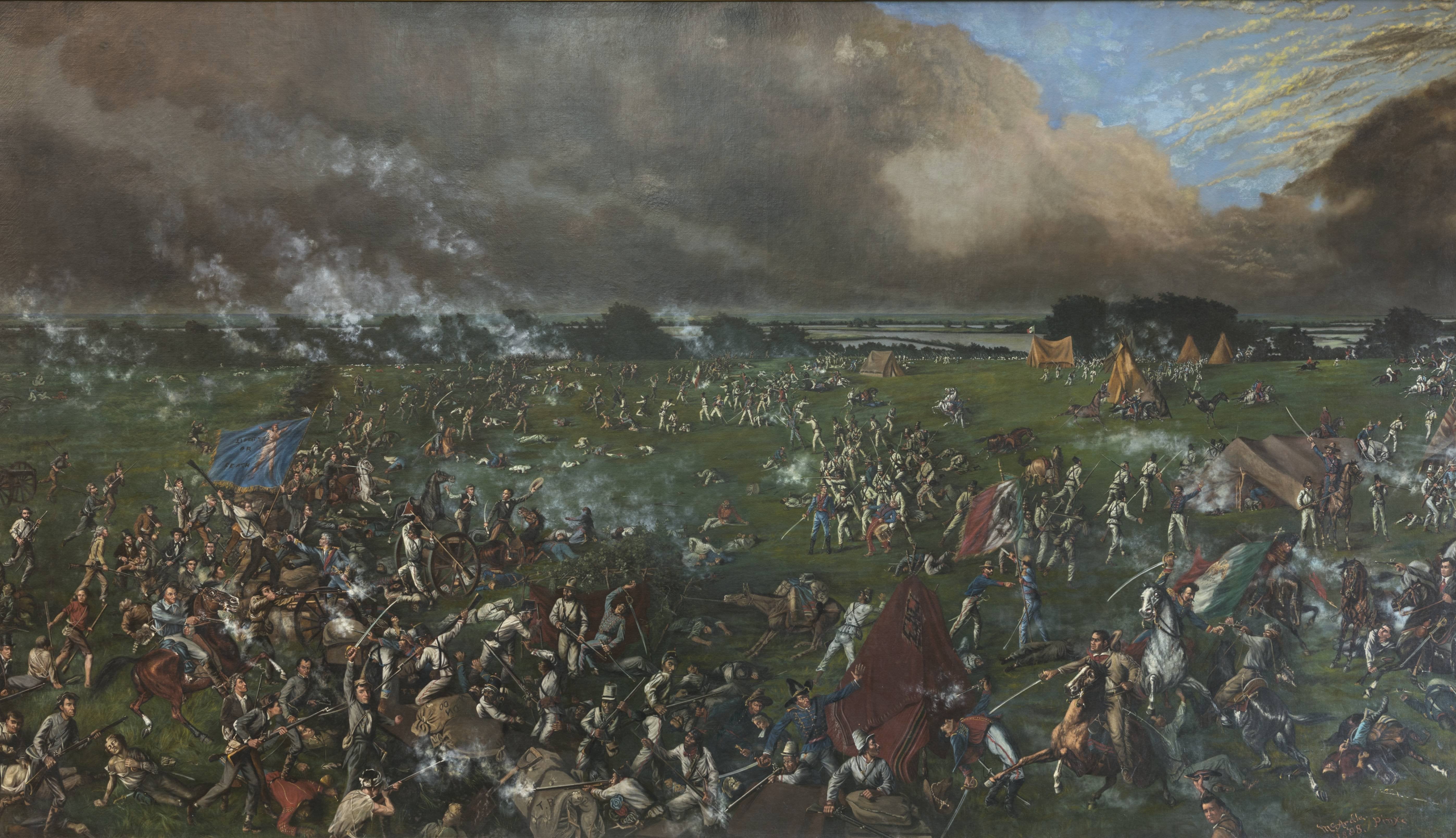
Eighteen minutes. That is how long the actual fighting lasted on April 21, 1836, when roughly 800 Texians swarmed over the breastworks of a sleeping Mexican army and won the decisive battle of the Texas Revolution. General Sam Houston had spent weeks retreating, ignoring orders to fight, enduring accusations of cowardice, and watching his own troops desert. President David G. Burnet wrote him furiously: 'The enemy are laughing you to scorn. You must fight them. You must retreat no further.' When Houston finally turned and attacked at the marshy confluence of Buffalo Bayou and the San Jacinto River, historian William C. Davis would later call the result 'one of the most one-sided victories in history.'
Playing Cards in Their Hats
Houston's army was a ragged coalition. When Deaf Smith and Henry Karnes captured a Mexican courier carrying intelligence on the positions of all Mexican forces in Texas, Houston realized that Santa Anna had split off with a small force of about 700 troops. He gave a rousing speech, exhorting his men to 'Remember the Alamo' and 'Remember Goliad,' and the army raced toward Lynchburg. But one problem nagged Houston: the Tejanos serving under Juan Seguin looked too much like the enemy. Houston ordered Seguin's company to stay behind in Harrisburg. Seguin and Antonio Menchaca protested so loudly that Houston relented -- on the condition that every Tejano soldier wear a playing card tucked into his hat, so that in the chaos of battle, Texians would not shoot their own allies. Two cannon called the Twin Sisters, gifts from Cincinnati, Ohio, gave the ragtag force its only artillery.
A General's Afternoon Nap
Santa Anna made a catastrophic choice of campground. Colonel Pedro Delgado later wrote that 'the camping ground of His Excellency's selection was in all respects, against military rules. Any youngster would have done better.' The plain sat near the San Jacinto River, bordered by woods on one side and marsh and lake on another -- terrain familiar to Texians and alien to the Mexican soldiers. When General Cos arrived with 540 reinforcements on the morning of April 21, his men were raw recruits who had marched for more than 24 hours without rest or food. As the morning passed with no Texian attack, Mexican officers lowered their guard. By afternoon, Santa Anna had permitted Cos's exhausted men to sleep. His own troops rested, ate, and bathed. Houston ordered Deaf Smith to destroy Vince's Bridge, cutting off the only escape route. Then the Texian cavalry advanced through the tall grass to within 200 yards of the Mexican breastworks.
Remember the Alamo
After a single artillery volley, the Texians broke ranks and swarmed over the barricades screaming 'Remember the Alamo! Remember La Bahia!' Hand-to-hand combat erupted across the camp. Santa Anna, Almonte, and General Castrillon yelled conflicting orders, trying to organize a defense that never materialized. Within minutes, Mexican soldiers were fleeing through the marsh toward Peggy Lake. Texian riflemen lined the banks and shot at anything that moved. Houston and Secretary of War Thomas Rusk tried to stop the slaughter but could not control their men, enraged by the massacres at the Alamo and Goliad. Terrified Mexican soldiers cried 'Me no Alamo!' and begged for mercy. By the time the killing stopped, 650 Mexican soldiers lay dead, 208 were wounded, and 300 had been captured. Eleven Texians were killed, and 30 wounded -- including Houston himself, shot in the ankle.
A Private's Jacket
Santa Anna escaped toward Vince's Bridge, only to find it destroyed. He hid in the marsh overnight and was captured the following day wearing the uniform jacket of a common private. The disguise failed when Mexican prisoners recognized their commander and cried out. Texian soldiers demanded immediate execution. Bargaining for his life, Santa Anna offered to order the remaining 4,000 Mexican troops in Texas to withdraw. In a letter to General Vicente Filisola, he described the disaster as 'an unfortunate encounter' and ordered a retreat to San Antonio. The Treaties of Velasco, signed weeks later, required all Mexican troops to withdraw south of the Rio Grande. Santa Anna secretly promised to persuade the Mexican Congress to recognize the Republic of Texas. Mexico never honored the agreement. Flags across the country were lowered to half-staff, and Mexican authorities denounced any treaty signed by a prisoner.
The Farmer's Unwanted Honor
The battlefield belonged to Margaret 'Peggy' McCormick, and the aftermath left her property strewn with hundreds of Mexican corpses. Houston refused to bury them, reasoning that Mexican forces had cremated every fallen Texian at the Alamo and Goliad. Santa Anna refused to order his captured soldiers to bury their comrades. When McCormick asked Houston to remove the rotting bodies, he told her she should be honored that her land was the site of the battle that won Texas its independence. Her family buried a few corpses, but hundreds were never recovered. Years later, the remains -- by then skulls and skeletons -- were interred in a mass trench somewhere on the battlefield. No one knows where that trench is today. The San Jacinto Battleground State Historic Site was designated a National Historic Landmark in 1960, and the San Jacinto Monument, authorized on the centennial of the battle in 1936, rises from the marshy ground where a nation was born in eighteen furious minutes.
From the Air
Located at 29.75N, 95.08W on the marshy lowlands where Buffalo Bayou meets the San Jacinto River, east of Houston. The San Jacinto Monument -- a 567-foot obelisk topped with a 34-foot star -- is unmistakable from the air. Best viewed at 2,000-4,000 ft AGL. The Houston Ship Channel runs directly through the battlefield area. Nearest airports: KHOU (William P. Hobby Airport, 18 nm W) and KEFD (Ellington Field, 10 nm SW). The Battleship Texas was berthed nearby from 1948 to 2022.