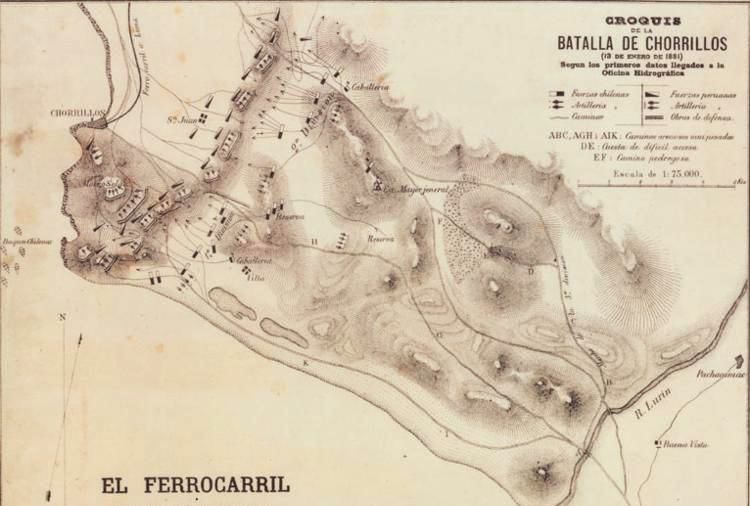
Battle of San Juan and Chorrillos
"The peace is at Lima, and nowhere else." When Chilean congressman Jose Miguel Balmaceda spoke those words, he sealed the fate of a city that had never expected to become a battlefield. By January 1881, Chile had already won the War of the Pacific in every way that mattered -- the disputed Bolivian territory was under Chilean control, and the nitrate-rich Peruvian department of Tarapaca was financing the Chilean war effort. But public opinion demanded the capture of Lima itself, and so General Manuel Baquedano marched nearly 30,000 soldiers north toward a capital defended by an army of conscripts that Peru's dictator, Nicolas de Pierola, had assembled from whatever human material was available: hastily trained civilians, teenagers, and elderly men.
A Fifteen-Kilometer Line of Desperation
Pierola's engineers, Gorbitz and Arancibia, did what they could. They laid out a defensive line stretching fifteen kilometers along the hills south of Lima, from Marcavilca hill to La Chira, threading through the elevations at San Juan and Santa Teresa. A second line was established at Miraflores as a fallback. The positions were sound on paper, but the troops manning them were not a professional army. They were citizens with rifles, holding ground against veterans who had already fought their way through Tacna and Arica. While Chile transported its divisions by sea from Pisco and Paracas to landing points at Curayacu and Chilca in late December 1880, the Peruvian defenders could only dig in and wait. By Christmas, Chilean cavalry under Lieutenant Colonel Ambrosio Letelier had scouted as far as Lurin without encountering resistance. The invasion force gathered at Pachacamac, and the countdown began.
The Line Breaks
The battle on January 13, 1881, was not a single engagement but a chain of fierce confrontations at Villa, Chorrillos, Santiago de Surco, San Juan de Miraflores, Santa Teresa, and Morro Solar. The Chilean assault split the Peruvian line at two points. Colonel Gana's brigade hammered the Peruvian positions at Papa and Viva el Peru hills, with the Buin 1st Line Regiment clearing defenders at bayonet point while the Esmeralda 7th Line Regiment captured the banner of the Manco Capac Battalion. When Gana wheeled left and struck the flank of Colonel Andres Avelino Caceres' corps, the Peruvian center collapsed. Reinforcements sent by General Silva -- the Huanuco Battalion among them -- were thrown back as fast as they arrived. At Morro Solar, Colonel Arnaldo Panizo's artillery battery, the Martir Olaya, poured fire onto the advancing Chileans, inflicting heavy casualties on the Chacabuco and 4th Line regiments. But ammunition ran out, and the stronghold fell after Patricio Lynch divided his forces for a pincer attack.
The Burning of Chorrillos
What followed the battle was worse than the battle itself. As surviving Peruvian troops retreated into the town of Chorrillos, Chilean forces pursued them house by house, and when the fighting proved too costly at close quarters, they set the town on fire. Night brought no relief. Drunken Chilean soldiers, no longer under their officers' control, looted homes, warehouses, and churches. Civilians were murdered. Women were assaulted. Foreign residents who had stayed to protect their property were killed and robbed. The Italian firefighters' brigade attempted to extinguish the flames and was executed by a Chilean firing squad -- an act Peru remembers to this day. Nearly 200 Chilean soldiers died fighting each other during the riots. Colonel Caceres begged Pierola for permission to counterattack the disorganized Chilean troops in the darkness, arguing they were scattered and mutinous. Pierola refused.
The Cost of a Single Day
The toll was staggering. Chile lost 3,107 men killed or wounded -- thirteen percent of its entire force. Lynch's and Sotomayor's divisions were gutted. Peru's losses were far worse: approximately 8,000 men, along with 87 cannons, 19 machine guns, and four battalion banners captured. Entire units ceased to exist. The Guardia Peruana, the Cajamarca, the Ayacucho, the Zepita -- names that had meant something to the men who carried them -- were erased from the order of battle in a single afternoon. The survivors staggered north to reinforce the second defensive line at Miraflores, but morale was shattered. Two days later, on January 15, the Chileans fought through that line as well. Lima fell. The war that had begun over guano and nitrates ended with a foreign army occupying Peru's capital, and the seaside town of Chorrillos reduced to ashes and memory.
From the Air
The battlefield is located at approximately 12.18S, 76.96W, in the southern districts of modern Lima including Chorrillos, San Juan de Miraflores, and Santiago de Surco. Morro Solar, the prominent hill where some of the fiercest fighting occurred, rises above the coast at Chorrillos and is visible from the air as a distinct headland. Jorge Chavez International Airport (SPJC) is approximately 12 nm to the northwest. The battlefield terrain stretches from the coast inland along the hills south of Lima's urban area.