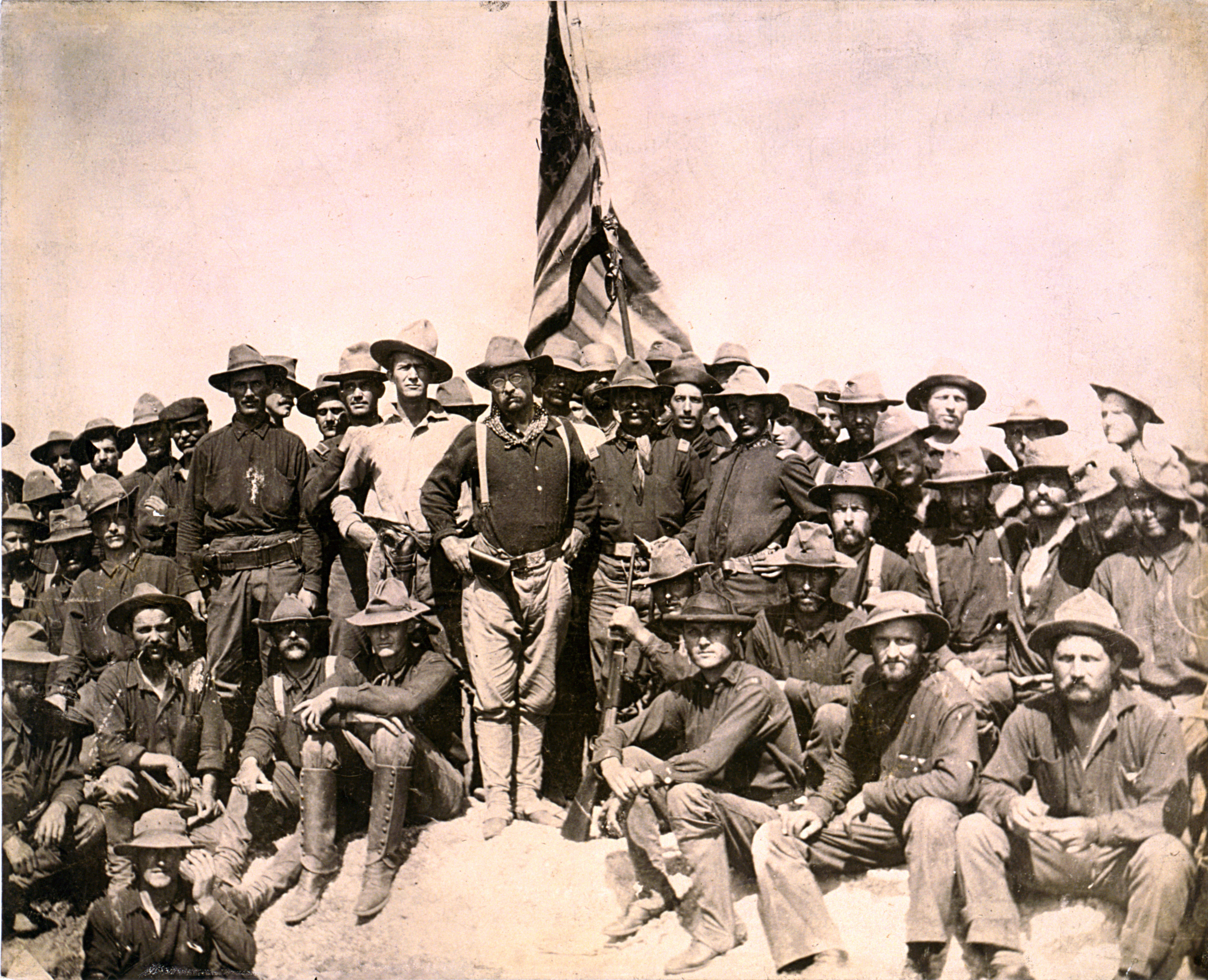
Battle of San Juan Hill
Eighteen thousand rounds in eight and a half minutes. That was the rate at which Lieutenant John Henry Parker's Gatling gun detachment poured fire into the Spanish trenches crowning San Juan Heights on July 1, 1898 - more than 700 rounds per minute of continuous, mechanical killing. Colonel Harry Egbert, commanding the 6th Infantry as it struggled uphill, had to halt his men near the summit because the Gatling fire sweeping the crest endangered attacker and defender alike. Down the slope, Theodore Roosevelt heard the hammering and leaped to his feet. "It's the Gatlings, men! Our Gatlings!" he shouted. The sound was, as he later wrote, "most inspiring." It was also the sound of a new kind of war arriving on a Cuban hillside outside Santiago.
Two Hills, One Fight
The battle was actually fought on two hills. San Juan Hill proper anchored the Spanish defensive line protecting Santiago de Cuba. A few hundred yards north stood Kettle Hill, a smaller rise named for the iron sugar-refining kettles found there. The American assault hit both on the morning of July 1, and the fighting quickly devolved into a chaotic, uphill slog through waist-high grass under Spanish Mauser fire. Troops dropped from heat exhaustion as much as from bullets. Officers from multiple brigades bunched together, units intermingled, and the chain of command dissolved into individual acts of courage and desperation. The assault on Kettle Hill drew Roosevelt's Rough Riders, the 10th Cavalry's Buffalo Soldiers, and elements of the 3rd Cavalry into a scramble for the summit that became the most famous charge of the Spanish-American War.
The Men Who Climbed First
The popular narrative gave Roosevelt the glory, but the first American soldier to reach the crest of Kettle Hill was Sergeant George Berry of the 10th Cavalry, one of the all-Black Buffalo Soldier regiments. Berry carried both the 10th and 3rd Cavalry battle flags to the summit, a fact recorded by First Lieutenant John J. Pershing, who fought alongside the 10th that day. Pershing - nicknamed "Black Jack" for his service with Black troops - would go on to become General of the Armies, the highest rank held by any living American officer. Second Lieutenant Thomas H. Rynning was credited as the first Rough Rider to reach the top. Roosevelt arrived shortly after, having charged on horseback while most of his dismounted cavalry advanced on foot. Black soldiers who reached the hilltop first would receive far less recognition than the white colonel who arrived behind them. As Pershing noted, politics and racial discrimination led to many myths about African-American involvement in the Cuba fighting.
The Counterattack
Taking the hills was only half the battle. From San Juan Heights, General Linares's troops opened fire on the Americans clinging to Kettle Hill's crest. Roosevelt decided to cross the steep ravine to San Juan Hill, ran forward calling for his men - and turned to find exactly five Rough Riders behind him. The rest had not heard the command. He doubled back, gathered a larger force, and led them down Kettle Hill's western slope. By the time they reached San Juan Hill, the fighting there was over. General Sumner furiously ordered Roosevelt back to prepare for the expected counterattack. When it came, his men were exhausted and his horse spent from the heat. The counterattack on Kettle Hill, led by some 120 Spanish regulars, was broken not by infantry but by Parker's Gatling guns firing obliquely from San Juan ridge.
The Price of the Heights
The Americans suffered more than twice the casualties the Spanish did. The defenders fought with extraordinary tenacity, losing a third of their force while surrendering almost no prisoners. The toll from Mauser fire was so severe that the U.S. Army overhauled its small-arms arsenal afterward. The aging .45-70 and Krag-pattern Springfields were retired in favor of the M1903 Springfield chambered in .30-03 (later the iconic .30-06). The Gatling guns were themselves replaced by 1909. Lawton's division, supposed to support the assault early on July 1, never arrived - pinned down at El Caney by unexpectedly fierce resistance, it did not reach San Juan until noon on July 2.
Fame and Forgetting
The battle's aftermath carved its participants into two categories: those history remembered and those it discarded. Roosevelt became an instant legend. His account of the charge propelled him to the governorship of New York and ultimately the presidency. But Captain Jules Garesche Ord, who led the actual assault column up San Juan Hill, saw his commanding officer's and general's medal requests denied by the Army. The Buffalo Soldiers of the 9th and 10th Cavalry, who had fought their way up both hills alongside white troops, returned to a country that would not let them eat at the same lunch counters or ride in the same train cars as the men they had charged with. The battle led directly to the Siege of Santiago, which surrendered on July 17, 1898, ending the war in Cuba. The hills remain outside the modern city, low green rises that give no hint of the carnage that once swept across them.
From the Air
Located at 20.02°N, 75.80°W, just east of Santiago de Cuba in southeastern Cuba. San Juan Hill and Kettle Hill are low rises northeast of the city, part of the heights that once guarded the approach to Santiago's harbor. Antonio Maceo Airport (MUCU) at Santiago de Cuba is approximately 8 km to the southwest. From altitude, Santiago de Cuba's harbor is the dominant visual landmark - a deep, narrow bay cutting inland from the Caribbean coast. The battlefield sits on the gentle hills northeast of the city, now largely absorbed into the urban area. The Sierra Maestra range rises dramatically to the west along the coast. Best viewed at 2,000-4,000 feet for terrain detail. Guantánamo Bay (MUGM) lies approximately 80 km to the east.