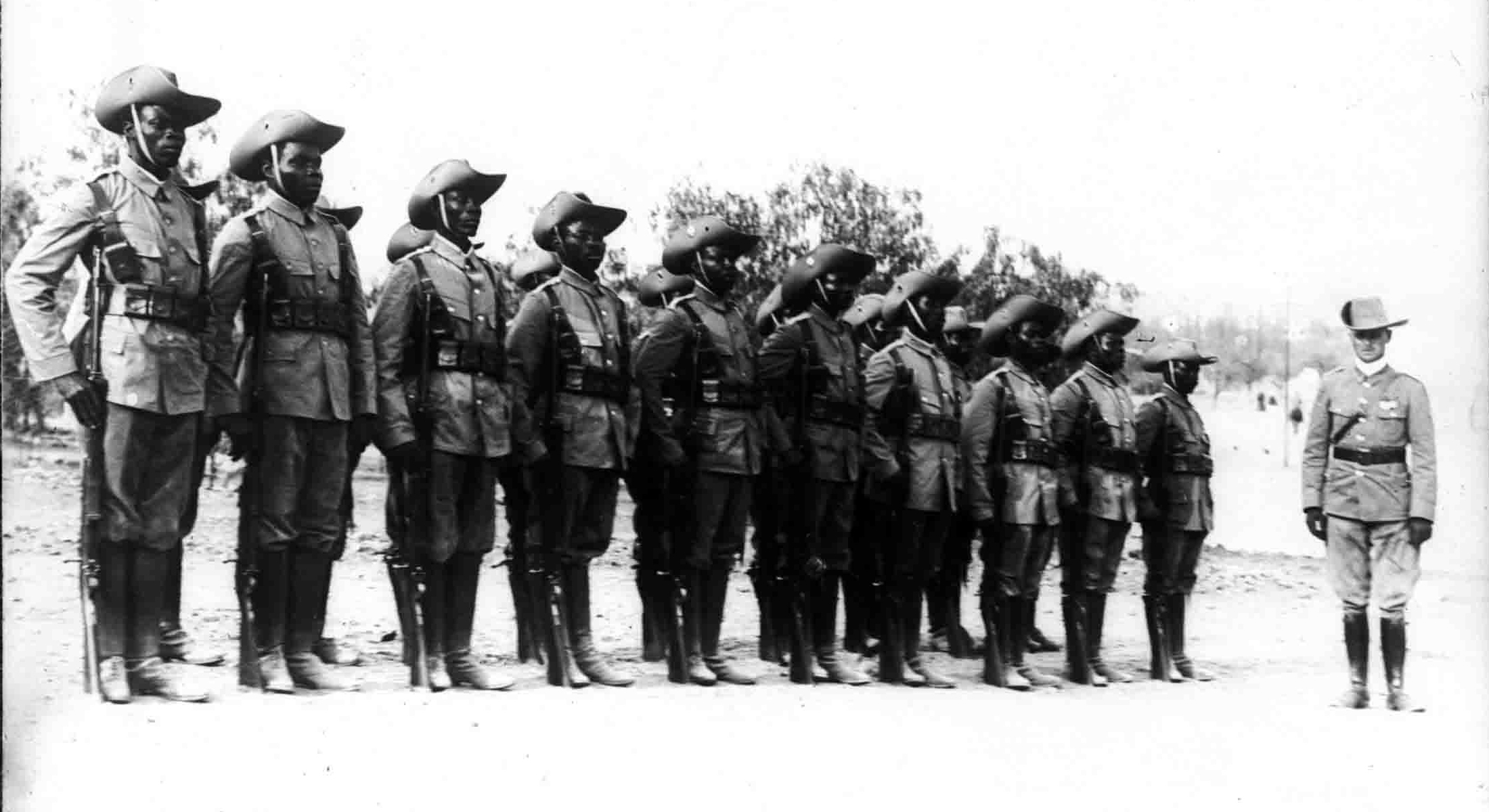
Battle of Sandfontein
Everything depended on water. In a 75-kilometer radius of open desert along the South African-German border, the wells at Sandfontein were the only source of high-quality water -- making this remote spot in what is now southern Namibia the most strategically valuable piece of ground in the entire region. On 26 September 1914, barely six weeks after South Africa entered World War I, a garrison of South African soldiers at these wells found themselves surrounded by 1,700 German troops. The ten-hour battle that followed became the first major engagement of the South West Africa Campaign, and it ended in defeat.
A Reluctant War
South Africa's entry into World War I was anything but straightforward. When the British government requested on 7 August 1914 that Prime Minister Louis Botha capture the German communication stations at Windhoek, Swakopmund, and Luderitzbucht, it thrust a young nation into a conflict that divided its own population. Pro-British loyalists supported full involvement; Afrikaner nationalists advocated neutrality. Botha's government reluctantly agreed on 10 August to create a volunteer expeditionary force, but only with parliamentary approval. Mobilization began even before parliament voted, under a press censorship designed to suppress rumors. When the plans were finally revealed during a 9 September session, they gained approval -- but the next day, everything was complicated by the outbreak of the Maritz Rebellion, an Afrikaner revolt against the very war the government had just endorsed. Several high-ranking commanders resigned and turned against their former colleagues.
The Desert Trap
The expeditionary force was organized into three columns. Force A, with 1,800 soldiers and eight guns, would land at Port Nolloth. Force B, 1,000 men, would advance from the east through Upington. Force C, 1,200 soldiers with six artillery pieces, would strike Luderitzbucht. On 12 September 1914, Force A under Brigadier-General Tim Lukin reached the border, and by the following week, the 4th and 5th South Africa Mounted Riflemen had pushed across and captured Sandfontein. But the position was a trap. The wells sat in low ground surrounded by hillocks and narrow sand ridges -- terrain perfectly suited for encirclement. Force A had dispersed across multiple positions at Steinkopf and Raman's Drift, leaving Sandfontein isolated. The Germans knew exactly what they were facing: they had detained a South African scout and held the allegiance of the rebellious Force B commander, Manie Maritz, who was feeding them intelligence.
Ten Hours at the Wells
The garrison at Sandfontein numbered only 120 men, hurriedly reinforced before dawn on 26 September with two squadrons of mounted riflemen, two machine guns, and two thirteen-pounder artillery pieces. Most of the reinforcements had marched through the night without sleep. Against them, 1,700 German soldiers with ten artillery batteries and four machine guns had gathered at Warmbad and launched a simultaneous attack from two directions at first light. By eight o'clock, an artillery duel was underway. The Germans struck the South Africans' exposed flank and rear, cutting off any chance of breakout. A machine-gun section repelled an infantry charge from the northeast, but a German gunner approaching from the south killed a large number of horses, eliminating the defenders' mobility. A second German battery appeared at 8:30, suppressing the South African artillery. At ten o'clock, a German infantry charge from the east was thrown back with heavy casualties. Between one and two in the afternoon, the German main body paused to eat while continuing to shell the exhausted defenders. By five o'clock, the distance between the lines had halved, and high-explosive shells were falling among men who had been fighting without rest for ten hours. At six o'clock, the white flag went up.
The Cost and the Aftermath
German casualties amounted to 14 dead and 46 wounded. The South Africans lost 16 men killed and 51 wounded -- relatively modest numbers that belie the intensity of the fighting and the significance of the outcome. Sandfontein was a German victory that demonstrated the difficulty of operating in this waterless border region, where logistics mattered more than firepower and intelligence could turn a small advantage into a decisive one. Colonel R. C. Grant, commanding the South African forces, was wounded by machine-gun fire during the battle and temporarily replaced by Captain E. J. Welby before resuming command. The broader South West Africa Campaign would eventually succeed -- Germany lost the territory by 1915 -- but Sandfontein showed that the path to victory would run through terrain that punished overextension and rewarded preparation.
Desert Memory
The battlefield at Sandfontein looks much as it did in 1914. The hillocks still rise from the sandy plain. The wells still mark the only reliable water for dozens of kilometers in any direction. It is the kind of place that reveals its strategic logic only when you understand the landscape -- why this unremarkable patch of desert mattered enough for men to fight and die over, and how a waterhole could determine the outcome of a campaign. The German Schutztruppe that won here were well-organized and disciplined, but their greatest advantage was understanding the ground. They knew where the water was, and they knew that whoever held it controlled everything else.
From the Air
Located at 28.70S, 18.55E in the borderlands between South Africa and Namibia. The battlefield site is in open desert terrain with scattered hillocks and sand ridges -- unremarkable from altitude except for the flat, arid character of the landscape. The Orange River and South African-Namibian border are nearby to the north. Nearest airports are Springbok (SBU) to the southwest and Keetmanshoop (KMP) in Namibia to the northeast. Warmbad, Namibia, from which the German attack was launched, is visible to the north. Terrain is flat to gently rolling desert; no significant altitude concerns.