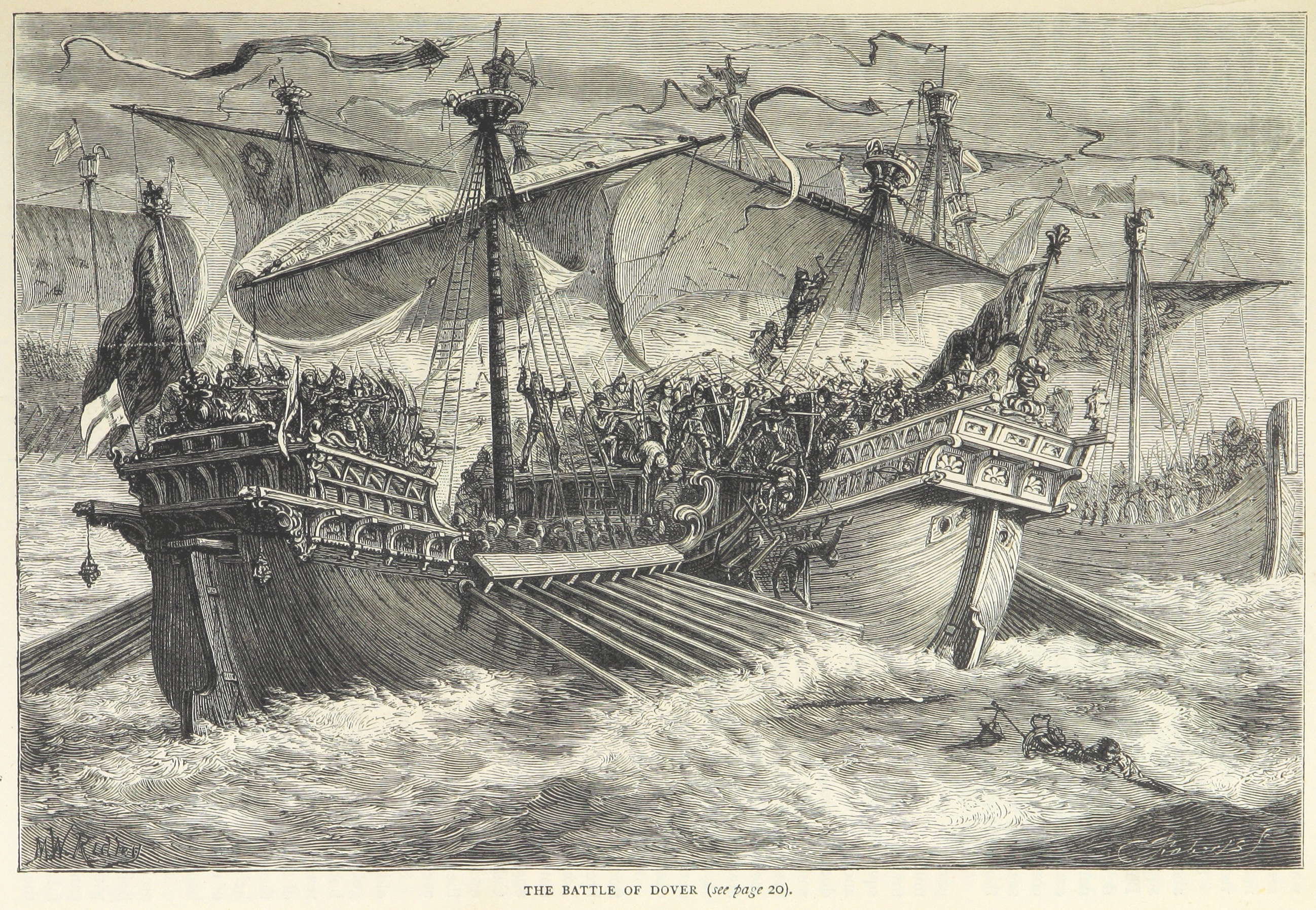
Battle of Sandwich (1217)
Eustace the Monk had broken his vows, taken up piracy with his brothers, and at one time held the Channel Islands for King John of England. By August 1217 he was the most feared sailor in the Channel, working for Prince Louis of France, and steering a fleet of overloaded troopships toward London to keep alive a French bid for the English crown. He never reached it. On 24 August, off Sandwich in Kent, English sailors hauled him out of his own bilge and hacked off his head on the deck. The Plantagenet throne was saved by a battle that lasted an afternoon.
The Pirate Monk
Eustace had once worn the habit of a monastic order, but he left it for the sea and a life that English chroniclers described, half in horror and half in admiration, as one of "diabolical ingenuity." From 1205 to 1208 he worked for King John, who let him hold the Channel Islands and operate out of Winchelsea. In 1212 he changed sides, was chased from England, and took service with the French. When the English barons rose against John in 1215, it was Eustace's ships that ferried their siege engines. When Prince Louis - son of the French king and married to John's niece Blanche of Castile - sailed for London on the barons' invitation in 1216, he sailed in Eustace's fleet. London and the Cinque Ports fell quickly. For a moment, England seemed about to become a province of France.
An Overloaded Fleet
By the summer of 1217 the moment had turned. King John was dead, his nine-year-old son Henry III had been crowned, and the war was no longer a clean cause - many barons had drifted back to the boy king. Louis still held London but he needed reinforcements. Blanche of Castile, his queen, organized the relief from Calais: ten or eleven troopships, seventy supply vessels, between a hundred and a hundred and twenty-five French knights packed onto the larger ships, and the great trebuchet meant for Louis bound in the flagship's hold along with horses. Robert of Courtenay commanded the soldiers. Eustace, by some accounts, was his deputy - by others, the man who actually ran the fleet. They sailed in clear weather on 24 August. The English, under the justiciar Hubert de Burgh, watched them pass Sandwich and only then slipped out from behind.
Lime in the Eyes
De Burgh's force was smaller - sixteen to eighteen larger ships and twenty smaller ones - but it had something Eustace's tightly packed armada lacked: the wind. The English came up to windward of the French and emptied pots of powdered lime into the breeze. The white dust drifted into French faces, blinding archers and bowmen at the rails. English arrows came back unanswered. Richard FitzRoy, an illegitimate son of the dead King John, drove his ship straight at the flagship Great Ship of Bayonne, and the Earl of Pembroke's cog closed on her other side. The rest of the French fleet held its formation and did not come to the flagship's aid. Boarded from both sides, Eustace's crew of French sailors and common soldiers was slaughtered. The knights were spared for ransom. Eustace himself was hauled out of the bilge where he had hidden. He offered ten thousand marks for his life - an enormous sum. FitzRoy and the others, remembering his earlier service to King John, called him a turncoat and beheaded him on the spot.
Twelve Marks for a Hospital
With the flagship taken, the rest of the French fleet turned and ran for Calais. The English rammed, grappled, and cut rigging as they pursued. Most of the smaller supply vessels were captured; the troopships escaped largely because the English broke off to plunder the supply train. As few as fifteen French ships made it home. A portion of the loot funded the Hospital of Saint Bartholomew at Sandwich, which would care for the poor and the sick of the town for centuries. The rest went into English sailors' purses, and into the legend of the day a small fleet had saved a kingdom.
The Kingdom Saved
The Battle of Sandwich did what years of land campaigns had not. Without resupply, without his most feared captain, and with most of his support among the barons evaporating, Prince Louis gave up the fight. The Treaty of Lambeth was negotiated at Kingston upon Thames around 12 September 1217 and formally ratified on 20 September 1217, less than a month after the battle. Louis renounced his claim to the English crown in return for safe passage home and a payment of ten thousand marks. He left Dover before the end of the month. Henry III would reign for fifty-six years on a throne that, in August 1217, had been one fleet away from belonging to France. Sandwich itself, then one of the great Cinque Ports, still stands a few miles inland from the silted-up estuary where Eustace's ships came past on the morning he died.
From the Air
Battle fought off Sandwich, Kent at approximately 51.27N, 1.42E. The medieval port of Sandwich now sits roughly two miles inland as the Wantsum Channel silted over the centuries. Visible from cruising altitude as the eastern tip of Kent, with Pegwell Bay and the Stour estuary clearly marked. Nearest airports: Manston (EGMH, retired) to the immediate north, Lydd (EGMD) to the southwest. Watch heavy ship traffic in the adjacent Dover Strait.