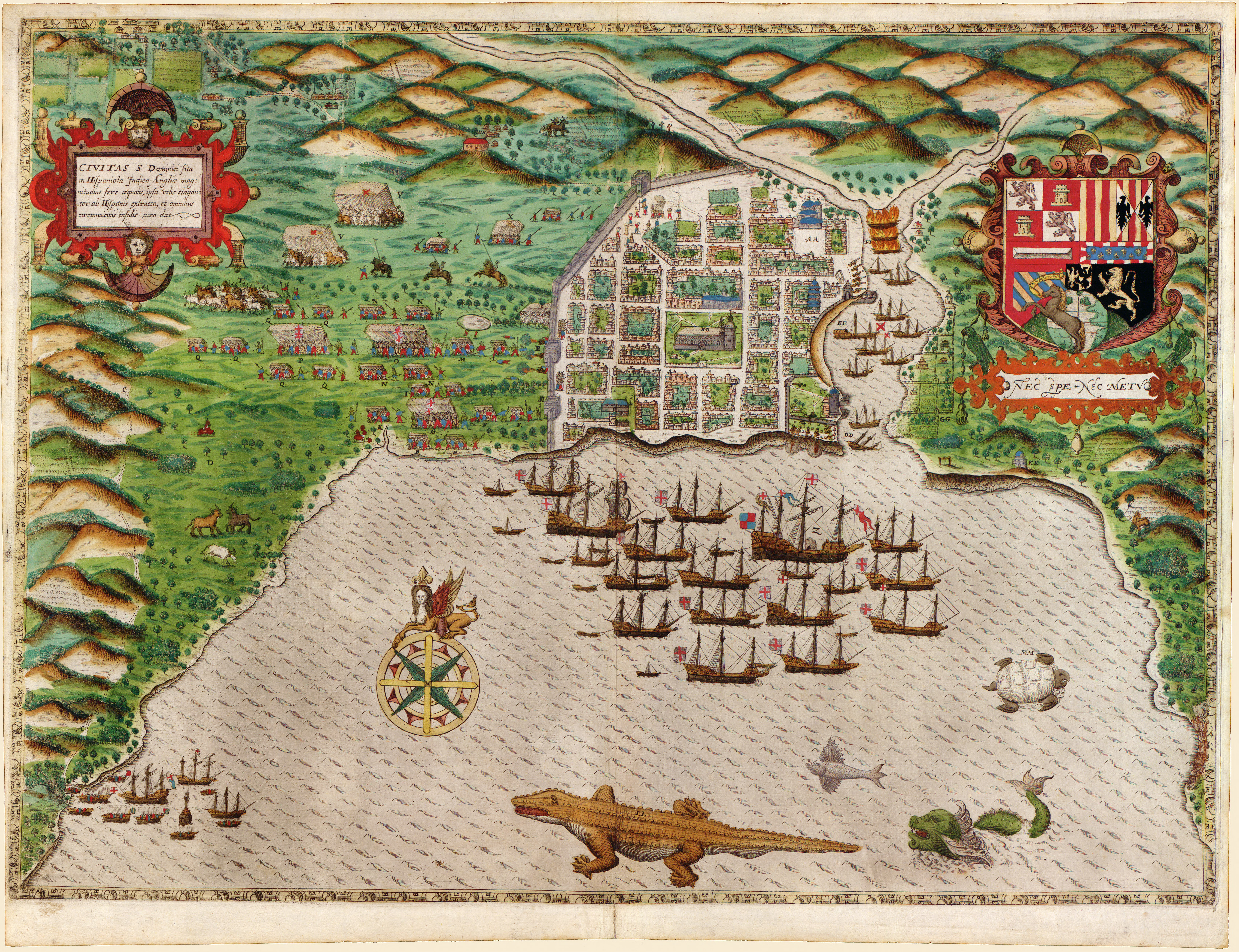
Battle of Santo Domingo (1586)
They came out of the jungle with standards flying and music playing. On New Year's Day 1586, while Drake's ships fired on the harbor fortress as a diversion, Lieutenant-General Christopher Carleill led 800 English soldiers through the dense vegetation west of Santo Domingo and emerged on the Spanish flank in two neat columns of a thousand men. The garrison had marched out to face a seaborne landing that never came. By the time they realized the real attack was behind them, the oldest European city in the Americas was already falling.
Elizabeth's Gambit
The raid on Santo Domingo was a calculated act of war disguised as piracy. After Philip II of Spain effectively declared hostilities following the Treaty of Nonsuch - Elizabeth I's pledge of military support to the Protestant Dutch rebels - the queen's spymaster Francis Walsingham ordered Drake to strike the Spanish New World in a preemptive campaign. Drake sailed from Plymouth in the autumn of 1585, first attacking Vigo in Spain, where he held the port for two weeks and ransomed supplies. He then struck Santiago in the Cape Verde Islands before crossing the Atlantic. Santo Domingo was not a random target. It was the capital of Spain's entire New World empire, seat of the Audiencia, and symbol of Spanish dominion in the Caribbean. Its fortifications included the Fortaleza Ozama, whose Torre de Homenaje had watched over the harbor since the early 1500s. Governor Cristobal de Ovalle commanded nearly 1,500 men, including 100 cavalry and artillery batteries covering both land and sea approaches.
Through the Gates at the Push of Pike
Drake's plan relied on misdirection. His ships anchored just within artillery range and opened fire on the castle, drawing the Spanish garrison out toward the shore. Meanwhile, Carleill's columns advanced through the jungle unseen. When the English burst from the treeline on the Spanish right flank, Ovalle scrambled to reposition. His cavalry attempted to screen the retreat using a herd of cattle as cover - an improvisation that failed spectacularly when Carleill's pikemen and musketeers formed up on every side and the terrified animals bolted into the jungle. Within half an hour, the landing party had reached the western walls. The defenders were down to roughly 300 men, most without firearms. Carleill split his force: Sergeant-Major Powell stormed the secondary gate while Carleill himself charged the main Lenba gate. Both columns broke into a run, fighting through at the push of pike. They did not stop until they met each other in the Plaza.
A Month of Fire and Negotiation
With Santo Domingo in English hands, Drake set up his headquarters in the Cathedral of Santa Maria la Menor - the oldest cathedral in the Americas, which he spared from the looting that consumed the rest of the city. Churches were ransacked, ornaments stolen, statues and windows smashed, religious tapestries torn down. Public buildings and private homes were stripped of anything valuable, though the Audiencia's treasury yielded only 16,000 gold ducats, a disappointment for a city that was supposed to be Spain's richest. Drake demanded one million ducats in ransom. Juan Malarejo, the head of the city's judiciary, stalled. In response, Drake began burning civic buildings and churches one by one, then set his exhausted sailors to demolishing the city's stone buildings by hand. Malarejo held firm through weeks of escalating destruction, eventually settling on 25,000 ducats - a fraction of Drake's demand but all the city could produce.
The Messenger's Murder
The ransom negotiations took a dark turn when Drake sent a delegation to the Spanish camp, accompanied by a young Black boy who had been freed from slavery and had joined the English. The Spanish, taking his presence as an insult, stabbed and killed him. Drake's reaction was immediate and brutal: he ordered Spanish prisoners executed in reprisal until the murderer was found and delivered, dead or alive. The Spanish complied, bringing the guilty man to the English and hanging him publicly before the city walls. The incident revealed the volatile intersection of racial violence, the politics of slavery, and the thin veneer of chivalric convention that governed sixteenth-century warfare. The ransom was finally paid in the last days of January.
Ruins and Reputation
On February 1, the English sailed away after exactly one month of occupation. They left behind a city in ruins - a full third of Santo Domingo had been destroyed, and every civic, military, and religious building lay damaged or demolished. Drake departed with over 20 captured or burned ships, 240 guns, quantities of merchandise, and scores of liberated galley slaves who joined his crews. He renamed the largest prize, a 600-ton armed merchant ship, the New Year's Gift. Garcia Fernandez de Torrequemada, the royal factor on Hispaniola, wrote to King Philip with grim fatalism: 'This thing must have had divine sanction, as punishment for the people's sins.' Pope Sixtus V offered his own assessment of Drake: 'God only knows what he may succeed in doing.' Santo Domingo would take decades to recover. For Spain, the loss was less about treasure than about prestige - the capital of the New World had fallen in a single afternoon. Drake sailed south toward Cartagena de Indias, where he would do it all again.
From the Air
Santo Domingo's colonial core sits at approximately 18.47N, 69.88W along the western bank of the Ozama River where it meets the Caribbean. The Fortaleza Ozama and the Torre de Homenaje are still standing and visible from low altitude as a stone fortification complex at the river mouth. The Cathedral of Santa Maria la Menor is located in the Zona Colonial a few blocks west. Las Americas International Airport (MDSD) lies 15 nautical miles to the east. From 3,000 feet over the harbor, the layout of Drake's assault is legible: the harbor entrance where his ships fired, the western approach through what was once jungle, and the old city walls.