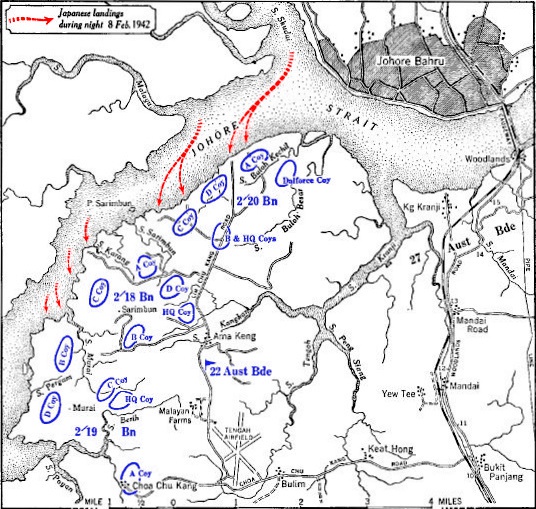
Battle of Sarimbun Beach
At 10:30 on the night of February 8, 1942, Australian machine-gunners along Singapore's northwestern shore opened fire on dark shapes moving across the Straits of Johor. The shapes were boats, hundreds of them, carrying the first wave of 4,000 Japanese soldiers toward Sarimbun Beach. What followed was not a battle so much as a slow unraveling. The defenders had been spread too thin across too wide a front, their commander had guessed wrong about where the blow would fall, and the mangrove swamps that were supposed to slow the attackers became the very channels through which they slipped behind the defensive line. By dawn, the 22nd Australian Brigade had been shattered, and the fall of Singapore had begun in earnest.
The Wrong Guess
Lieutenant-General Arthur Percival, commanding all Allied forces on Singapore, had to defend an entire island coastline with insufficient troops. He assigned the northwestern sector, widely considered the most likely Japanese landing zone, to Major-General Gordon Bennett's two brigades from the 8th Australian Division. Brigadier Harold Taylor's 22nd Australian Infantry Brigade drew Sarimbun Beach itself, a stretch of mangrove swamp and tropical forest broken by rivers and creeks. They were joined by the Jind Infantry Battalion of the Indian States Forces, guarding Tengah Airfield inland, and a company of Dalforce, a guerrilla militia recruited from Singaporean Chinese. But Percival hedged his bets. He withheld reserves, apparently expecting the main Japanese thrust to come from the northeast, closer to the Causeway. The 22nd Brigade was left to hold a front far wider than its numbers justified, with the 2/4th Machine Gun Battalion parceled out among infantry units that needed every gun they could get.
A Night in the Mangroves
The Japanese 5th and 18th Divisions, under Lieutenant-General Tomoyuki Yamashita, crossed the strait in assault boats and barges. Australian gunners raked the water, but in the darkness it was impossible to stop every vessel, and the Japanese possessed crushing superiority in artillery, tanks, and aircraft. They found the gaps that the thinly-spread defenders could not cover: small rivers, tidal creeks, the labyrinth of mangrove channels that threaded the coast. By midnight, the two Australian brigades had lost radio contact with each other. The 22nd Brigade, fighting blind, began pulling back in confusion. At one in the morning, more Japanese troops landed, and the last Australian reserves were committed to the fight. There were no more to send.
Half a Battalion Gone by Dawn
When light broke on February 9, the scale of the disaster became clear. The 2/18th Australian Infantry Battalion, holding the center of the line, had lost more than half its men. On the right flank, the 2/20th Battalion was locked in close combat. On the left, the 2/19th Battalion was being outflanked, and only "B" Company remained to face the full weight of Japanese landings on its stretch of beach. These were soldiers fighting not for victory but for time, and the time was running out. Percival finally ordered reinforcements forward, but only after Tengah Airfield was directly threatened. British and Indian infantry arrived to find the Australian and Singaporean defenders already in retreat toward the Jurong Line, a defensive position stretching south from the village of Bulim. Tengah Airfield fell to the Japanese by midday.
Too Little, Too Late
After dark on February 9, three British Fairmile B motor launches made a daring raid up the western channel of the Straits of Johor, threading between enemy-held shores on both sides. They attacked Japanese landing craft and pressed almost as far as the Causeway before turning back with minimal damage. A few enemy barges were sunk. Allied soldiers who witnessed the raid saw it as proof of what aggressive tactics might have achieved had they been employed earlier and in greater force. Instead, the motor launch sortie became a footnote to a defeat. Singapore would surrender on February 15, one week after the landings at Sarimbun Beach, in what Winston Churchill called the worst disaster in British military history.
What the Beach Remembers
Sarimbun Beach today lies in Singapore's quiet northwestern corner, near the reservoir that now bears its name. The mangrove forest has regrown. The creeks that Japanese soldiers used to infiltrate the defensive line still empty into the Straits of Johor. There are no dramatic monuments here, no towering memorials. The area is better known for its nature reserves than its wartime past. But the ground remembers what happened: Australian soldiers from the other side of the world, Indian troops from the princely states, Chinese guerrillas from the neighborhoods of Singapore, all thrown together in a defense that their own commanders had failed to properly support. The battle lasted barely eighteen hours. Its consequences lasted years.
From the Air
Located at 1.44N, 103.70E on the northwestern coast of Singapore Island, near Sarimbun Reservoir. The Straits of Johor, roughly 1 km wide at this point, separate Singapore from Malaysia to the north. Tengah Air Base (WSAG), the former Tengah Airfield that was the Japanese objective, lies approximately 3 km to the southeast. Seletar Airport (WSSL) is about 15 km to the east. The coastline of mangrove forest and tidal creeks is clearly visible at lower altitudes. Best viewed at 2,000-4,000 ft AGL heading northwest along the coast.