Battle of Seattle (1856)
The city that would become the tech capital of the Pacific Northwest nearly died in its cradle. On the morning of January 26, 1856, Seattle was a four-year-old settlement of scattered wooden cabins and stumps, home to a few hundred souls who had recently -- and with considerable presumption -- named their town after Chief Seattle (Sealth), the leader of the Suquamish and Duwamish peoples whose ancestral land they occupied. That morning, a coalition of Native American warriors opened fire on the settlement from the dense forest east of town. What saved Seattle was a warship. The USS Decatur, a Navy sloop-of-war, lay at anchor in Elliott Bay with sixteen 32-pounder cannons trained on the treeline. The battle that followed lasted seven hours and decided whether Seattle would survive its infancy.
A Territory on Fire
The attack did not come from nowhere. The broader Puget Sound War of 1855-1858 had been simmering for months, fueled by Territorial Governor Isaac Stevens's aggressive treaty-making that demanded tribes cede vast swaths of their homeland. Fighting had already broken out in southern King County and Thurston County. The Nisqually leader Leschi -- later blamed for orchestrating the Seattle attack, though he denied involvement and called the assault foolish -- had been resisting settler encroachment with increasing force. Settlers on scattered forest claims lived in denial, many refusing to believe the tribes would actually strike their settlement. The volunteer militia that was supposed to defend the town had disbanded and re-formed multiple times, its members declaring they would not serve as long as the Decatur sat in the harbor to protect them. Seattle was, by any measure, dangerously unprepared.
Seven Hours Under Fire
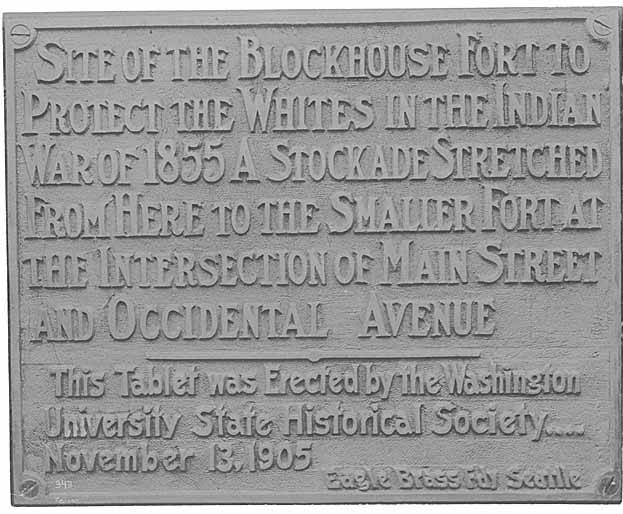
The shooting began early on the 26th, gunfire erupting from the thick timber that pressed against the settlement's eastern edge. Settlers scrambled for the blockhouse. The Decatur, commanded by Guert Gansevoort, responded with devastating broadsides -- heavy shells crashing into the forest where the warriors had positioned themselves. The first fatality was grimly ironic: Jack Drew, a deserter from the Decatur itself, was shot dead by fifteen-year-old Milton Holgate when Drew tried to climb through a cabin window and was mistaken for an attacker. For seven hours, roughly 160 defenders endured what one officer described as an almost uninterrupted storm of bullets. Lieutenant Thomas Phelps, who chronicled the battle, called the low settler casualties "incredible" and "miraculous." One or two additional settlers died. The native casualties remain uncertain -- Phelps claimed to have personally witnessed ten men killed by a single shell, and the warriors later acknowledged 28 dead and 80 wounded, though their women reportedly hid the bodies beyond discovery.
The Aftermath and the Hanging
News of the attack spread fast. By four in the afternoon, word had reached Bellingham. The next day, the steamer Active arrived in Elliott Bay with Governor Stevens aboard, who was, in Phelps's acid words, "at last compelled to acknowledge the presence of hostile Native forces in the Territory." Stevens had long minimized the threat. When scouts visited Leschi's camp days later, they counted roughly 150 warriors, nearly all from west of the Cascades. The battle's failure to overwhelm the settlement -- despite numerical superiority of perhaps 500 to 1,000 warriors against roughly 100 defenders -- exposed the limits of uncoordinated attacks against positions backed by naval artillery. The consequences fell hardest on Leschi. Despite his claims that he had not participated in the Seattle attack, he was tried and convicted of murder. After a year-long defense -- argued in part by Bing Crosby's grandfather, H.R. Crosby -- Leschi was hanged at Fort Steilacoom on February 19, 1858. In 2004, the Washington State Historical Court posthumously exonerated him.
The City That Almost Wasn't
Seattle lore loves the Battle of Seattle for its improbable footnotes. Decades after the fighting, the city's future fire chief, Gardner Kellogg, was excavating the foundation of his house when he unearthed an unexploded shell from the Decatur. He wedged it beneath a stump he was trying to burn out and went to lunch. While he was gone, banker Dexter Horton stopped by to warm himself at the fire. The shell detonated, and Horton nearly became the battle's last casualty. The story captures something essential about early Seattle -- a place where danger was always one misstep away, where the line between catastrophe and comedy was a matter of timing. The settlement that nearly fell to the warriors' assault would grow into a city of millions. But on that January morning in 1856, Seattle's survival hung on sixteen cannons and an anchored warship, a reminder that the city's origin story is inseparable from the dispossession of the peoples who named it.
From the Air
Located at 47.60°N, 122.32°W on the eastern shore of Elliott Bay, now downtown Seattle. The battle site encompasses the area around what is today Pioneer Square and the original settlement, visible as the cluster of older low-rise buildings south of the modern downtown towers. Elliott Bay, where the USS Decatur was anchored, stretches west from the waterfront. The dense forest the attackers fired from is long gone, replaced by the Capitol Hill and First Hill neighborhoods ascending the ridge to the east. Nearest airport: Boeing Field/KBFI, 2nm south. Seattle-Tacoma International (KSEA) is 10nm south. Look for the waterfront piers and the ferry terminal at Colman Dock for orientation.