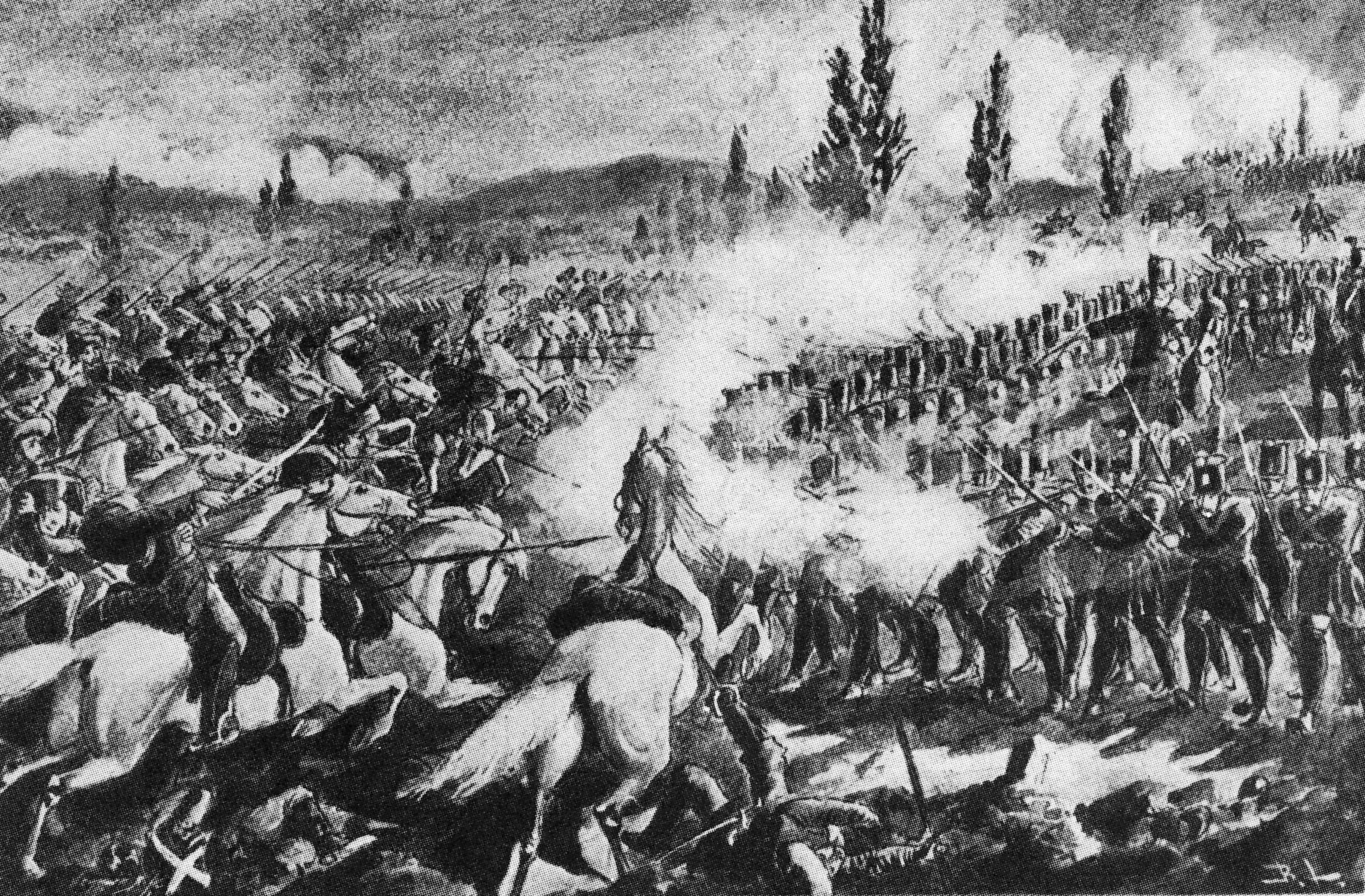
Battle of Segesvár
Sándor Petőfi was twenty-six years old, a poet who had helped ignite a revolution, and on the afternoon of July 31, 1849, he disappeared. Somewhere in the fields and woods near Fehéregyháza, outside the Transylvanian town of Segesvár -- modern Sighișoara -- the young man who had written Hungary's rallying cry for freedom walked into battle and was never seen again. No body was recovered. No grave was marked. His vanishing became one of Hungarian history's most enduring mysteries, layered onto a battle that was itself a study in doomed courage: a Polish exile commanding outnumbered Hungarian revolutionaries against the full weight of the Russian Empire.
A General Without Reinforcements
Lieutenant General Józef Bem was a Polish officer who had already fought in one failed revolution -- Poland's November Uprising of 1830 -- before throwing himself into Hungary's war of independence against the Austrian Empire. By the summer of 1849, Bem had become the most effective Hungarian commander in Transylvania, chasing the Austrian corps of General Eduard Clam-Gallas from Székely Land and even crossing the Ojtoz Pass into Moldova, where he defeated Russian troops and advanced to Onești and Târgu Ocna. But when the local population showed no willingness to rise against the Russians, Bem turned back. His plan was to recapture Nagyszeben and the Vöröstorony Pass by concentrating forces from multiple directions: his own column from Segesvár, Colonel Farkas Kemény's detachment of nearly 2,918 soldiers, and Lieutenant Colonel Károly Dobay's force of approximately 1,000. Neither reinforcement arrived in time.
The Afternoon at Fehéregyháza
On July 31, 1849, Bem's Hungarian forces met the Russian V Corps under General Alexander von Lüders near the village of Fehéregyháza. Legend holds that Bem personally guided the cannon shot that killed the Russian Chief of Staff, General Grigory Skariatin -- though the Hungarian historian Róbert Hermann has pointed out that the cannons of the era lacked such precision, and aiming from horseback was impossible. What is certain is that Lüders read the battlefield shrewdly. Observing that Bem had strengthened his left wing at the expense of his right, the Russian general sent Jäger companies and light batteries to press the weakened flank. By late afternoon, four Uhlan cavalry companies were charging the Hungarian right wing. At five o'clock, Russian artillery found and destroyed Bem's two ammunition wagons -- a catastrophic loss for an already outgunned force.
Broken Swords and Last Bullets
The collapse came quickly. Near a bridge in the village, retreating Hungarian artillery horses turned too sharply on the main road, overturning the guns and blocking the only escape route. Lieutenant Dénes Kozma of the 88th battalion gathered thirty-five men behind the improvised barricade of wrecked cannons and fired three volleys that drove back the Uhlan cavalry attempting to pour into the village. Kozma retreated, then stopped twice more in front of a village tavern, holding the Russian horsemen at bay each time. Elsewhere on the field, the nobleman Domokos Zeyk fought until his sword broke. Drawing his pistol, he shot one Russian soldier, then turned the weapon on himself. These acts of individual defiance could not reverse the outcome. The battle was lost, and with it, any realistic hope of holding Transylvania.
The Poet Who Never Came Home
Petőfi had been serving as an aide-de-camp to Bem, the general he admired above all others. After the battle, he simply vanished. Theories have multiplied across nearly two centuries: killed in the fighting and buried in an unmarked mass grave, captured and deported to Siberia, escaped and living under an assumed identity. None has been conclusively proven. What is known is that his body was never identified despite repeated searches and excavations. In the following days, Russian and Austrian forces swept across Transylvania. Within a week, the province had fallen. The Hungarian Army of Transylvania had lost roughly 75 percent of its soldiers during the six weeks since the Russian intervention began. Yet Bem had accomplished his strategic purpose -- keeping the invading armies occupied in Transylvania and away from the main theater of war in Hungary proper. An obelisk and a statue of Petőfi now stand at Fehéregyháza, marking the place where a revolution's voice fell silent.
From the Air
The battlefield sits at approximately 46.236°N, 24.846°E, in the Târnava Mare river valley near Sighișoara, Romania. From 3,000-5,000 feet AGL, the rolling hills and agricultural fields around Fehéregyháza (modern Albești) are visible south of the medieval walled town. The Petőfi memorial obelisk stands in open fields. The nearest airport is Târgu Mureș International Airport (LRTM), approximately 28 nm northwest. Terrain is hilly with elevations around 1,000-1,500 feet MSL. Weather is continental with good visibility in summer months.