Battle of Sekigahara
A Prussian general named Jakob Meckel once studied the troop positions at Sekigahara and concluded that the Western Army, with superior numbers and higher ground, should have won. He refused to believe otherwise until a Japanese staff officer walked him through what actually happened. What happened was not primarily a military victory. It was a masterpiece of political manipulation, a battle decided less by swords than by letters written in the weeks before, promises whispered in secret, and loyalties that crumbled the moment steel met steel. On October 21, 1600, in a narrow valley in Gifu Prefecture where mountains funnel toward the old Nakasendo road, roughly 160,000 samurai collided in what became the most consequential two hours in Japanese history.
The Red Devils Open Fire
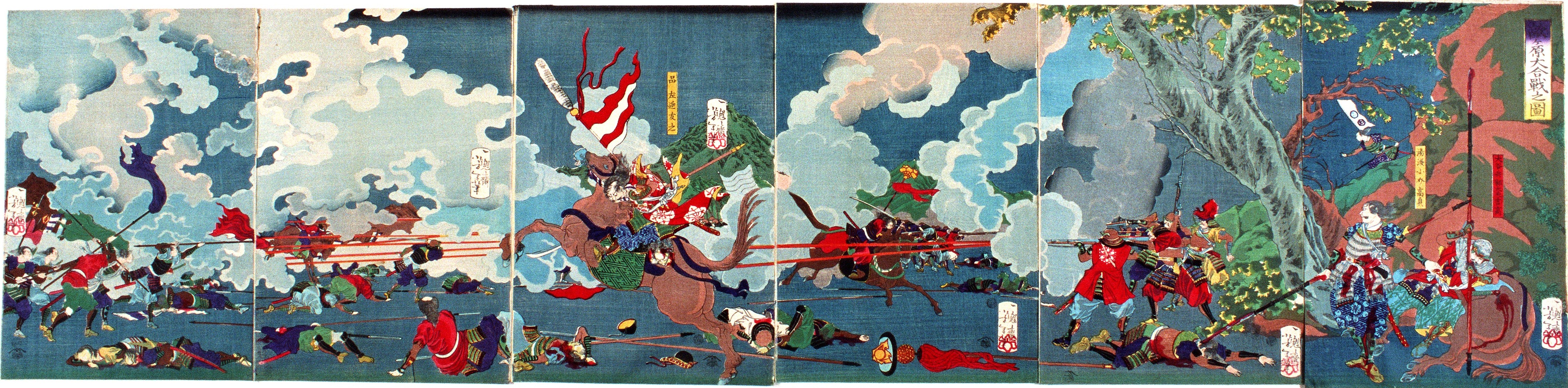
The battle began when Ii Naomasa, commander of the feared Ii no Akazonae, 3,600 warriors clad entirely in crimson armor, charged forward with 30 spearmen into the Western Army's center. Fukushima Masanori's forces followed immediately, engaging the troops of Ukita Hideie. The fighting rapidly became a deadlock. The chronicler Ota Gyuichi, who witnessed the battle firsthand, wrote that friends and foes pushed against each other while gunfire thundered and hails of arrows flew across the sky. The Tokugawa forces even deployed 19 cannons salvaged from a Dutch trading ship. But this was merely the visible battle. The real struggle was unfolding on the hillsides above, where commanders on both sides calculated which way the wind was blowing, not meteorologically but politically.
The Traitor on the Mountain
The pivotal figure at Sekigahara never committed fully to either side until it was almost too late. Kobayakawa Hideaki, nephew of the late Toyotomi Hideyoshi, had positioned his 15,000 troops on Mount Matsuo overlooking the battlefield. He had secretly agreed to defect to the Tokugawa, but as the battle raged below, he hesitated. The traditional account holds that Ieyasu, growing impatient, ordered his arquebusiers to fire at Hideaki's position to force a decision, though modern Japanese historians like Jun Shiramine argue that Hideaki had already defected before the battle even started, and the famous shots may be Edo-period embellishment. Whatever the truth, when Hideaki's forces finally swept downhill, they struck the Western Army from behind. The chronicler of the Nakatomi Yuhan-ki recorded the moment: the armies of the Western coalition had the upper hand, until Kobayakawa Hideaki betrayed them and attacked from behind with over 15,000 men. Hideaki's defection triggered a cascade. Wakisaka Yasuharu, Ogawa Suketada, Akaza Naoyasu, and Kutsuki Mototsuna all switched sides. The Western Army's formation shattered.
Two Hours That Forged an Empire
Otani Yoshitsugu, one of the few Western commanders who had anticipated Hideaki's betrayal, fought desperately against the turncoat forces but was overwhelmed. He committed suicide on the field. Shima Sakon, another Western general, was fatally shot by an arquebus round while battling Kuroda Nagamasa's flanking forces. Shimazu Yoshihiro's Satsuma troops found themselves completely encircled and fought their way out in a brutal breakout that left only 200 survivors from the entire contingent. Ii Naomasa himself was shot and incapacitated while pursuing the retreating Shimazu. The entire battle, historian Ando Yuichiro has calculated, lasted a mere two hours, from ten in the morning to noon. This timing comes from Ieyasu's own letter written that same day to Date Masamune. Meanwhile, 38,000 Eastern Army reinforcements under Tokugawa Hidetada never arrived, bogged down in the Siege of Ueda against Sanada Masayuki. They were not needed.
A Political Victory
Ieyasu's triumph was less about martial prowess than about reading men. As University of Tokyo researcher Kazuto Hongo has noted, Sekigahara was essentially a political victory rather than a military one. Mitsunari had fatally overestimated the loyalty his coalition would command. Even his close ally Otani Yoshitsugu had warned him before the battle: you are hated by the daimyo, and if you raise an army, those who sued you last year will become your enemies. The aftermath was swift and merciless. Ieyasu redistributed domains worth 6.8 million koku, rewarding allies and stripping roughly 87 daimyo of their lands. Ishida Mitsunari, Konishi Yukinaga, and Ankokuji Ekei were captured and executed on November 6. In 1603, Ieyasu was appointed shogun by Emperor Go-Yozei, inaugurating the Tokugawa shogunate that would govern Japan for the next 260 years.
The Battlefield Remembers
In 1931, the Sekigahara battlefield was registered as a Monument of Japan. Today the valley where those two decisive hours played out lies quiet beneath the mountains of western Gifu Prefecture, the positions of Ieyasu and Mitsunari's armies, and the site of Otani Yoshitsugu's death, all marked with stone monuments. The battle has been retold in Ryotaro Shiba's 1966 novel, James Clavell's Shogun, and the 2024 television adaptation that introduced the story to a new global audience. Yet the most telling tribute may be Tachibana Muneshige's response when his retainer urged him to join the Eastern Army because the Western side could not win. Muneshige replied that he did not care about winning or losing. He chose loyalty over pragmatism and lost everything. Most of the daimyo at Sekigahara made the opposite calculation.
From the Air
Located at 35.37N, 136.46E in Sekigahara, Gifu Prefecture, in a valley between mountains along the old Nakasendo road. The battlefield area is identifiable by the open valley floor surrounded by hills, now marked with monuments. The Tokaido Shinkansen passes nearby. Nearest airports: RJNA (Nagoya Airfield/Komaki, ~45 nm east), RJOO (Osaka/Itami, ~70 nm southwest). Best viewed at 3,000-5,000 ft AGL to appreciate the strategic terrain and mountain passes that channeled the armies. Clear weather recommended for seeing the monument markers.