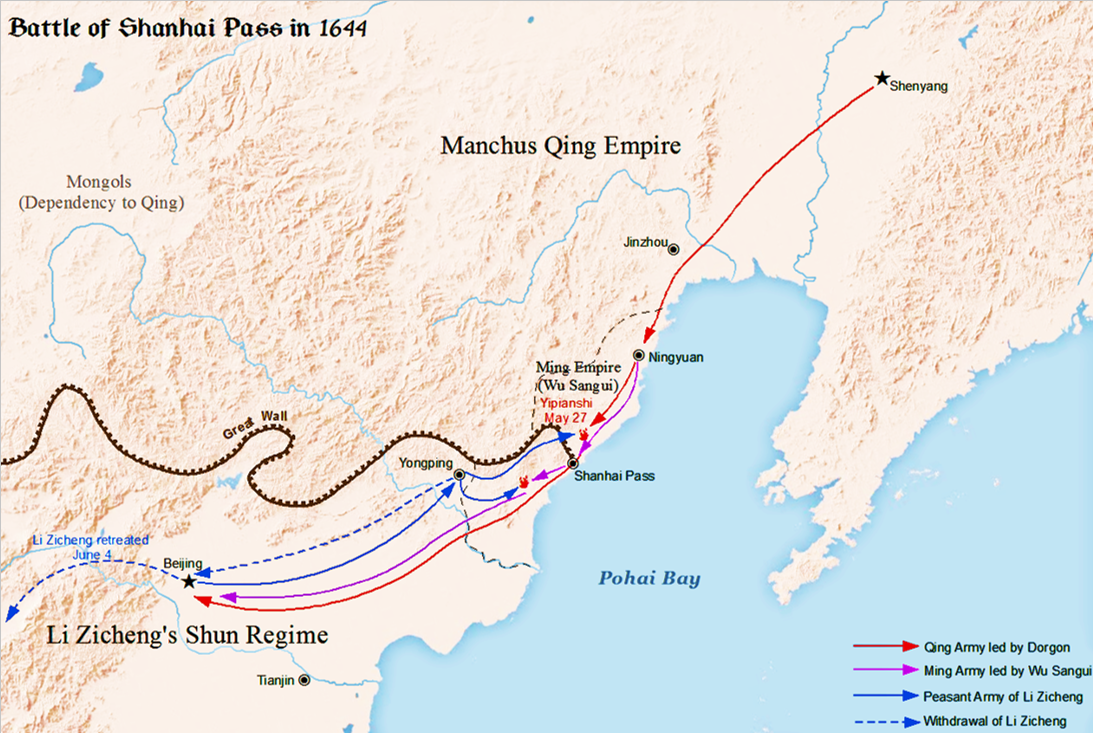
Battle of Shanhai Pass
On June 5, 1644, the elders and officials of Beijing dressed in their finest robes and walked out through the city gates to welcome their liberators. They expected to greet Wu Sangui, the Ming general who had defeated the rebel army that sacked their capital. They expected to see the Ming heir apparent riding at his side. Instead, the man who rode through the gates was Dorgon, prince-regent of the Manchu Qing dynasty -- a foreign conqueror whom no one in Beijing had invited and few had even considered. The elders' shock was the hinge on which Chinese history turned. Everything that led to that moment had happened in a compressed, violent spring at a fortified pass where the Great Wall meets the sea.
An Emperor Hangs Himself at Dawn
The Ming dynasty had been dying for decades, but the end, when it came, took only hours. In February 1644, a former postal worker named Li Zicheng declared himself king of a new dynasty -- the Shun -- in Xi'an. His peasant rebel army swept northeast through Shanxi, gathering strength as it moved. By late April, Li's forces reached Beijing's suburbs. Rather than assault the walls, Li sent a captured eunuch to negotiate the emperor's surrender. The Chongzhen Emperor refused. On April 24, a sympathetic eunuch opened a city gate from inside, and the rebels poured through. The next morning, the last Ming emperor to rule from Beijing walked to Jingshan Hill behind the Forbidden City, tied a silk cord to a tree, and hanged himself. He was thirty-three years old. The dynasty his ancestors had built over 276 years was finished.
The General Between Two Fires
Wu Sangui commanded 40,000 to 50,000 battle-hardened troops at Ningyuan, north of the Great Wall -- the last major Ming army between the Manchu Qing forces in Manchuria and the Chinese heartland. When the emperor's desperate call for help reached him, Wu marched south through Shanhai Pass and was halfway to Beijing when word arrived that the capital had fallen and the emperor was dead. He turned around. Now Wu faced an impossible position: Li Zicheng's rebels to his west, the Manchu armies to his northeast, and no emperor to serve. Li sent envoys offering generous terms if Wu would submit to the Shun dynasty. Wu initially seemed willing -- until he learned that Li's men had seized his father as a hostage and, according to tradition, taken his concubine Chen Yuanyuan. Whether driven by personal rage or cold strategic calculation, Wu chose the option that would define the rest of Chinese history. He sent messengers to the Manchu prince-regent Dorgon, proposing an alliance against the rebels.
One Hundred Fifty Kilometers in Twenty-Four Hours
Dorgon recognized the opportunity of a lifetime. His Han Chinese advisors, Hong Chengchou and Fan Wencheng, urged him to claim the Mandate of Heaven -- the cosmic authorization to rule that Chinese political theory granted to legitimate sovereigns. On May 14, Dorgon led the Qing Grand Army out of Mukden. When he received confirmation that Wu Sangui had accepted an alliance, he force-marched his troops toward Shanhai Pass, covering more than 150 kilometers in a single day and night. His soldiers arrived on May 26, settled eight kilometers from the pass, and were allowed a few hours of sleep before being woken at midnight to continue. Meanwhile, Li Zicheng had personally led 60,000 troops out of Beijing to destroy Wu's army. By May 25, the rebel forces were deployed along the Sha River, just a few kilometers west of the Shanhai Pass fortifications. Li watched from a nearby hilltop, two captive Ming princes at his side.
Dust Storm and Cavalry Charge
On May 27, the battle began. Wu Sangui's troops engaged Li Zicheng's rebels in fierce fighting west of the pass, suffering heavy casualties as they struggled to break the rebel line. Dorgon held his Manchu cavalry in reserve behind the walls, waiting. The exact moment of their entry into the battle is debated by historians, but the effect is not: the Qing cavalry struck Li's army from the flank at a critical moment, shattering his formations. A dust storm reportedly blew sand into the faces of the rebel troops, blinding them as the Manchu horsemen charged. By evening, Li's army was in full retreat. He fled east to Yongping, then back to Beijing, where he arrived on May 31 and allowed his troops to loot the capital's official buildings. On June 3, in what historians call a final gesture of defiance, Li formally declared himself Emperor of the Great Shun. The next day, he set the imperial palaces on fire and fled west. He had held Beijing for forty-two days.
The Price of the Alliance
Wu Sangui got his victory but lost everything else. Dorgon raised him from Earl to Prince the day after the battle, and Wu's troops shaved their foreheads and braided their remaining hair into the Manchu queue -- the visible mark of submission to Qing authority. When Beijing's population discovered that their deliverers were Manchu conquerors rather than Ming loyalists, the implications settled slowly but irrevocably. A six-year-old boy named Fulin was enthroned as the Shunzhi Emperor on November 8, 1644, inaugurating Qing rule that would last until 1912. Li Zicheng was killed the following year, either by his own hand or by a peasant militia. Wu Sangui spent decades as a Qing feudal lord in southwestern China before rebelling against his masters in 1673 -- dying five years later, having served and then betrayed both the dynasty he was born into and the dynasty he helped install. The battle that decided all of it lasted a single day, at a pass where mountains compress the road between two worlds into a corridor barely wide enough for an army to march through.
From the Air
Located at 39.98N, 119.78E at Shanhai Pass, the eastern terminus of the Great Wall of China in Hebei Province. From altitude, the pass is visible where the Yan Mountains meet the Bohai Sea coast, with the Great Wall running along ridgelines to the northwest. The Sha River west of the pass was the main battlefield. Nearest airport is Qinhuangdao Beidaihe Airport (ZBQD). The Liaoxi Corridor -- the narrow coastal plain between mountains and sea -- is clearly visible from altitude as the strategic choke point that made this location so consequential.