Battle of Shiloh
Sherman found Grant standing under a tree in the rain, past midnight on April 6, 1862. The day had been catastrophic. Grant's army had been surprised at Pittsburg Landing, driven back from their camps, nearly pushed into the Tennessee River. Seven thousand men were killed or wounded, three thousand captured, and ten thousand more had simply refused to fight, huddling under the bluffs at the river's edge. Sherman, himself wounded twice with three horses shot from under him, approached his commander. "Well, Grant, we've had the devil's own day, haven't we?" Grant, chewing an unlit cigar in the downpour, replied: "Yes. Lick 'em tomorrow, though."
The Hornet's Nest and the Gathering Dark
By sundown on April 6, the Confederate army under Generals Albert Sidney Johnston and P.G.T. Beauregard had shattered the Union camps around Shiloh Church and Pittsburg Landing in southwestern Tennessee. Johnston himself was dead -- shot in the leg during the assault, he bled out in his boot when no one applied a tourniquet. Beauregard took command of an army that had already suffered 8,000 casualties. Confederate soldiers, many armed with better weapons scavenged from dead or fleeing Union troops -- Austrian, Enfield, and Springfield rifles replacing their own inferior muskets -- believed the battle was essentially won. Some stopped to plunder the abandoned Union camps. Others took their loot and simply walked back toward Corinth, Mississippi. No orders were issued for the next day. The plan, such as it was, called for a "final mop-up action" at dawn.
Reinforcements in the Storm
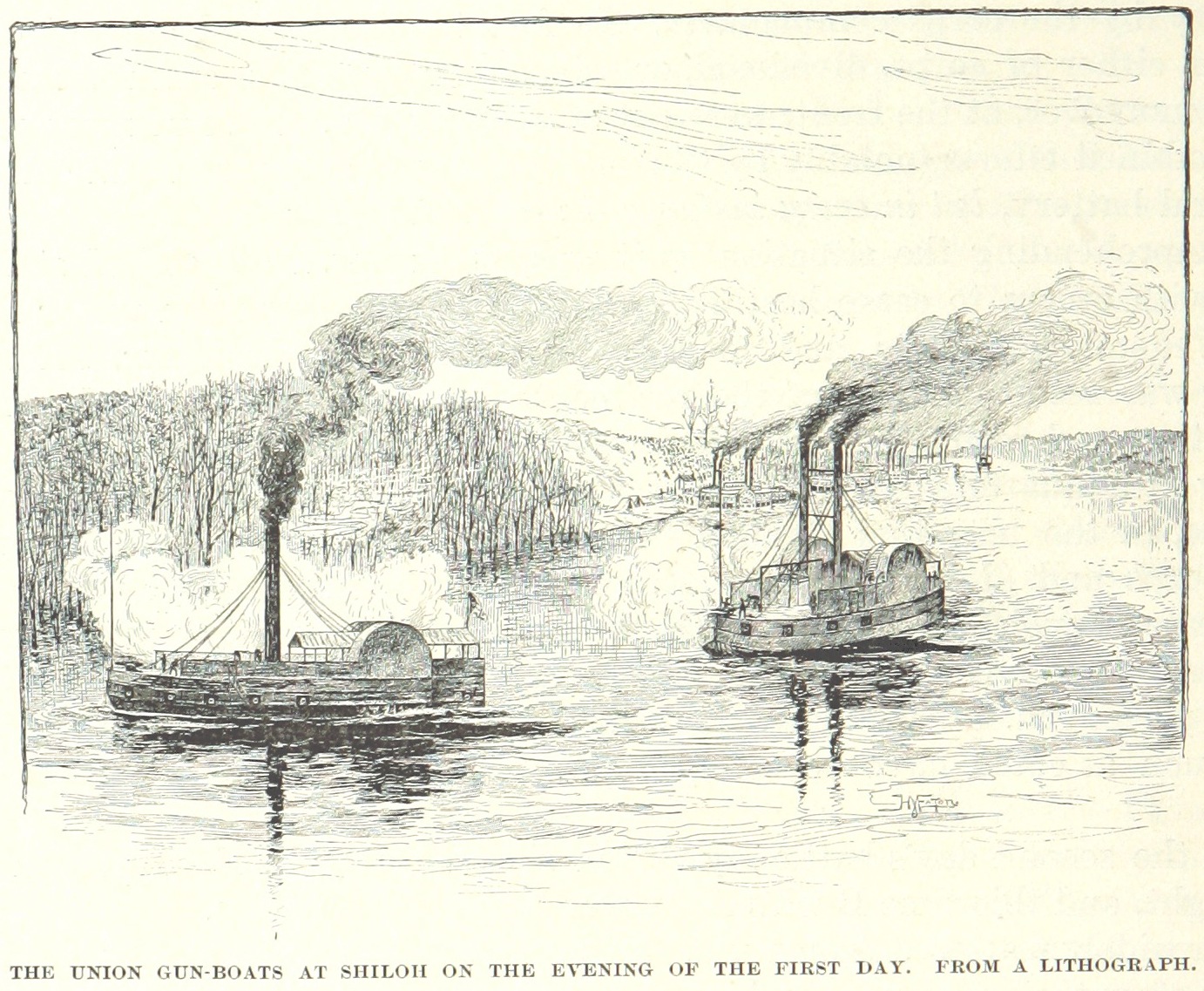
What Beauregard did not know was that Grant's situation was already changing. At 7:15 PM, Lew Wallace's division of 5,800 fresh troops finally reached the battlefield after a daylong march plagued by confusion over which road to take -- a controversy Wallace would spend decades trying to explain. More critically, Don Carlos Buell's Army of the Ohio was arriving by steamboat at Pittsburg Landing. Thomas Crittenden's division came ashore at 9:00 PM, and by the early hours of April 7, Buell had nearly 18,000 men ready to fight. Alexander McCook's division arrived between midnight and 4:00 AM. The Confederates received exactly one reinforcement: the 47th Tennessee Infantry, 600 raw recruits so poorly armed they did not reach the field until 8:00 AM. Combined with the rain that began at 10:00 PM, the thunderstorm at midnight, and the constant shelling from Union gunboats on the river, the exhausted Confederates got no sleep and no plan.
Lick 'Em Tomorrow
Grant attacked at dawn on April 7. On the east side, Buell's fresh divisions pushed forward against Hardee's disorganized Confederates. On the west, Wallace's men drove Pond's exhausted brigade from Jones Field. Sherman and McClernand joined the advance, and by 10:30 AM four Union divisions were driving south. The Confederates resisted fiercely for six hours -- Beauregard personally led counterattacks near Shiloh Church -- but they were outnumbered and exhausted. By early afternoon, Beauregard realized that the 20,000 reinforcements he had hoped for under Earl Van Dorn were nowhere close. At 1:00 PM, he began preparations to withdraw. Breckinridge's corps formed a rear guard near Shiloh Church while Confederate batteries fired a deception bombardment to mask the retreat. By 3:30 PM, the last Confederate guns were hauled away toward Corinth. Grant and Buell did not pursue -- a decision historians have called the "final Federal blunder."
A Nation Counts Its Dead
The numbers shocked America. Union casualties totaled 13,047: 1,754 killed, 8,408 wounded, 2,885 missing or captured. Confederate losses reached 10,699: 1,728 killed, 8,012 wounded, 959 missing. The combined toll of nearly 24,000 exceeded all previous American battles put together -- Manassas, Wilson's Creek, Fort Donelson, and Pea Ridge combined accounted for only 12,000 casualties. Among the Confederate dead was Samuel B. Todd, half-brother of Mary Todd Lincoln, the president's wife. The carnage forced Northern leaders to abandon any illusion that the war would be short. For the Confederacy, the loss at Shiloh meant the upper Mississippi Valley was slipping beyond reach, and the grinding war of attrition that would ultimately destroy the South had begun.
The General Who Fought
Grant became the target of savage criticism. A newspaper account by Whitelaw Reid, written under a pen name and based largely on testimony from deserters, claimed Union soldiers had been bayoneted in their tents -- a falsehood that stuck. Politicians from Ohio and Iowa, whose constituents had fled the battlefield, demanded Grant's removal. One told Lincoln that Grant was an incompetent drunk and a political liability. Lincoln's reply became legend: "I can't spare this man; he fights." Grant kept his command, went on to capture Vicksburg in 1863, and eventually won the war. Today, the Shiloh National Military Park preserves the ground where America lost its innocence about the cost of civil war. The Bloody Pond, the Hornet's Nest, the Peach Orchard, and Pittsburg Landing are all part of the park. A replica of the original Shiloh Church, built from 150-year-old timber, marks the spot where Beauregard made his last stand before ordering the retreat south.
From the Air
Located at 35.14°N, 88.34°W in Hardin County, southwestern Tennessee, along the west bank of the Tennessee River at Pittsburg Landing. The battlefield park covers thousands of acres of rolling, wooded terrain. The Tennessee River is the primary visual landmark, with the landing area clearly visible from altitude. Savannah-Hardin County Airport (KSNH) is approximately 8nm northeast in Savannah, Tennessee. Pickwick Dam and Pickwick Lake are visible to the south. The terrain is a mix of farmland and forest in the Tennessee River valley, with the river winding prominently through the landscape.